

The Double-Trust Structure: Protect Your Family's Assets From Estate Duty
The Double-Trust Structure: How to Protect Your Family's Assets From Estate Duty in South Africa
Every week, I speak with South African families who have spent decades building something meaningful — a rental property in Soweto, a smallholding in Limpopo, a portfolio of two or three flats in Cape Town — only to discover that when the time comes to pass that wealth on, the taxman is first in line. The double trust structure South Africa families are increasingly turning to may be the single most powerful legal tool available to protect everything you have built. If you have never heard of it, this article could change your family's financial trajectory forever.
The Silent Wealth Destroyer: Estate Duty in South Africa
Let me be direct with you. South Africa's estate duty sits at 20% on the first R30 million and 25% on everything above that — levied against the net value of your estate at death. Add to that the executor's fees (up to 3.5% plus VAT), capital gains tax triggered at death, and possible conveyancing costs, and your family could lose 30% to 40% of the wealth you spent a lifetime building before your children see a single rand.
This is not a problem reserved for the ultra-wealthy. A middle-class family in Johannesburg or Durban who has worked hard to accumulate three or four properties — even modest ones — can find themselves in estate duty territory faster than they realise. Property values have risen dramatically. A house bought in Pretoria East fifteen years ago for R800,000 may now be valued at R2.5 million. Multiply that across a small portfolio and you are looking at a significant tax exposure.
According to SARS, estate duty is one of the most consistently collected taxes in South Africa, and it disproportionately affects families who hold illiquid assets like property — because the estate owes cash while the assets are tied up in bricks and mortar.
"The greatest threat to generational wealth is not a bad investment. It is a good estate with no structure around it." — Dr. Chomba Chuma
What Is the Double-Trust Structure and Why Does It Matter?
The double trust structure — sometimes called a dual trust arrangement — is a legal estate planning strategy that uses two inter-vivos (living) trusts working in coordination to achieve maximum asset protection, minimise estate duty exposure, and facilitate seamless generational wealth transfer. It is entirely legal, SARS-compliant when properly implemented, and has been used by South Africa's wealthiest families for decades.
Here is the core concept in plain language:
- Trust One (the Asset Trust): This trust owns and holds the actual assets — the properties, investments, or business interests. Assets are transferred into this trust ideally early in life, before they appreciate significantly in value.
- Trust Two (the Trading or Loan Trust): This trust acts as the funding mechanism. It holds a loan account or liquid assets and is used to purchase assets from or lend money to the Asset Trust. This trust often has a corporate trustee for additional governance.
The magic lies in how these two trusts interact. By structuring ownership and funding correctly, you can achieve what is known as estate pegging — freezing the value of assets in your personal estate while future growth occurs inside the trust structure, completely outside your taxable estate.
Why Two Trusts Instead of One?
A single family trust offers meaningful protection, but it has limitations. A single trust can still create issues with loan accounts that sit in your personal estate, or with tax attribution rules under Section 7 of the Income Tax Act. The double trust structure addresses these vulnerabilities by separating the funding mechanism from the asset-holding mechanism, creating a cleaner separation of estate and trust interests.
Additionally, having two trusts provides operational flexibility. If one trust faces a legal challenge, litigation, or creditor action, the other remains insulated. This is the kind of structural thinking that separates families who preserve wealth across generations from those who rebuild it every generation.
The Legal Foundation: How South African Trust Law Enables This
South African trust law is governed primarily by the Trust Property Control Act 57 of 1988. Under this framework, a properly constituted trust is a separate legal entity — assets held in trust do not form part of the founder's personal estate for the purposes of estate duty, provided the trust was set up correctly and the founder does not retain effective control in a way that the courts or SARS could deem it a sham.
This is a critical point I cannot overemphasise: the structure must be genuine. Trustees must act independently. Trustee meetings must be held. Resolutions must be documented. The trust must operate as a real entity, not merely as an extension of your personal finances. SARS is increasingly sophisticated in identifying poorly administered trusts, and the consequences of getting this wrong are severe.
For further reading on trust registration and compliance, the South African government's official portal provides access to the Master of the High Court's requirements for trust registration and ongoing administration obligations.
Step-by-Step: Building Your Double-Trust Structure
I want to give you a practical roadmap. This is not a substitute for professional legal and tax advice — you will need a qualified trust attorney and a tax practitioner to implement this correctly. But understanding the steps will help you have the right conversations and make informed decisions.
- Engage a qualified trust attorney and tax advisor: This structure requires bespoke drafting. The trust deeds for both trusts must be carefully written to achieve your specific objectives. Cookie-cutter trust deeds purchased online will not suffice.
- Register both trusts with the Master of the High Court: Each trust must be formally registered, trustees appointed, and Letters of Authority obtained. This process typically takes four to eight weeks per trust.
- Establish the loan account mechanism: The second trust (Loan Trust) typically receives funding — either through a loan from the founder or through contributions — which it then lends to the Asset Trust to acquire properties. This loan account in the Loan Trust is carefully structured to peg estate values.
- Transfer assets or acquire new assets in the Asset Trust's name: Existing properties can be sold to the trust (ideally at current market value to minimise CGT exposure at point of transfer). New properties should be purchased directly in the trust's name. Engage a property conveyancer experienced in trust transactions — see resources at the PPRA for registered professionals.
- Appoint an independent trustee: SARS looks unfavourably on trusts where the founder is the sole trustee and sole beneficiary. An independent trustee — a professional or trusted non-family member — strengthens the legitimacy of the structure.
- Implement ongoing administration protocols: Annual trustee meetings, documented resolutions, separate bank accounts, and proper financial statements are non-negotiable. This is where many families fail — they set up the structure and then treat the trust like a personal account.
- Review the structure every three to five years: Tax law changes. Family circumstances change. Your structure must evolve accordingly. Build in formal review cycles with your advisors.
If you want a comprehensive framework for approaching this as part of a complete legacy-building journey, I invite you to explore our 6-step legacy journey at Mumbi, which walks you through property acquisition, structuring, and wealth transfer in a structured, mentor-supported process.
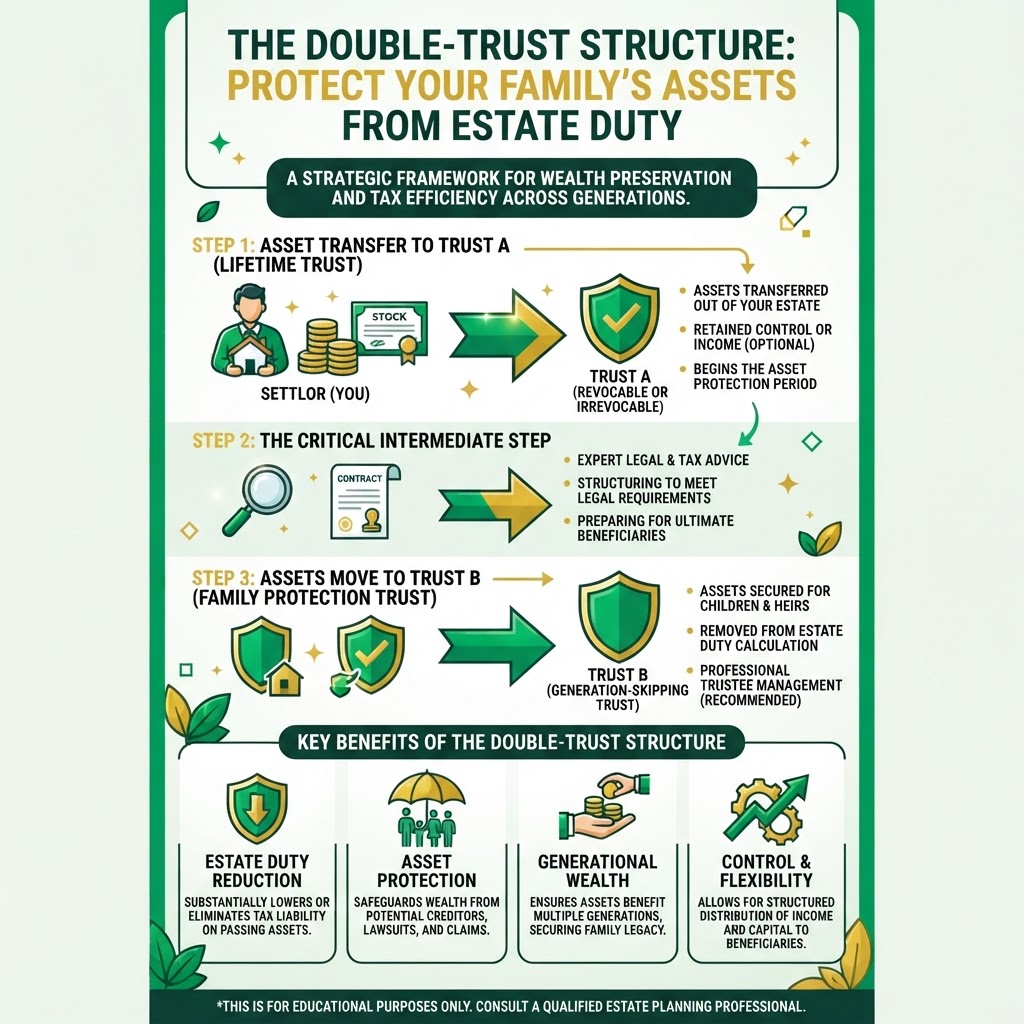
Fig. Key insights from this article — The Double-Trust Structure: Protect Your Family's Assets From Estate Duty
Real Families, Real Results: Anonymised Case Studies
Case Study 1: The Mokoena Family — Johannesburg
Mr. and Mrs. Mokoena (names changed) came to us in 2019 with a portfolio of four residential properties in Soweto and Midrand, with a combined value of approximately R6.8 million. Their entire portfolio was held in their personal names. At that point, their projected estate duty liability on the portfolio alone — assuming continued growth — would have been in the region of R900,000 to R1.2 million, not counting executor fees or CGT.
We worked with their attorneys to implement a double trust structure over eighteen months. The properties were transferred into the Asset Trust at their market values at the time of transfer, crystallising a known and manageable CGT liability then, rather than a much larger one later. The Loan Trust was structured to hold the loan accounts, effectively pegging the estate value at the point of transfer.
By 2023, those same properties had grown in value to approximately R9.4 million. That R2.6 million in growth occurred entirely inside the trust — outside of their taxable estates. Their children are beneficiaries of the Asset Trust and will inherit the income and assets through the trust framework without triggering a fresh estate duty event.
Case Study 2: The Dlamini Sisters — Durban
Two sisters in their early forties approached us after losing a significant portion of their late mother's estate to executor fees and estate duty. Their mother had owned two properties in Umhlanga and one in Pinetown — modest by some standards, but representing thirty years of sacrifice. Nearly R480,000 was absorbed in estate costs before the daughters received anything.
Determined not to repeat this, they implemented a joint double trust structure with themselves as co-founders and co-trustees, with an independent professional trustee. They have since acquired two additional properties directly in the Asset Trust. Their children — ranging in age from eight to sixteen — are named beneficiaries. Barring changes in law, those assets will transfer to the next generation without a repeat of what their mother's estate endured.
"The best time to build your structure was ten years ago. The second best time is today. Don't let perfect be the enemy of protected." — Dr. Chomba Chuma
Common Mistakes That Undermine the Double-Trust Structure
I have seen well-intentioned families implement this strategy and still face problems — almost always because of avoidable mistakes. Here are the most common ones:
- The founder retains excessive control: If you are the founder, sole trustee, and primary beneficiary, SARS may argue the trust is a sham. Distribute control genuinely and appoint an independent trustee.
- No separation of finances: Mixing personal and trust bank accounts, paying personal expenses from trust accounts, or depositing rental income into personal accounts destroys the legal distinction between you and the trust.
- Outdated trust deeds: A trust deed drafted in 2005 may not adequately address today's tax provisions. Review and update your deeds regularly.
- Failure to document decisions: Every significant trustee decision must be formally minuted and resolved. Verbal agreements among family trustees are not sufficient.
- Transferring encumbered property carelessly: If a property has a home loan, transferring it to a trust requires bank consent and is more complex. Many families skip this step — it can cause serious legal and financial complications. Check with institutions like FNB regarding their requirements for trust-held bond applications.
- Ignoring the Section 7C implications: If you lend money to your trust at below the official rate of interest, SARS may deem a donation to have occurred. Your loan to the trust must bear interest at the official SARS rate, or you must account for donations tax on the difference.
- DIY trust deeds: I cannot stress this enough. The double trust structure is a sophisticated legal instrument. It is not a weekend project. The cost of professional setup is a fraction of the cost of getting it wrong.
Financing Property Through a Trust: What You Need to Know
One of the most common questions I receive is: Can a trust get a home loan? The answer is yes — but it is more complex than personal financing. South African banks do provide mortgage finance to trusts, but they typically require personal surety from the trustees, and lending criteria can be stricter.
This is why the Loan Trust mechanism is so powerful — it can provide the initial equity or deposit funding for the Asset Trust to acquire properties, reducing or eliminating the need for external financing in some cases. Over time, as properties generate rental income, the trust can service any loan accounts and accumulate further assets.
For a broader perspective on property investment strategy in South Africa, our detailed property investment strategy guide walks through financing, acquisition, and portfolio growth in a structured way that complements the trust framework.
Your Actionable Next Steps
Understanding the double trust structure is the first step. Action is what separates families who talk about generational wealth from those who actually create it. Here is what I recommend you do right now:
- Educate yourself deeply: My book, Build a Legacy, Touch Freedom, covers the full framework of property wealth building and trust structuring for South African families. It is practical, accessible, and written specifically for people who are serious about protecting what they build. Get your copy in our shop for R799.
- Map your current exposure: Calculate the approximate value of all assets currently held in your personal name. Estimate your potential estate duty liability. This number — however uncomfortable — is your motivation to act.
- Engage with our Trust Masterclass: We run a comprehensive masterclass that covers trust law, double trust implementation, tax compliance, and practical administration. Access the Trust Masterclass here.
- Begin the Legacy Journey: Our 6-step legacy journey is designed for families at every stage of wealth building. Whether you are just starting out or already have a portfolio that needs restructuring, the journey meets you where you are. Start your legacy journey today.
- Book a free consultation: If you are ready to talk specifics about your family's situation, our team can guide you through the initial assessment and connect you with the right legal and tax professionals. Book your free consultation here.
The Legacy You Leave Is a Choice You Make Today
There is a generational shift happening in South Africa. Families who once had no framework for building and preserving wealth are beginning to think differently — not just about the property they buy next year, but about what their grandchildren will inherit. The double trust structure is one of the most powerful tools in that arsenal. It is legal, it is tested, and it works — but only when it is implemented with intention, maintained with discipline, and reviewed with care.
I started Mumbi Legacy because I believe that generational wealth transfer should not be the exclusive domain of South Africa's historically privileged families. The same structures, the same strategies, the same legal frameworks are available to every family willing to learn and act. The only question is whether you will take that step.
Your children should not have to rebuild what you spent a lifetime creating. Your grandchildren should stand on your shoulders, not start from scratch. The asset protection trust framework, properly structured, makes that possible. The double trust structure is not just a tax strategy — it is a declaration of intent. It is you saying: what I have built will outlast me.
That is legacy. And it starts with a decision you make today.