

How to Register Property in a Trust: A Complete South African Guide
How to Register Property in a Trust: A Complete South African Guide to Building Generational Wealth
Let me tell you about a family I worked with a few years ago — a hardworking couple from Soweto who spent 22 years building a property portfolio. Three houses. Paid off. A legacy they were proud of. Then the husband passed away unexpectedly, and within 18 months, two of those properties were tied up in estate disputes, one was sold to cover executor fees, and the children — the very people those properties were meant to protect — walked away with almost nothing. It was one of the most heartbreaking situations I have ever witnessed. And the tragedy? It was entirely preventable. If those properties had been held in a trust in South Africa, that family's story would have ended very differently. This guide is for every South African family that refuses to let that story be theirs.
Why South African Families Must Think Beyond Personal Ownership
Most South Africans are taught to work hard, buy property, and leave something behind. What we are rarely taught is how to structure that something so that it actually survives us. The truth is, owning property in your personal name — while completely legal and common — exposes your family to a set of risks that most people never see coming until it is too late.
When you own property personally in South Africa, that property forms part of your deceased estate when you pass away. That triggers a legal process called winding up an estate, which can take anywhere from 6 months to several years. During that time, your family may have limited or no access to those assets. Executor fees, which are legally capped at 3.5% of the gross estate value plus VAT, can amount to hundreds of thousands of rands on a multi-property portfolio. Add transfer duties, legal fees, and potential estate duty — and you start to see how much of your legacy can quietly disappear before your children receive a cent.
There is also the matter of creditors. If you run a business, face a lawsuit, or fall into financial difficulty, properties held in your personal name are vulnerable. A trust changes all of that.
"The goal is not just to own property. The goal is to own it in a way that outlives you, protects your family, and multiplies across generations. That is the difference between wealth and legacy." — Dr. Chomba Chuma, Mumbi Legacy
What Is an Inter Vivos Trust and Why Does It Matter for Property?
In South Africa, there are two primary types of trusts: a testamentary trust (created through a will and activated upon death) and an inter vivos trust (created during your lifetime). For property wealth-building purposes, the inter vivos trust — also called a living trust or family trust — is the gold standard.
An inter vivos trust is a legal entity created by a founder (also called a settlor or donor) through a written trust deed. The founder transfers assets — including property — into the trust, which is then administered by one or more trustees for the benefit of the beneficiaries. Importantly, the trust owns the property, not you personally. This is the critical distinction.
Key Parties in a Trust
- Founder: The person who creates the trust and donates assets into it. You can be the founder and also a trustee and beneficiary.
- Trustees: The people responsible for managing the trust assets according to the trust deed. You should always include at least one independent trustee.
- Beneficiaries: The people who benefit from the trust — typically your spouse, children, or grandchildren.
- Trust Deed: The founding document that governs how the trust operates, who benefits, and under what conditions assets are distributed.
Once properly constituted and registered, a family trust in South Africa becomes a legal person in its own right. It can own property, enter contracts, open bank accounts, and hold assets indefinitely — surviving the death of any individual trustee, founder, or beneficiary.
The Core Benefits of Holding Property in a Trust
- Asset protection: Property owned by a trust is generally protected from personal creditors of the trustees and beneficiaries.
- Estate planning: Trust assets fall outside your deceased estate, avoiding executor fees and delays in asset transfer.
- Estate duty savings: Growth in trust assets does not attract estate duty in your personal estate, as the trust owns the growth.
- Continuity: The trust survives indefinitely — your grandchildren and great-grandchildren can benefit from properties bought today.
- Income distribution: Rental income can be distributed to beneficiaries in lower tax brackets, reducing overall tax liability.
- Control: As a trustee, you maintain effective control over the assets while they are no longer "yours" for estate or creditor purposes.
For a deeper dive into how trust structures fit into a broader property investment strategy, read our complete property investment strategy guide on the Mumbi Legacy platform.
The Trust Registration Process in South Africa: Step by Step
Registering a trust in South Africa is a structured process governed by the Trust Property Control Act 57 of 1988. It is not something you do alone, and it is not something you cut corners on. Done correctly, it becomes one of the most powerful financial decisions your family will ever make. Here is how it works.
- Draft the Trust Deed: This is the most critical step. Your trust deed must be carefully drafted by a qualified attorney who understands property law and estate planning. The deed must clearly define the trust's purpose, identify the founder, trustees, and beneficiaries, outline trustee powers, specify distribution rules, and include provisions for trustee succession. A poorly drafted trust deed can create legal vulnerabilities and tax complications that defeat the entire purpose.
- Sign and Witness the Trust Deed: Once drafted, the trust deed must be signed by the founder and all initial trustees in the presence of a commissioner of oaths. Every signature must be properly commissioned.
- Apply for Registration at the Master of the High Court: You must submit your application to the Master of the High Court in the jurisdiction where the trust will operate. Required documents typically include the original signed trust deed, a completed J401 form (application for registration), certified copies of identity documents for the founder, all trustees, and major beneficiaries, proof of residential addresses, and trustee acceptance letters signed by each trustee. The South African government's official guidance on trust registration provides the most current requirements.
- Receive Your Letters of Authority: Once the Master of the High Court approves the application, the trust is officially registered and assigned a trust reference number. The trustees receive Letters of Authority — the document that proves the trust legally exists and that the trustees are authorised to act. Without Letters of Authority, trustees cannot legally act on behalf of the trust.
- Register the Trust with SARS: Every trust in South Africa must be registered as a taxpayer with the South African Revenue Service. You will receive a unique tax reference number for the trust. Trusts are taxed as separate entities and are subject to specific tax rates. For detailed tax information, visit the SARS website's trust tax section.
- Open a Trust Bank Account: Once you have your Letters of Authority and SARS tax number, open a dedicated trust bank account. Never mix personal funds with trust funds. This separation is not just good practice — it is a legal requirement that protects the trust's integrity.
- Transfer Property into the Trust: This is where your conveyancing attorney becomes essential. Transferring property into a trust is a formal conveyancing process that involves preparing a deed of sale or deed of donation between yourself and the trust, paying any applicable transfer duty or donations tax, lodging transfer documents at the Deeds Office, and registering the property in the name of the trust. Note: transferring property you already own into a trust has tax implications — specifically donations tax at 20% on the value above R100,000 annually, and potentially capital gains tax. Always get professional tax advice before doing this.
The entire registration process from drafting the deed to receiving Letters of Authority typically takes between 4 to 8 weeks, depending on the Master's Office and the completeness of your documentation. Purchasing property directly in the name of a newly registered trust can happen simultaneously with the trust registration process.
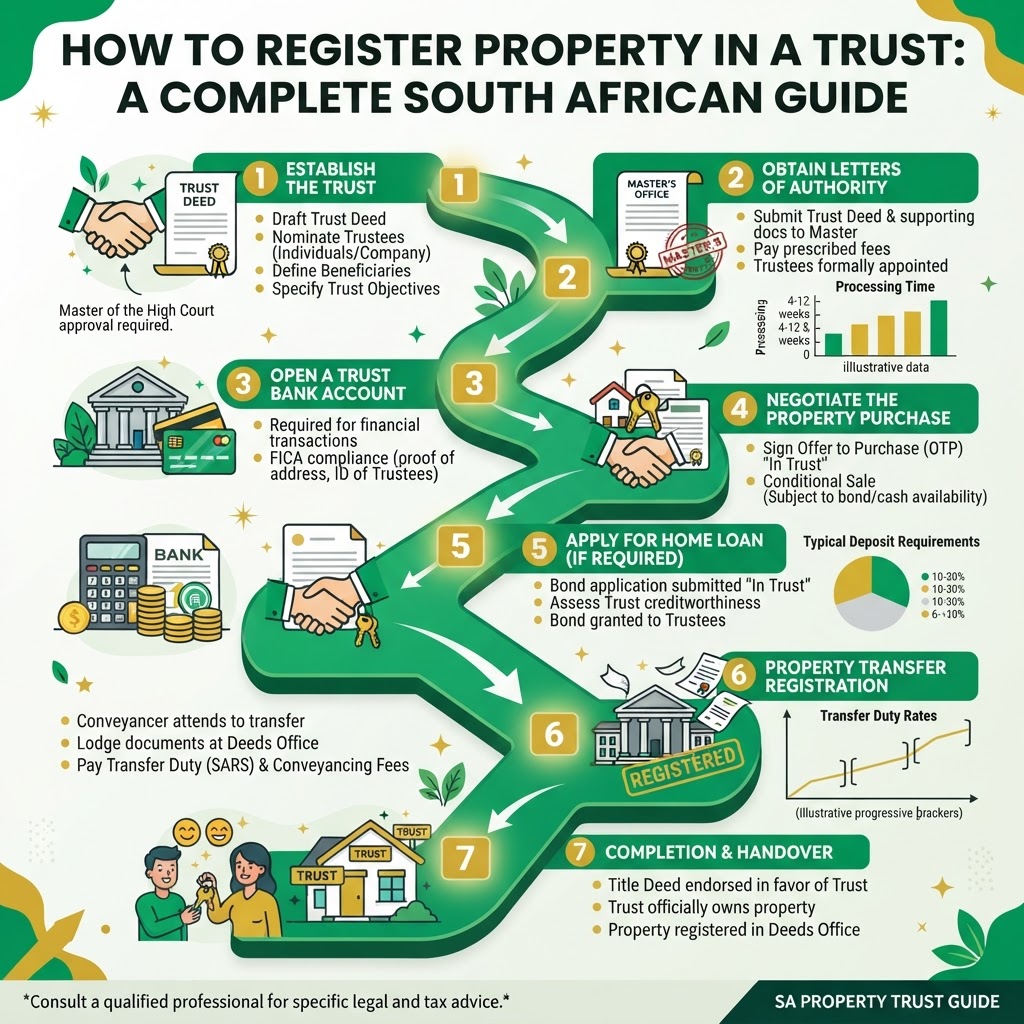
Fig. Key insights from this article — How to Register Property in a Trust: A Complete South African Guide
Real-World Examples: How South African Families Are Using Trusts
The Dlamini Family — Johannesburg
Mr. and Mrs. Dlamini (names changed for privacy) are a professional couple in their early 40s with two young children. They had already purchased their primary residence in their personal names but wanted to begin building a rental property portfolio. Rather than purchasing additional properties personally, they established the Dlamini Family Trust and used it to buy two buy-to-let properties in Pretoria. The rental income flows through the trust and is distributed to their children as beneficiaries, utilising the children's lower tax brackets. When Mr. and Mrs. Dlamini retire, those properties — and years of compound growth — will pass seamlessly to their children without estate duty or executor fees.
The Molefe Estate — Cape Town
Mrs. Molefe (name changed) was a widow who had built a portfolio of four properties over 30 years. After learning about the estate duty implications and executor fees her children would face, she worked with a Mumbi Legacy-recommended attorney to restructure two of her investment properties into a trust while she was still alive. When she passed away three years later, those two properties transferred to her children immediately and cost-effectively. The other two properties — still in her personal name — went through estate administration and cost her family over R180,000 in fees and took 14 months to resolve. The contrast was stark and instructive.
"Every rand lost to executor fees, estate duty, and administrative delays is a rand your children deserved to inherit. A trust does not just protect wealth — it amplifies it across generations." — Dr. Chomba Chuma, Mumbi Legacy
Common Mistakes South Africans Make When Using Property Trusts
Understanding how to register property in a trust is only half the battle. Avoiding these critical mistakes is what separates families that build lasting wealth from those that create expensive problems.
- Using a trust deed template from the internet: South African trust law is nuanced. A poorly drafted deed can be invalid, create unintended tax consequences, or fail to protect assets when it matters most. Always use a qualified attorney.
- Not appointing an independent trustee: SARS and the courts look closely at trusts where all trustees are related beneficiaries. Including an independent trustee — such as a trusted professional or attorney — strengthens the trust's legal standing and protects against the "sham trust" argument.
- Mixing personal and trust finances: Using trust bank accounts for personal expenses, or vice versa, undermines the trust's legal separateness. Always keep finances completely separate.
- Failing to hold proper trustee meetings and keep minutes: Trusts must be properly administered. Trustees should hold regular meetings, document decisions in minutes, and maintain proper accounting records. Failure to do so can expose the trust to legal challenges.
- Assuming trusts are only for the very wealthy: This is perhaps the most costly misconception. A family trust in South Africa costs between R8,000 and R25,000 to establish properly. Compared to the savings on executor fees alone — typically 3.5% of estate value plus VAT — a trust pays for itself on a single property worth R1.5 million.
- Not reviewing the trust deed regularly: Circumstances change. Marriages, divorces, new children, new properties — your trust deed should be reviewed every 3 to 5 years to ensure it still achieves your goals.
- Ignoring home loan implications: Banks in South Africa may apply different lending criteria to trusts compared to individuals. Some banks, including FNB, offer home loans to trusts but may require personal suretyship from trustees. Understand the lending implications before structuring your purchase through a trust.
Your Practical Action Plan: Next Steps to Register Property in a Trust
You have read the strategy. You understand the benefits. Now it is time to act. Here is your practical next-step plan to begin the process of registering property in a trust in South Africa.
Step 1: Educate Yourself Thoroughly
The more you understand, the better decisions you make. Start by reading our Mumbi Legacy property investment strategy guide which covers entity structures, financing strategies, and portfolio building in detail. Knowledge is the foundation of every legacy.
Step 2: Get the Blueprint
Our book, "Build a Legacy, Touch Freedom", available on the Mumbi Legacy platform for just R799, is the most comprehensive South African guide to building generational wealth through property. It covers trust structures, tax strategies, financing, and portfolio management in a way that is practical, clear, and actionable. This book has changed the trajectory of hundreds of South African families, and it will change yours.
Step 3: Join Our Trust Masterclass
For those who want to go deeper, our Trust Masterclass walks you through the entire process of setting up and operating a property trust in South Africa, with detailed guidance on tax implications, trustee responsibilities, and property acquisition strategies. This is the room where serious wealth-builders sit.
Step 4: Start Your Legacy Journey
Every great property portfolio starts with a plan. Our 6-Step Legacy Journey on the Mumbi Legacy platform is designed specifically for South African families who want to build real, transferable, generational wealth through property. It meets you where you are and walks you forward, step by step.
Step 5: Speak to a Professional
No article — no matter how comprehensive — replaces personalised professional advice. Book a free consultation with the Mumbi Legacy team today. We will help you understand your current position, clarify your goals, and connect you with the right attorneys, tax advisors, and conveyancers to make your trust a reality.
The Legacy You Build Today Is the Foundation Your Grandchildren Will Stand On
Here is what I want you to hold onto as you finish reading this: the families that build generational wealth in South Africa are not necessarily the ones who earn the most. They are the ones who structure the best. They are the families who looked beyond the next paycheck, beyond the next property purchase, and asked a deeper question — how do I make sure what I build today still stands 50 years from now?
An inter vivos trust is not a complicated idea reserved for the ultra-wealthy. It is a practical, accessible, and powerful tool available to every South African family that is serious about legacy. It protects your property from creditors. It eliminates unnecessary executor fees. It shields your assets from estate duty. And most importantly, it ensures that the properties you worked your entire life to acquire are passed on — intact and protected — to the people you love most.
The family from Soweto I told you about at the beginning of this article? I think about them often. Not with sadness, but with determination. Because their story is why Mumbi Legacy exists. It is why we created the Legacy Journey. It is why we wrote the book. It is why every single piece of content on this platform is designed to give you the knowledge, the strategy, and the confidence to do things differently.
You have the opportunity right now — today — to make a decision that your grandchildren will thank you for. Do not let another year pass without a structure in place to protect what you are building. Reach out to us, get the guidance you need, and take the first step toward a legacy that truly lasts.
Dr. Chomba Chuma is the MD and Founder of Mumbi Legacy, South Africa's leading property wealth education platform. He is a passionate advocate for financial literacy and generational wealth-building in African families. Connect with him and the Mumbi Legacy community at mumbi.africa.