

Why Your Property Must Be In the Right Entity: Tax and Legal Explained
Why Your Property Must Be In the Right Entity: Tax and Legal Explained
Let me tell you about a family I'll call the Dlaminis. Hard-working, ambitious, the kind of South African family that does everything right. They saved for years, bought three properties in their personal names, built what looked like a solid portfolio — and then life happened. A lawsuit. A divorce. A tax bill they never saw coming. Within eighteen months, two of those properties were gone. Not because they made bad investments. Because they put those investments in the wrong entity. The property entity structure they chose — or rather, didn't consciously choose — cost them everything they had built. I share this story not to frighten you, but because I have seen it happen too many times, and I refuse to let it happen to your family.
At Mumbi Legacy, our entire mission is to help South African middle-class families build wealth that survives generations. And one of the most critical — yet most overlooked — foundations of that mission is understanding how and where your property is legally held. Whether you are buying your first investment property or expanding a growing portfolio, the entity decision you make today will define your tax liability, your legal protection, and your family's legacy for decades to come.
The Hidden Crisis: Why Most South African Families Get This Wrong
Here is the uncomfortable truth. Most South Africans who invest in property do so in their personal names simply because it is the path of least resistance. The bank approves the bond, the attorney registers the transfer, and before you know it, your name is on the title deed. It feels like ownership. It feels like progress. And in many ways, it is. But personal ownership comes with a set of risks and tax consequences that most families only discover when it is too late.
When property is held in your personal name, it is directly exposed to personal liability. If someone trips on your rental property and sues you, your primary residence, your vehicle, your savings — everything you own personally — is potentially at risk. Beyond liability, there is the question of capital gains tax on property in South Africa. When you sell a property held personally, SARS will include a portion of your capital gain in your taxable income. For an individual, the inclusion rate is 40%, and depending on your marginal tax rate, that can translate into a significant tax bill eating into your profits.
Then there is the estate planning dimension. When you pass away, properties held in your personal name form part of your deceased estate. Transfer duty, executor fees, potential estate duty — the costs can be crippling for your heirs, and the process can take years. Your children inherit a legal and financial headache instead of a legacy.
"The entity your property sits in is not just a legal technicality. It is the architecture of your legacy. Get the architecture wrong, and even the most beautiful property portfolio can collapse."
— Dr. Chomba Chuma, MD & Founder, Mumbi Legacy
Understanding Your Options: Company vs Trust for Property in South Africa
When we talk about property entity structure, we are essentially asking: who legally owns this property? The answer can be you personally, a private company, a family trust, or even a combination of structures. Each has distinct tax and legal implications, and the right choice depends on your specific goals, income level, family situation, and long-term strategy.
Holding Property in Your Personal Name
As discussed, this is the default for most buyers. It offers simplicity and is often the only option available to first-time buyers who need to qualify for a home loan. However, for investment properties beyond your primary residence, the personal name route exposes you to full marginal income tax on rental income, a 40% CGT inclusion rate, and complete personal liability. It also creates estate planning complexities that can burden your heirs.
The Private Company (Pty Ltd)
A private company is a popular vehicle for property investors, particularly those with multiple properties. Companies pay a flat corporate income tax rate of 27% in South Africa — often lower than a high-earning individual's marginal rate of up to 45%. The capital gains tax inclusion rate for companies is 80%, however, which means that on disposal, companies pay more CGT proportionally than individuals. This makes companies better suited for buy-to-hold, income-generating properties than for those you intend to sell for capital appreciation.
Companies also offer a degree of separation between personal and business assets, though this protection is not absolute — particularly if you have personally signed surety for company loans, which banks almost always require. You can learn more about the legal registration of companies through the Companies and Intellectual Property Commission (CIPC) on gov.za.
The Family Trust
A family trust is arguably the most powerful long-term vehicle for generational wealth through property — when structured correctly. In a trust, the property is owned not by an individual but by the trust itself, for the benefit of the beneficiaries (typically your family members). This means the property falls outside your personal estate, providing both asset protection and estate planning benefits.
Trusts are taxed at a flat rate of 45% on income and have an 80% CGT inclusion rate — seemingly punishing. However, the real power lies in the ability to distribute income to beneficiaries who are taxed at their own, often lower, marginal rates. A well-structured trust with multiple beneficiaries can dramatically reduce the overall tax burden of a property portfolio.
Trusts also do not die. When you pass away, the trust continues, and your properties remain protected, managed, and growing — without the disruption, costs, and delays of estate administration. This is why at Mumbi Legacy, our Trust Masterclass has become one of our most sought-after resources for families serious about building generational wealth.
Capital Gains Tax and Transfer Duty: What the Numbers Actually Mean
Let us get practical with the numbers, because capital gains tax on property and transfer duty in South Africa are two costs that can either be managed strategically or can silently erode decades of wealth building.
Capital Gains Tax (CGT)
CGT applies when you sell a property for more than you paid for it. The gain is not taxed at a flat rate — instead, a portion of the gain (the inclusion rate) is added to your taxable income and taxed at your applicable rate. Here is a simplified comparison:
- Individual: 40% inclusion rate. If your marginal rate is 45%, effective CGT rate is 18%.
- Company: 80% inclusion rate. At 27% corporate tax, effective CGT rate is 21.6%.
- Trust: 80% inclusion rate. At 45% flat rate, effective CGT rate is 36% — but income distributed to beneficiaries is taxed in their hands, potentially at much lower rates.
There is also the primary residence exclusion of R2 million for individuals — a significant benefit that does not apply to companies or trusts. This is one reason why your family home may be best held personally, while investment properties belong in a more structured vehicle.
Transfer Duty
Transfer duty is a tax paid to SARS by the purchaser when buying property. It applies to properties purchased from non-VAT vendors and is calculated on a sliding scale. Properties under R1,100,000 attract zero transfer duty, while higher values are taxed at increasing rates up to 13% on the portion above R2,500,000. Importantly, transfer duty is payable regardless of which entity buys the property — whether personal, company, or trust. What changes between entities is not the transfer duty itself but the long-term tax treatment of income and gains from that property.
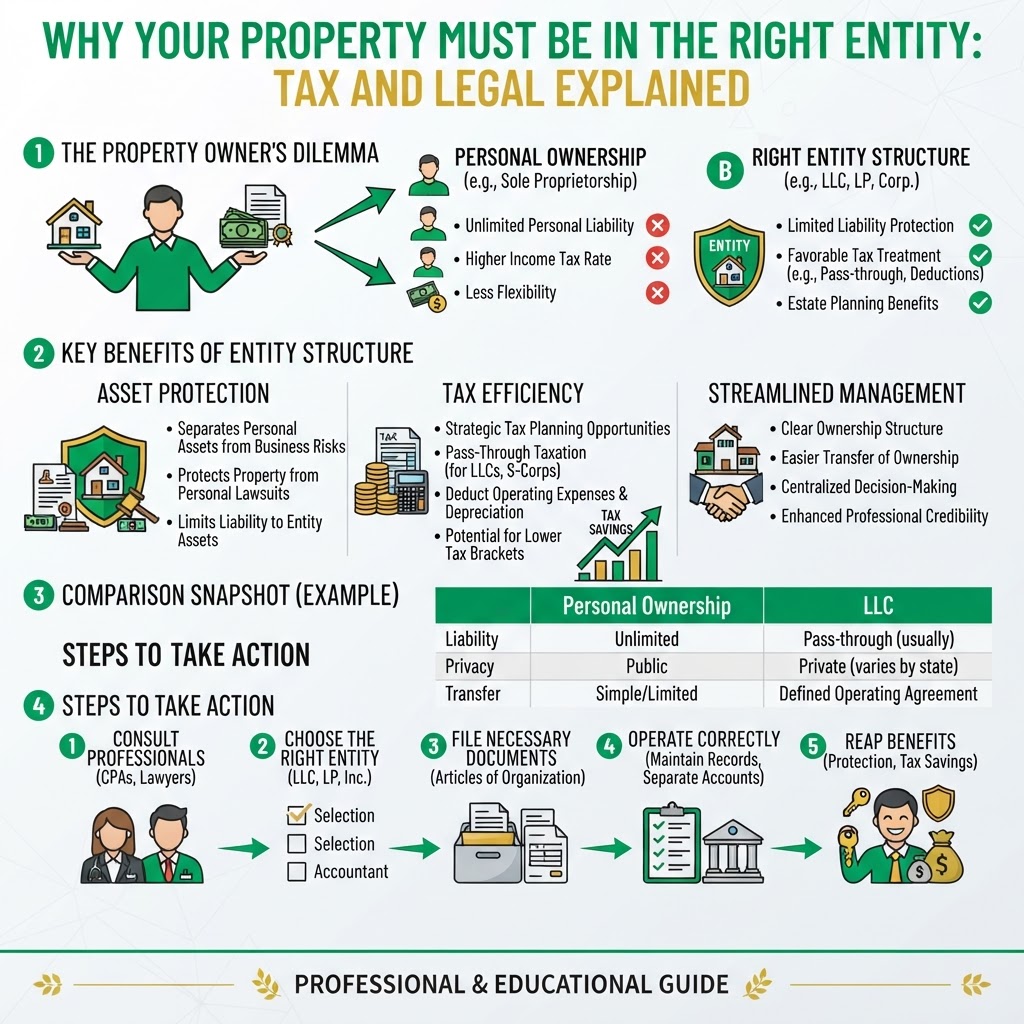
Fig. Key insights from this article — Why Your Property Must Be In the Right Entity: Tax and Legal Explained
A Step-by-Step Guide to Choosing the Right Property Entity Structure
There is no single correct answer for every family. The right property tax strategy depends on your unique circumstances. But here is a practical framework to help you think through the decision:
- Clarify your purpose. Is this property your primary residence? A long-term rental? A property you plan to develop and sell? Your intention shapes the optimal structure. Primary residences often work best personally. Long-term rentals may suit a trust. Development projects may suit a company.
- Assess your income tax position. If you are already earning at the top marginal rate (45%), holding rental income personally is expensive. A company or trust with income distribution can offer meaningful tax relief.
- Consider your liability exposure. If you operate a business, have significant personal debt, or work in a high-risk profession, keeping investment properties in a separate legal entity protects them from personal claims.
- Think generationally. If you want this property to pass to your children and grandchildren without disruption, a family trust removes it from your estate permanently and cleanly.
- Get professional advice. Entity structuring has legal and tax implications that require qualified guidance. Do not rely on generic advice. Engage a property-specialised attorney and tax practitioner — or book a free consultation with our team at Mumbi Legacy.
- Register correctly from the start. Changing the ownership of a property after the fact — for example, transferring from your personal name into a trust — triggers transfer duty and potentially CGT. The cost of restructuring later is almost always higher than structuring correctly from the beginning.
For a deeper dive into building a complete property investment strategy, our property investment strategy guide walks you through every layer of decision-making, from acquisition to legacy planning.
Real-World Examples: How Entity Structure Changes Everything
Let me bring this to life with two anonymised cases from families we have worked with at Mumbi Legacy.
Case Study One: The Nkosis — Rental Income, Company Structure
Mr. and Mrs. Nkosi are both professionals earning in the top tax bracket. They purchased two rental properties in their personal names early in their investment journey. Between them, the rental income pushed their already-high taxable income even higher, costing them nearly 45 cents in every rand of rental profit. After working with our team, they established a private company to hold their third property. Rental income earned by the company is taxed at 27%, and profits retained in the company are reinvested into further acquisitions. Over five years, this structural change saved the family hundreds of thousands of rands in income tax — money that went back into growing their portfolio.
Case Study Two: The Mthembus — Family Trust and Generational Transfer
The Mthembu family had a different challenge. Mr. Mthembu senior had accumulated four properties over thirty years, all in his personal name. He was approaching retirement and worried about what would happen to his portfolio when he passed. Estate duty, executor fees, and the emotional burden on his children weighed on him. We helped him establish a family trust and, over a planned period, transfer properties into the trust in a tax-efficient manner. His children and grandchildren are now beneficiaries. When Mr. Mthembu eventually passes, his properties will not form part of his estate. The trust continues. The portfolio continues. The legacy continues — exactly as he intended.
"Generational wealth is not built by accident. It is built by design. The entity structure you choose today is one of the most important design decisions you will ever make for your family."
— Dr. Chomba Chuma, Mumbi Legacy
Common Mistakes South African Property Investors Make With Entity Structure
In my years working with families across South Africa, I have seen the same costly errors repeated. Here are the most important ones to avoid:
- Buying everything in your personal name by default. Convenience is not a strategy. Every property purchase deserves a deliberate entity decision.
- Assuming a trust always saves tax. A poorly administered trust can cost more in tax than it saves. Trusts require proper setup, independent trustees, and annual maintenance.
- Ignoring the impact of personal suretyship. Many investors assume a company provides complete protection — but if you have signed personal surety for the bond, your personal assets remain at risk in the event of default.
- Waiting until retirement to think about estate planning. Transferring properties into a trust after years of appreciation can trigger substantial CGT and transfer duty. Starting early dramatically reduces this cost.
- Using one structure for everything. A hybrid strategy — perhaps a trust owning shares in a company that holds the properties — can offer the best of both worlds for larger portfolios. This is advanced planning, but it is exactly what sophisticated investors do.
- Not reviewing the structure regularly. Tax laws change. Your family circumstances change. Your portfolio changes. What was optimal five years ago may not be optimal today. Annual reviews with a qualified advisor are essential.
The Property24 market insights portal regularly publishes data on property market trends, and while market conditions matter, they are secondary to the legal and tax foundation you build beneath your investments.
Your Next Steps: Start Building the Right Foundation Today
Knowledge without action is just information. So let me give you something concrete to do with everything you have just learned.
If you are just beginning your property wealth journey and want to understand the full picture — the mindset, the strategy, the structures, and the legacy plan — start with our book, Build a Legacy, Touch Freedom. At R799, it is the most affordable and comprehensive introduction to property wealth building written specifically for South African families. It covers entity structure, tax strategy, financing, and the philosophy of generational wealth in plain, practical language.
If you are ready to go deeper on trust structures specifically — how to set one up, how to fund it, how to use it to protect and grow your portfolio — our Trust Masterclass will give you the detailed, step-by-step knowledge you need to make informed decisions alongside your professional advisors.
If you want to see the complete roadmap — from your first property purchase to building a multi-generational legacy — explore our 6-Step Legacy Journey. This is the framework we use with every family we work with, and it integrates entity structure, financing, portfolio growth, tax strategy, and estate planning into one coherent path.
And if you are at a point where you need personalised guidance — where you want to sit down and talk through your specific situation, your current properties, your family goals — then book a free consultation with our team. We will listen, we will assess, and we will point you in the right direction without obligation.
Conclusion: Your Legacy Deserves the Right Foundation
Every great building begins with a foundation. You can have the most beautiful, expensive structure above ground, but if the foundation is weak, everything eventually crumbles. Your property portfolio is no different. The entity structure beneath your investments is that foundation — invisible perhaps, but absolutely decisive.
The Dlamini family I told you about at the beginning of this article lost their properties not because they failed as investors, but because no one sat them down and explained what you now know. They were not equipped with the right information at the right time. You are.
South Africa is a country of extraordinary resilience and ambition. The middle-class families I work with every day are proof of what is possible when determination meets strategy. You are working hard. You are saving. You are dreaming of a future where your children and grandchildren have options, opportunities, and a foundation that you built with your own hands and your own sacrifices.
Do not let a preventable structural mistake unravel that dream. Take the time — today, not someday — to ensure that every property you own and every property you acquire is held in the right entity, structured for the right tax outcome, and positioned to create the right legacy.
The wealth is within reach. The knowledge is now in your hands. The legacy is yours to build. Let us build it together.