

Step-by-Step Guide to Buying Your First Investment Property in South Africa
Step-by-Step Guide to Buying Your First Investment Property in South Africa
Let me tell you about a woman I'll call Nomsa. She was a 34-year-old teacher in Johannesburg, earning a decent salary, but watching her money disappear every month — rent, groceries, school fees, and very little left over. She came to me with one question: "Dr. Chuma, how do I stop working for money and make money work for me?" The answer I gave her was the same answer I've given hundreds of South African families since founding Mumbi Legacy: your first investment property in South Africa is the most powerful vehicle for building generational wealth that this country has ever offered the middle class. Three years after that conversation, Nomsa owns two properties, earns passive rental income every month, and is building something her children will inherit. This guide is for every Nomsa out there — and for you.
Why South African Families Struggle to Build Wealth
The truth is uncomfortable, but I will say it plainly because I respect you too much to soften it: most South African middle-class families are one financial shock away from crisis. We earn, we spend, we survive — but we rarely build. The township economy, the suburban hustle, the government employment ladder — none of these systems were designed to make you wealthy. They were designed to keep you productive for someone else's legacy.
According to data consistently reflected on platforms like Property24, South Africa has one of the most accessible property markets for first-time buyers in the developing world — yet the vast majority of working South Africans never take advantage of it. Why? Fear. Misinformation. And a belief that property investment is only for the wealthy.
- Fear of bond rejection — many families assume they won't qualify and never apply
- Lack of financial education — the school system never taught us about assets and liabilities
- Decision paralysis — too many options, too little guidance
- Generational rent cycles — families who have always rented assume that's their destiny
- Misunderstanding of risk — not investing is actually the greatest financial risk of all
The good news? Every single one of these barriers is breakable. And the property buying guide you're reading right now is your first tool for breaking them.
Why Property Remains South Africa's Most Reliable Wealth-Building Strategy
Before we get into the steps, I want you to understand why property works — because knowledge builds conviction, and conviction is what keeps you moving when fear whispers that you should stop.
South African property has historically delivered long-term capital appreciation above inflation. Rental demand in our urban centres — Johannesburg, Cape Town, Durban, Pretoria, and the growing secondary cities — remains consistently strong. Our population is young and urbanising, which means the demand for housing is not going away. Add to this the tax benefits available to property investors under SARS regulations — including deductions for bond interest, rates, repairs, and depreciation — and property becomes not just an asset, but a tax-efficient wealth engine.
"Property is not just about bricks and mortar. It is about building a fortress for your family — a tangible, touchable inheritance that outlives you and empowers the generation that follows." — Dr. Chomba Chuma
When you understand our 6-step legacy journey, you will see that property acquisition is not a standalone transaction — it is part of a deliberate, structured plan to transfer wealth across generations. But let's start where every journey starts: with the very first step.
Your Step-by-Step Property Buying Guide for First-Time Investors
Step 1: Get Your Financial House in Order
Before you look at a single listing, you need to audit your financial health honestly. Pull your credit report — you can do this through the major bureaus or your bank. A credit score above 650 significantly improves your bond application success rate, though many lenders will consider applications from 580 upward depending on other factors.
Reduce your debt-to-income ratio where possible. Pay down short-term debt — store accounts, personal loans, credit cards. Lenders look at your total monthly debt commitments as a percentage of your gross income. Ideally, your total debt repayments, including the new bond, should not exceed 30–35% of your gross monthly income.
- Request your free annual credit report from TransUnion or Experian
- Close unused store accounts — they count against your credit profile
- Save at least 10–15% of the property price for deposit and transfer costs
- Budget for transfer duty, conveyancing fees, and bond registration costs
- Build a 3-month emergency reserve separate from your deposit savings
Step 2: Define Your Investment Strategy Before You Buy
This is where most first-time investors go wrong — they fall in love with a property before they have a strategy. Your strategy must drive your property selection, not the other way around.
Ask yourself these questions: Are you buying for rental income (cash flow), capital growth, or both? Are you targeting the residential market — sectional title, freehold, or student accommodation? What is your investment horizon — 5 years, 10 years, 20 years? What areas can you manage a property in, or will you use a managing agent?
For a deeper breakdown of investment strategies suited to different income levels and family goals, read our property investment strategy guide on the Mumbi Legacy platform.
Step 3: Research Your Market and Calculate Rental Yield
Never buy a property without running the numbers. The rental yield calculator is your most important tool as a new investor. Here is how to calculate it:
- Find the average monthly rental for similar properties in your target area
- Multiply that monthly rental by 12 to get your annual rental income
- Divide that annual income by the purchase price of the property
- Multiply by 100 to get your gross rental yield percentage
Example: A property priced at R800,000 renting for R7,500 per month gives you: (R7,500 x 12) ÷ R800,000 x 100 = 11.25% gross rental yield. In South Africa, a gross rental yield of 8–12% is generally considered strong. Anything below 6% in a non-high-growth area warrants careful scrutiny.
Use platforms like Private Property and Property24 to research comparable rentals and sales in your target area. Study suburb-level data, not just city-level averages.
Step 4: Conduct Thorough Property Due Diligence
Property due diligence is not optional — it is the difference between a wealth-building asset and a financial nightmare. Before you sign any offer to purchase, you must investigate the following:
- Title deed check — verify ownership and any registered bonds or endorsements at the Deeds Office via gov.za
- Municipal rates clearance — confirm no outstanding rates, water, or electricity accounts
- Levy status — for sectional title, check that the body corporate levies are current and the scheme is financially healthy
- Physical inspection — hire an independent property inspector to check for structural issues, damp, roof condition, and electrical compliance
- Zoning verification — confirm the property is zoned for your intended use
- Rental history — if buying a tenanted property, review existing lease agreements carefully
Always work with a registered estate agent. Verify their registration with the Property Practitioners Regulatory Authority (PPRA) before engaging their services.
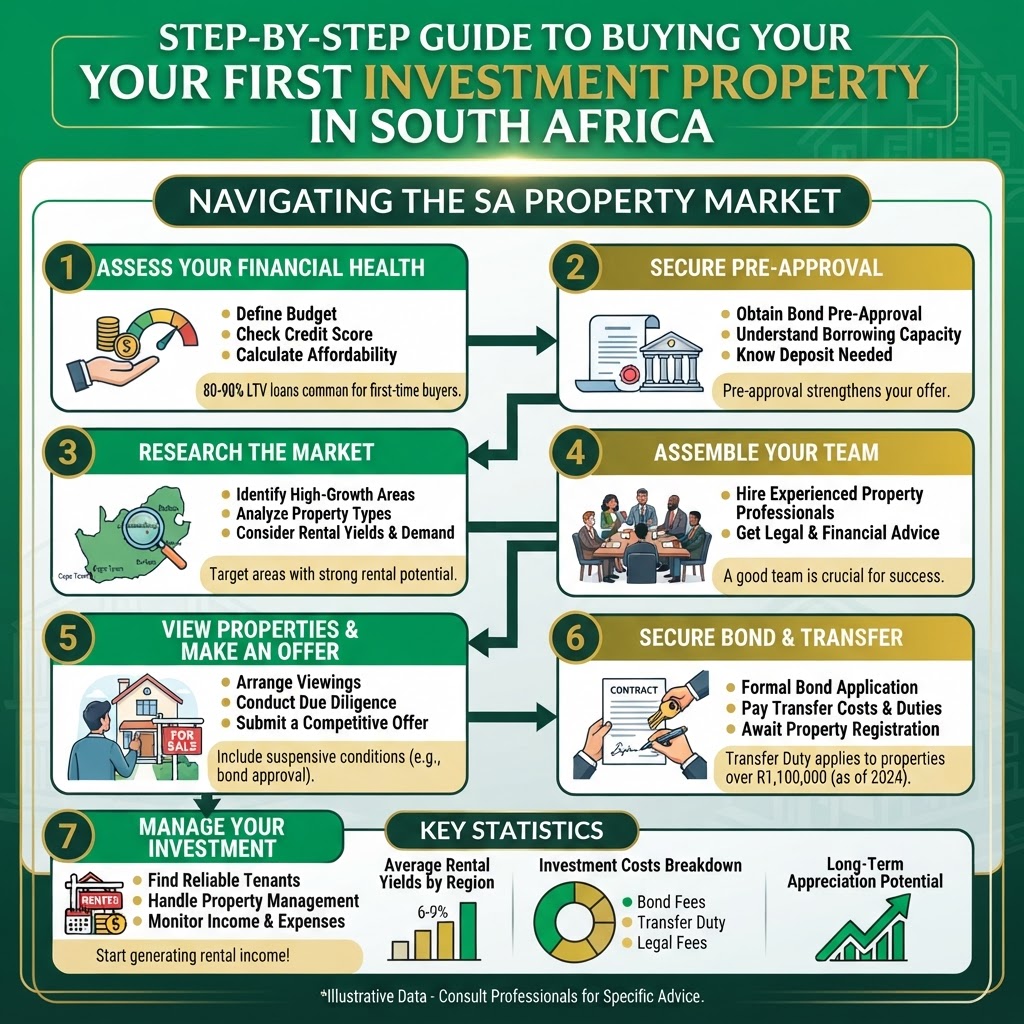
Fig. Key insights from this article — Step-by-Step Guide to Buying Your First Investment Property in South Africa
Step 5: Apply for Your Bond — Bond Application Tips That Make a Difference
Your bond application is your moment of financial truth, and preparation is everything. Here are the bond application tips that our Mumbi Legacy community uses to maximise approval rates and secure the best possible interest rates:
- Apply to multiple banks simultaneously — use a bond originator (it costs you nothing) to submit to FNB, Standard Bank, Nedbank, Absa, and SA Home Loans at once
- Provide a clean, complete application — missing documents cause delays and create doubt in underwriters' minds
- Show consistent income — three to six months of payslips and bank statements that reflect stable, predictable income
- Offer a deposit where possible — a 10% deposit not only improves approval odds but reduces your monthly repayment and total interest paid over the loan term
- Negotiate your interest rate — never accept the first rate offered; your bond originator should negotiate on your behalf
- Understand what you are signing — know the difference between a fixed and variable rate bond
You can explore home loan calculators and eligibility tools directly on banking platforms such as FNB Home Loans to estimate your affordability before formally applying.
Step 6: Navigate the Transfer Process with Confidence
Once your offer to purchase is accepted and your bond is approved, the conveyancing process begins. A conveyancing attorney — appointed by the seller — handles the legal transfer of the property into your name. This process typically takes six to twelve weeks in South Africa and involves bond registration, transfer of title, and payment of transfer duty to SARS.
Stay engaged throughout this process. Follow up regularly with the conveyancer and your bond originator. Ensure you have your funds for transfer costs ready in advance — delays here can cause transactions to collapse.
Real-World Stories: Ordinary South Africans Building Extraordinary Legacies
Beyond Nomsa, let me share two more stories from our community — names changed to protect privacy, but the results are very real.
The Mthembu Family — Soweto to a Property Portfolio
Mr. and Mrs. Mthembu were a dual-income couple, both in their early forties, who believed they had "started too late." They attended one of our Mumbi Legacy workshops and decided to act. They purchased a modest two-bedroom sectional title unit in Roodepoort for R620,000 using a 10% deposit they had saved over 18 months. Today that unit rents for R6,800 per month — nearly covering their full bond repayment. They have since refinanced using equity in the first property to fund a deposit on a second. Their goal: five properties before retirement.
The Young Professional — A 28-Year-Old's First Step
Thabo was a 28-year-old IT professional in Pretoria who was renting a flat for R9,500 per month and saving very little. After reading our book — Build a Legacy, Touch Freedom — he realised he could buy a two-bedroom unit in his target suburb for R950,000, rent one room out, and reduce his effective housing cost to under R4,000 per month. He applied for his bond, was approved at prime minus 0.5%, and closed within 10 weeks. He effectively turned his biggest monthly expense into a wealth-building asset.
Common Mistakes First-Time Property Investors Must Avoid
I have seen brilliant, hardworking South Africans make costly mistakes that set their wealth journey back by years. Learn from them:
- Buying with emotion, not data — falling in love with a property that doesn't make financial sense
- Ignoring vacancy risk — not accounting for months when the property may be untenanted in your cash flow projections
- Underestimating maintenance costs — budget 1–1.5% of property value per year for maintenance
- Skipping the lease agreement review — a poorly drafted lease is a legal and financial vulnerability
- Buying in the wrong name — purchasing property in your personal name when a trust structure would offer better asset protection and estate planning benefits. Our Trust Masterclass covers this in depth
- Not having a tenant screening process — a bad tenant can cost you more than six months of rental income in legal fees and damages
- Over-leveraging too quickly — give each property time to stabilise before using its equity to buy the next
"The biggest mistake is not making a mistake — it is being so afraid of making a mistake that you never buy at all. Inaction is the most expensive financial decision you will ever make." — Dr. Chomba Chuma
Your Actionable Next Steps Toward Your First Investment Property
Knowledge without action is just entertainment. So here is exactly what I want you to do after reading this article:
- This week: Pull your credit report and calculate your current debt-to-income ratio
- This month: Set a savings target for your deposit and transfer costs — open a dedicated savings account
- In the next 30 days: Identify two to three target suburbs and research average rental yields and sales prices
- Right now: Read our property investment strategy guide to align your property selection with your long-term legacy goals
- For deeper learning: Get your copy of Build a Legacy, Touch Freedom — our flagship property wealth book — available for R799. It is the most valuable R799 investment you will make this year
- For personalised guidance: Book a free consultation with our team at Mumbi Legacy. We will review your financial profile and map out your first property acquisition together
If you are ready to go beyond theory and commit to a structured wealth-building journey, our 6-step legacy journey is exactly where you need to be. It is the framework that has helped hundreds of South African families move from renting to owning, from surviving to building, from one generation to the next.
Your Legacy Begins With One Decision
I started Mumbi Legacy because I watched too many brilliant, deserving South African families work hard their entire lives and have nothing tangible to pass on. Not because they lacked intelligence or effort — but because no one ever handed them a map. This article is that map. Your first investment property in South Africa is not just a financial transaction. It is a declaration. A declaration that your family's story is changing. That the cycle of building other people's wealth through rent is ending. That the next generation will inherit something real — something that grows, generates income, and says: someone loved us enough to plan ahead.
The market is not perfect. The timing will never feel exactly right. Your credit score may need work. Your savings may feel small. But none of that matters as much as the decision to begin. Nomsa began with a teacher's salary and a question. Thabo began with a book and a bond application. The Mthembu family began with 18 months of disciplined saving. They all began somewhere ordinary — and built something extraordinary.
Your legacy does not start when conditions are perfect. It starts the moment you decide it will. Take that step today. We are here to walk it with you.
— Dr. Chomba Chuma, MD & Founder, Mumbi Legacy | mumbi.africa