

Finding Undervalued Properties in South Africa: A Practical Guide
Finding Undervalued Properties in South Africa: A Practical Guide to Building Wealth Below Market Value
Let me tell you about a family I worked with — a nurse and a school teacher from Soweto, both earning modest salaries, both convinced that real property wealth was reserved for people with old money or big corporate connections. Within eighteen months of working together, they had acquired two undervalued properties in South Africa — one a distressed estate sale in Roodepoort, another a motivated-seller deal in Krugersdorp — and their net worth had shifted in a way that will echo through generations. They did not win the lottery. They did not inherit anything. They simply learned how to see what most people walk right past.
That is what this guide is about. If you are a South African family serious about building generational wealth through property, understanding how to find and secure below market value property is arguably the single most powerful skill you can develop. It compresses your timeline, reduces your risk, and gives you equity from day one. Let us get into it.
Why Most South African Families Miss the Best Property Deals
The honest truth is that the property market does not advertise its best opportunities. The properties that appear polished on Property24 with professional photography and asking prices at peak market value are rarely where generational wealth is built. Those listings serve a purpose — but they are the retail shelf of the property world. The real deals happen before the listing, behind the listing, or in circumstances that most buyers simply do not know how to navigate.
South African families face a particular set of challenges when it comes to property deal sourcing. Many are first-generation property investors, without mentors who have walked this road before them. Many have been taught to wait for the "right time" or to save until they can afford something "proper." Meanwhile, distressed properties, estate sales, and motivated sellers are changing hands every single week — often to the same small circle of informed investors who know exactly what to look for.
The gap is not money. The gap is knowledge, strategy, and the confidence to act when opportunity presents itself.
"The best property deal you will ever find is the one nobody else recognised as a deal. Your job is to train your eyes to see differently." — Dr. Chomba Chuma
What Exactly Is an Undervalued Property — and Why Do They Exist?
An undervalued property in South Africa is any property being sold at a price meaningfully below its true market value or its potential value once repositioned. The gap between what you pay and what the property is actually worth — or can become worth — is called instant equity. That equity is your profit margin, your safety buffer, and your leverage for the next deal.
These properties exist for very real human reasons:
- Financial distress: The owner has fallen behind on bond repayments and needs to sell quickly to avoid repossession or a worse credit outcome.
- Deceased estates: When a property owner passes away without a clear estate plan, heirs often want to liquidate quickly and move on.
- Divorce proceedings: Emotionally charged separations frequently result in rushed sales below market value.
- Relocation or emigration: Sellers who have accepted job offers abroad or are emigrating often prioritise speed over price.
- Neglected or cosmetically distressed properties: Properties that look terrible but are structurally sound and located well are underpriced because most buyers cannot see past the surface.
- Inheritance disputes or complications: Multiple heirs who cannot agree sometimes accept a lower offer just to finalise the matter.
- Bank repossessions: Properties repossessed by financial institutions are often sold through auction at significant discounts.
Understanding why a property is undervalued helps you craft the right approach, the right offer, and the right exit strategy. It also helps you move with empathy — which, in my experience, makes you a far more effective negotiator than aggression ever will.
The Five Most Reliable Sources for Finding Below Market Value Property in South Africa
Strategy without sourcing is theory. Let us talk about where — practically and specifically — you go to find these deals in the South African context.
1. Sheriff of the Court Auctions and Bank Repossessions
When homeowners default on their bonds, South African banks proceed through the courts to repossess and sell those properties. These sales — often conducted by the Sheriff of the Court — are advertised in local newspapers and government gazettes. Properties can sell for as little as 50 to 70 cents on the rand at these auctions. The key discipline here is doing your homework before the auction: visit the property if possible, check the Deeds Office records for any outstanding rates, levies, or encumbrances, and set a firm maximum bid before you walk in. Emotion at an auction is your enemy.
2. Estate Agent Relationships — The Off-Market Network
This is perhaps the most underutilised channel for everyday investors. Experienced estate agents often know about motivated sellers before a property ever hits the public portals. They know which client is behind on their bond, which deceased estate is about to be liquidated, which divorce is finalised and the property must go. Build genuine relationships with two or three active agents in your target area. Make your buying criteria crystal clear. Let them know you can move quickly and that you are a serious, prepared buyer. Agents prioritise buyers who close, not browsers who waste their time.
3. Direct-to-Seller Prospecting
Distressed property investment at its most direct involves going to the source. This means identifying areas where you want to invest, then looking for physical signals of motivated sellers: overgrown gardens, peeling paint, municipal notices on gates, properties that have been vacant for extended periods. A respectful, handwritten note dropped in a letterbox — introducing yourself, explaining you are a cash-ready or pre-approved buyer looking for a direct sale — can open doors that no portal ever would. This approach requires patience and volume, but the deals it produces are typically the deepest discounts available.
4. Property Networking Groups and Investment Clubs
South Africa has a growing community of serious property investors who share deals, strategies, and opportunities. Attend property investment meetups, join active online communities, and consider structured education programmes that connect you with like-minded investors. The Mumbi Legacy 6-Step Legacy Journey was designed specifically to build this kind of knowledge base and community support around property wealth for South African families.
5. Deceased Estate Listings and Liquidation Sales
The Master of the High Court regularly processes deceased estates across South Africa. Executors appointed to administer these estates are often motivated to sell quickly, particularly when heirs are geographically spread or financially pressed. Watch legal notices in newspapers and Government Gazette publications. Connect with estate attorneys in your area — they are often looking for reliable buyers for their estate properties.
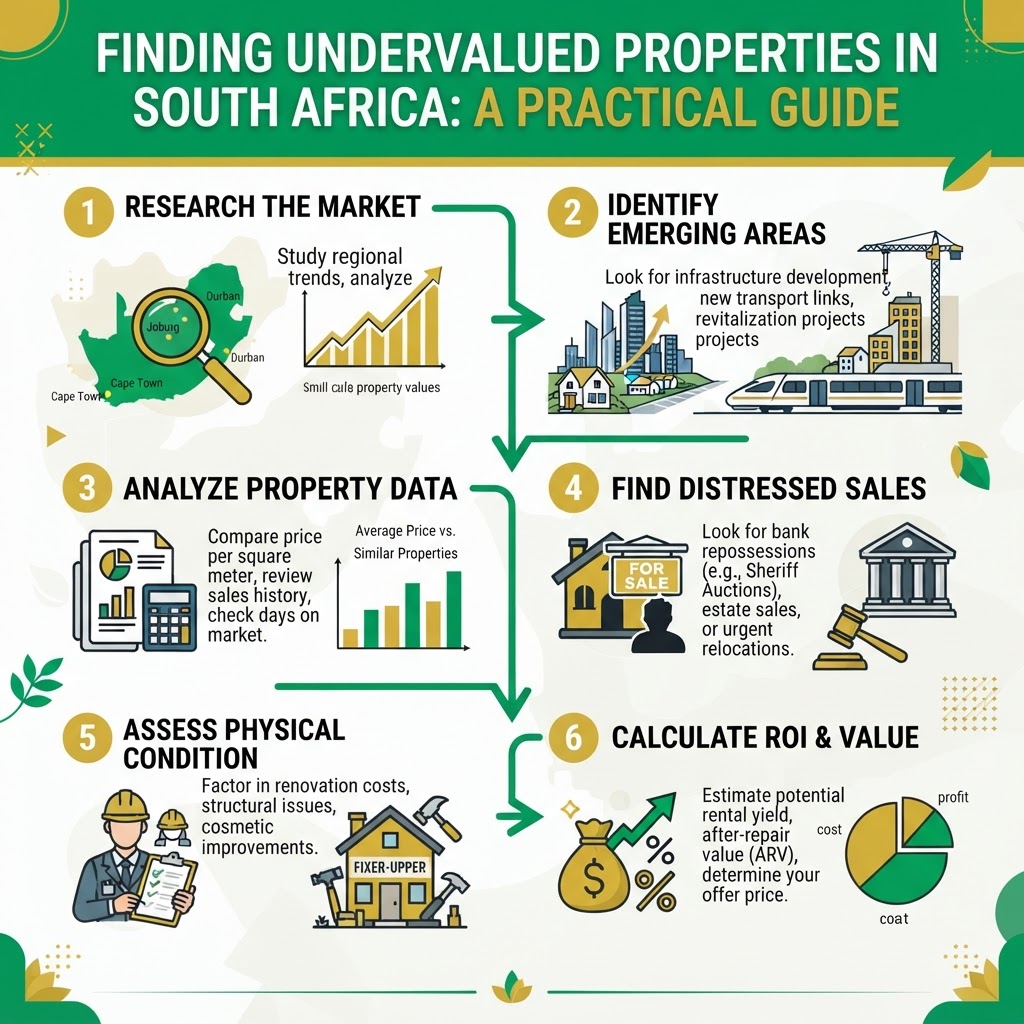
Fig. Key insights from this article — Finding Undervalued Properties in South Africa: A Practical Guide
A Step-by-Step Framework for Securing Undervalued Property Deals
Finding the deal is only half the work. Securing it — and securing it profitably — requires a repeatable process. Here is the framework I teach to families on the Mumbi Legacy platform:
- Define your buying criteria before you search. Know your target area, your price range, your preferred property type, and your exit strategy (rental hold, flip, or sectional title). Clarity speeds up decision-making enormously.
- Get pre-qualified for finance. Before you can move fast, you must know your numbers. Speak to a bond originator or your bank and understand exactly what you qualify for. Banks like FNB offer dedicated home loan advisors who can guide first-time investors through the process. A motivated seller will not wait for you to figure out your finances.
- Conduct rapid comparative market analysis. When you identify a potential deal, quickly establish what similar properties in the area have sold for in the past six to twelve months. Use Lightstone, Private Property, or ask your agent network. Know the true market value before you make a single offer.
- Inspect thoroughly and price in the problems. A property priced below market value because of cosmetic or structural issues is only a deal if your cost to repair it still leaves margin. Get a qualified building inspector through a registered professional — never skip this step on a distressed property.
- Make your offer compelling beyond just price. A motivated seller often values certainty and speed as much as price. An offer with a short suspensive condition period, a cash deposit, and a clean record of pre-approval can beat a higher offer with complicated conditions. Structure your offer to remove the seller's anxiety.
- Use a property attorney from the start. Never navigate a distressed, estate, or below-market-value deal without a qualified conveyancing attorney on your side. The legal protection is worth every cent. Ensure you work with a registered professional through the Property Practitioners Regulatory Authority.
Real-World Examples: South African Families Who Found the Deal
Allow me to share a few anonymised examples from families I have worked with and observed — each one instructive in a different way.
The Tshwane Deceased Estate — R180,000 Below Market Value
A couple in their early forties, both civil servants, identified a three-bedroom home in a stable Tshwane suburb that had been sitting in a deceased estate for eleven months. The executor was growing frustrated with the delays and lack of serious buyers. Our family made a clean, pre-approved offer — R180,000 below the asking price — with a fifteen-day suspensive condition and a substantial deposit. The executor accepted within four days. The property was tenanted within six weeks, cash-flow positive from month one, and valued R220,000 above their purchase price at the twelve-month mark.
The Johannesburg Cosmetic Distress Flip
A young professional in Johannesburg found a property in a sought-after suburb that had been badly neglected by an elderly owner who had moved into a retirement home. The garden was wild. The interior had not been touched in fifteen years. Every other buyer was scared off by the appearance. He bought it at R350,000 below comparable properties, spent R95,000 on cosmetic renovation, and listed it for rent at a premium to market — fully leased within three weeks. His equity position from day one was transformational.
The Motivated Emigration Seller in the Western Cape
A family in Cape Town connected with a seller who had accepted an international position and needed their property sold within sixty days or face losing the relocation package timing. They were not in distress financially — they simply valued speed above price. A fair but firm below-market offer, structured around their timeline, was accepted. The purchasing family secured a property in a high-demand area at 14% below what the seller would have achieved on the open market with patience.
"Wealth in property is rarely found at the listing price. It is found in the gap between what a property is and what it can become — and the wisdom to act while others hesitate." — Dr. Chomba Chuma
Common Mistakes That Cost South African Investors Dearly
I have seen talented, motivated families lose deals — and sometimes lose money — by falling into predictable traps. Here is what to watch for:
- Falling in love with the deal before the numbers work. Emotion is the enemy of sound property investment. If the numbers do not work on paper, walk away no matter how excited you feel.
- Underestimating renovation costs on distressed properties. Always add a 20% contingency buffer to any renovation quote. Hidden structural problems, rising material costs, and unreliable contractors are the norm, not the exception.
- Skipping due diligence because of time pressure. A motivated seller creating urgency is often legitimate — but it is never a reason to skip the deeds search, rates clearance verification, or building inspection. These checks protect you from purchasing someone else's liability.
- Not understanding the tax implications. Purchasing property in your personal name versus a trust or company has significant implications for capital gains tax, transfer duty, and estate duty. Understand these before you structure your purchase. The SARS website provides detailed guidance on property-related taxes, and our Trust Masterclass covers exactly how to structure your property portfolio for maximum protection and tax efficiency.
- Negotiating aggressively instead of strategically. Property negotiation tips that actually work are rooted in understanding what the seller needs, not just battering them down on price. The best negotiators are empathetic listeners who solve problems.
- Acting alone without a team. Property investment is a team sport. You need a good bond originator, a conveyancing attorney, a building inspector, and a mentor or community. Lone wolves make expensive mistakes.
Your Actionable Next Steps Toward Your First or Next Deal
Reading this article is a starting point — not a finish line. Here is how you take what you have learned and convert it into real action:
- Educate yourself deeply and systematically. My book, Build a Legacy, Touch Freedom (available for R799), walks you through the complete property wealth framework I have developed for South African families — from mindset to deal sourcing to portfolio structuring. It is the foundation everything else is built on.
- Follow a proven pathway. The Mumbi Legacy 6-Step Legacy Journey gives you a structured progression from financial education through to portfolio building and generational wealth transfer. Do not try to figure this out alone.
- Structure your investments correctly from day one. Before you buy your second property, understand how trusts and companies can protect your portfolio and reduce your tax burden. Our Trust Masterclass is the practical guide to getting this right.
- Deepen your investment strategy knowledge. Read our comprehensive Property Investment Strategy Guide for additional depth on portfolio building, rental yields, and long-term wealth accumulation through South African property.
- Book a free consultation. If you are ready to talk through your specific situation — your financial position, your goals, your timeline — book a free consultation with the Mumbi Legacy team. We work with real families in real circumstances, and we will give you honest, practical guidance tailored to where you are right now.
Your Legacy Begins with the Next Decision You Make
I want to leave you with something important. The families I have watched build extraordinary generational wealth through property in South Africa were not, in most cases, people with extraordinary advantages. They were teachers and nurses and civil servants and small business owners. What they had was a decision — a clear, committed decision that they were going to learn what they needed to learn and act on what they discovered.
Finding undervalued property in South Africa is not a secret skill reserved for the wealthy. It is a learnable, repeatable discipline. It requires patience, education, the right team around you, and the courage to make offers that most people would never make. It requires you to see possibility where others see problems, and to value education enough to invest in it before the deal arrives.
The nurse and the teacher from Soweto I mentioned at the beginning of this article are not special cases. They are what becomes possible when knowledge meets action. Your family's story can read the same way — or better. The next chapter depends on what you do with what you now know.
The best time to start building your property legacy was ten years ago. The second best time is today. We are here to walk that road with you.