

How to Analyze a Property Deal Using the RVR Method
How to Analyze a Property Deal Using the RVR Method: A South African Investor's Guide to Smart Property Analysis
Let me tell you about a family I worked with a few years ago. Thandi and Sipho, a couple from Soweto, had been saving diligently for over a decade. They had R180,000 set aside and were ready — absolutely ready — to buy their first investment property. They found a townhouse in Roodepoort, fell in love with the area, and were about to sign the offer to purchase. Then they called me. Within twenty minutes of running the numbers together, we discovered that the deal would have cost them R3,200 every single month out of pocket. They would have been buying stress, not wealth. That one conversation saved their family legacy. That conversation introduced them to what I call the RVR Method — and today, I want to share it with you.
If you are serious about property analysis in South Africa, if you want to stop guessing and start making decisions with confidence, this article is for you. Whether you are a first-time investor or someone looking to grow an existing portfolio, the RVR Method gives you a repeatable, reliable framework for property evaluation that will protect your capital and accelerate your wealth-building journey.
The Real Problem: Why South African Families Lose Money on Property
Property is widely regarded as one of the most powerful vehicles for building generational wealth in South Africa. And it absolutely can be. But here is the uncomfortable truth that nobody talks about at braais or family gatherings: most people who buy investment properties in this country are not investors — they are accidental landlords sitting on underperforming assets.
According to data consistently reported on platforms like Property24, the South African residential property market is enormous, with hundreds of thousands of transactions happening every year. Yet a significant proportion of landlords report negative monthly cash flow. Why? Because they bought emotionally, not analytically.
Here are the traps that ordinary families fall into:
- Buying based on aesthetics: A beautiful kitchen or a freshly painted face means nothing if the numbers do not work.
- Ignoring total holding costs: Bond repayments, rates, levies, insurance, maintenance, vacancy periods — these add up fast.
- Overestimating rental income: Many investors use the asking rental, not the achievable rental after vacancy factored in.
- Underestimating time: Property management is not passive income if you have no system — it becomes a second job.
- Skipping due diligence: Title deeds, zoning regulations, sectional title rules — skipping these can be catastrophic.
The South African middle class deserves better than this. Your family deserves a method — a real, tested method — that turns property from a gamble into a calculated strategy. That is exactly what the RVR Method delivers.
What Is the RVR Method? Understanding Rental Value Ratio
The RVR Method stands for Rental Value Ratio analysis, and it is Mumbi Legacy's proprietary framework for property investment screening in the South African context. It is not borrowed wholesale from American real estate books or European models. It has been adapted, tested, and refined specifically for our market — our interest rates, our rental yields, our sectional title regulations, our municipal billing systems, and our unique socioeconomic realities.
At its core, the RVR Method answers one fundamental question before you spend a single rand on a deal: Does this property have the potential to pay for itself, build equity, and generate positive cash flow over time?
"A property is not an investment simply because someone is selling it. A property becomes an investment the moment its numbers prove it deserves your money." — Dr. Chomba Chuma, Mumbi Legacy
The RVR Method consists of three integrated layers of analysis:
- R — Rental Yield Analysis: What does the market actually pay for this type of property in this location?
- V — Value Assessment: Is the asking price fair relative to comparable sales, income potential, and long-term capital growth prospects?
- R — Return on Investment Calculation: After all costs, what does this deal actually return — monthly and annually?
When these three layers align favourably, you have a deal worth pursuing. When they do not, you walk away — no matter how beautiful the kitchen is.
Step-by-Step Guide to Applying the RVR Method for Property Analysis in South Africa
Let us now walk through the method practically, step by step. Get a notebook. Run these numbers on an actual deal you are currently considering.
Step 1: Establish the Gross Rental Yield (GRY)
The Gross Rental Yield is your first filter. It tells you, at a high level, whether the purchase price is even in the right ballpark relative to rental income potential.
The formula is simple:
GRY = (Annual Rental Income ÷ Purchase Price) × 100
For example, if a property costs R1,200,000 and achieves R9,000 per month in rent:
Annual income = R9,000 × 12 = R108,000
GRY = (R108,000 ÷ R1,200,000) × 100 = 9%
In the South African market, a gross rental yield of 8% to 12% is generally considered healthy for residential investment property. Anything below 6% should raise immediate red flags unless the capital growth story is extraordinarily compelling. Research current market benchmarks and rental trends on platforms like Private Property to validate your rental income assumptions before moving forward.
Step 2: Calculate Total Monthly Expenses (TME)
This is where most investors fail — they only think about the bond repayment. The RVR Method requires you to account for every rand that leaves your pocket each month:
- Bond repayment (use a bond calculator from FNB or your preferred bank)
- Municipal rates and taxes
- Levies (if sectional title or estate property)
- Building insurance
- Property management fees (typically 8–10% of rental income)
- Maintenance provision (budget 1% of property value per year, divided monthly)
- Vacancy allowance (budget for at least 1 month per year — roughly 8.3%)
- Accounting and administrative costs
Add all of these together. That is your Total Monthly Expense figure.
Step 3: Determine Net Cash Flow (NCF)
Now the moment of truth. Subtract your Total Monthly Expenses from your expected monthly rental income:
NCF = Monthly Rental Income − Total Monthly Expenses
A positive NCF means the property pays for itself and puts money in your pocket. A negative NCF means you are subsidising the property every month — and unless you have a very deliberate, well-resourced strategy for doing so, this is a warning sign. For most South African middle-class families building their first or second investment property, cash flow neutrality or positivity is non-negotiable.
Step 4: Apply the Value Assessment (The V in RVR)
Now assess whether the purchase price itself is rational. Look at:
- Comparable sales (comps): What have similar properties in the same area sold for in the last 6 to 12 months? The Deeds Office records, accessible via official government portals, provide verified transfer data.
- Price-to-rent ratio: Divide the purchase price by the annual rental income. A ratio below 15 is generally favourable in South Africa.
- Area growth indicators: Is there infrastructure development nearby? Is the municipality functional? Are schools and amenities improving?
- Vacancy rates in the area: A beautiful property in an oversupplied rental market is still a risk.
Step 5: Calculate Your Return on Investment (ROI)
The final R in our method is the full Return on Investment picture. This includes both your income return and your capital growth estimate:
Total Annual ROI = (Net Annual Cash Flow + Estimated Annual Capital Growth) ÷ Total Cash Invested × 100
Your total cash invested includes your deposit, transfer costs, bond initiation fees, and any immediate renovation costs. This number tells you the true efficiency of your capital deployment. Compare it to alternative investments — unit trusts, ETFs, or even a high-interest savings account — and ask yourself whether this property justifies the risk, time, and capital you are committing.
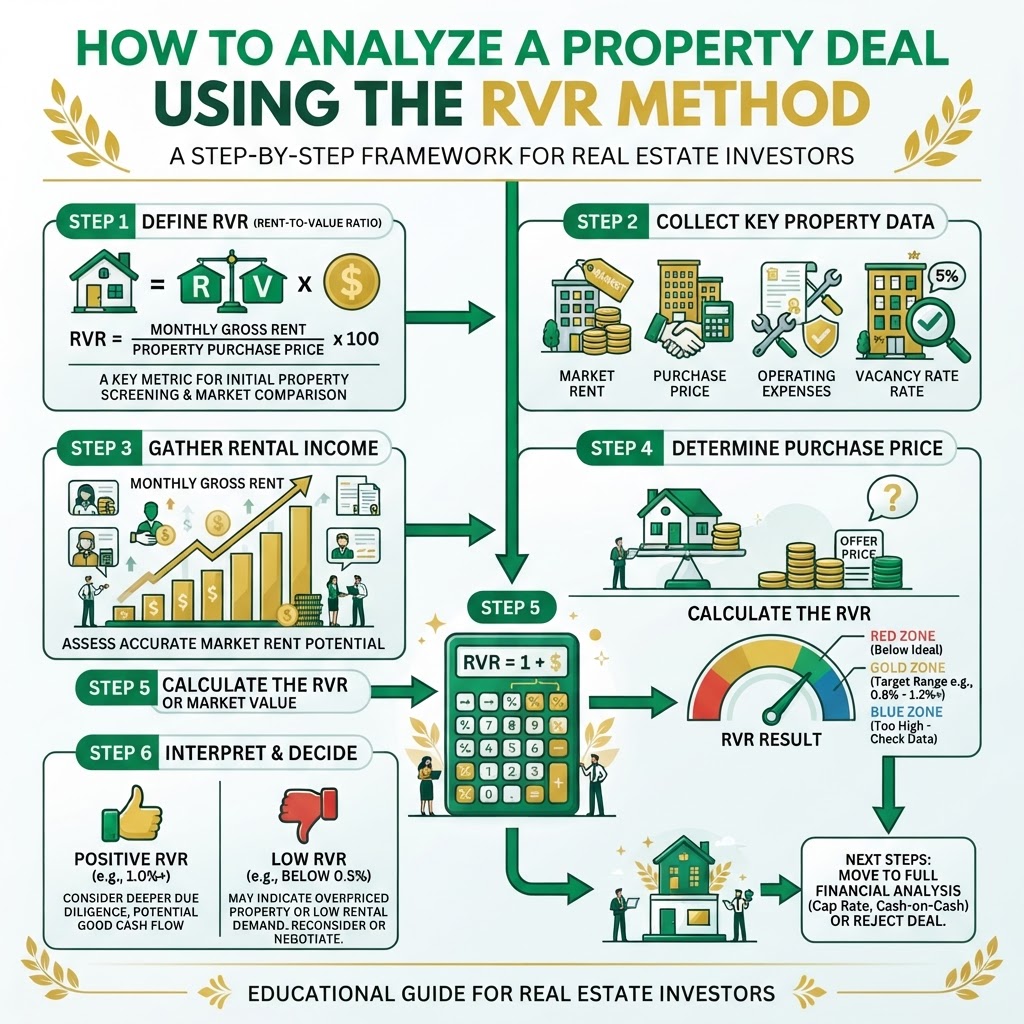
Fig. Key insights from this article — How to Analyze a Property Deal Using the RVR Method
Real-World RVR Case Studies: What the Numbers Look Like in Practice
Let us look at two anonymised examples drawn from real consultations with Mumbi Legacy clients.
Case Study A: The Deal That Looked Good but Was Not
A client — let us call him Mandla — came to us excited about a two-bedroom apartment in Centurion listed at R950,000. The estate agent told him he could rent it for R8,500 per month. Mandla was ready to sign.
We ran the RVR Method:
- GRY = (R102,000 ÷ R950,000) × 100 = 10.7% — looked great on paper
- Bond repayment at prime + 1% over 20 years: approximately R9,100/month
- Levy: R1,800/month
- Rates: R800/month
- Insurance: R350/month
- Management fee: R850/month
- Maintenance provision: R792/month
- Vacancy allowance: R708/month
- Total Monthly Expenses: R14,400
Net Cash Flow = R8,500 − R14,400 = −R5,900 per month
Mandla would have been paying nearly R6,000 every month to own this property. Over five years, that is R354,000 out of pocket — before any major maintenance issues. We helped him walk away and redirect his search. Six months later, he found a deal in the East Rand that returned a positive R1,200 per month from day one.
Case Study B: The Overlooked Gem
A client we will call Nolwazi was hesitant about a dated-looking three-bedroom house in a small Limpopo town, listed at R620,000. It did not look glamorous. But the local hospital and government offices created strong, stable tenant demand.
- Expected rental: R7,200/month (confirmed through local agent research)
- GRY = (R86,400 ÷ R620,000) × 100 = 13.9%
- Total monthly expenses (including bond, rates, insurance, management): R5,800/month
- Net Cash Flow: +R1,400/month
Nolwazi bought the property, placed a government employee as a tenant within three weeks, and has had consistent occupancy since. Not glamorous. Extremely effective. This is what the RVR Method for property evaluation is designed to surface.
Common Mistakes to Avoid When Screening Investment Properties
Even with a solid method in hand, investors can still make avoidable errors. Here are the most common ones I see among South African buyers:
- Trusting the agent's rental estimate without verification: Always get independent rental comparisons. Speak to local property managers directly.
- Ignoring special levies: In sectional title schemes, a special levy can appear at any time and significantly impact your cash flow. Always request the scheme's financials and meeting minutes.
- Forgetting SARS obligations: Rental income is taxable. Visit SARS to understand your tax obligations as a landlord. Many investors are caught off guard when the taxman comes knocking.
- Buying in the wrong ownership structure: Owning property in your personal name versus in a company or trust has significant legal, tax, and estate planning implications. This is a conversation worth having with a professional before you sign.
- Not reading the title deed: Servitudes, restrictions, and other conditions registered on the title deed can dramatically affect what you can do with a property. Always review the title deed through the Deeds Office before purchasing.
- Skipping the building inspection: A professional inspection can uncover hidden defects that would destroy your cash flow projections. This is non-negotiable.
"The most expensive mistake in property is not the deal you lost — it is the deal you should never have done. The RVR Method exists so that you know the difference before you sign." — Dr. Chomba Chuma, Mumbi Legacy
How to Use the RVR Method as Part of a Long-Term Property Investment Strategy
The RVR Method is not just a screening tool for individual deals — it is a mindset shift. Once you begin analysing every opportunity through this lens, something profound happens: you stop seeing properties and start seeing financial instruments. You stop buying walls and start buying cash flow. That shift in perspective is the foundation of true generational wealth.
Here is how to integrate the RVR Method into your broader property investment strategy in South Africa:
- Build your criteria first: Before you look at a single listing, define your minimum acceptable GRY, your target cash flow, and your maximum purchase price based on available capital. Let your criteria filter the market — not your emotions.
- Analyse at least 20 deals before making an offer: This builds pattern recognition. You will begin to instinctively know when something is off — or when something is exceptional.
- Track your portfolio performance quarterly: The RVR Method applies not just to acquisitions but to ongoing management. Every quarter, run the numbers on properties you already own. Underperforming assets can be improved or should be sold.
- Review your ownership structures annually: As your portfolio grows, your tax exposure and estate planning needs change. A trust or company structure may become advantageous. Our Trust Masterclass covers this in detail for South African investors.
- Reinvest strategically: Positive cash flow from one property should be channelled deliberately — not spent. This is how one property becomes three, and three becomes ten. This is how a legacy is built.
For a comprehensive framework that takes you from your first property to a multi-asset portfolio, download our free property investment strategy guide. It builds directly on the RVR principles covered in this article and gives you templates, checklists, and worked examples tailored to the South African market.
Your Next Steps: Start Building Your Property Legacy Today
Knowledge without action is just entertainment. So here is what I want you to do this week — not someday, this week:
- Find one property listing in an area you are interested in on Property24 or Private Property. It does not have to be one you can afford today. Just find one.
- Run the RVR Method on it using the steps in this article. Write down every number. See what the deal actually looks like beneath the photographs.
- Compare your findings to at least two other listings in the same area. Start building your analytical muscle.
- Read Build a Legacy, Touch Freedom — my book that covers not just property analysis, but the complete blueprint for building generational wealth in South Africa through property, trust structures, business, and mindset. Get your copy now at our online shop for just R799. It is the most affordable investment in your family's future that you will make this year.
- Start the Legacy Journey — our structured six-step legacy journey walks you through every phase of building a property portfolio, from mindset and financing to acquisition, structuring, and succession. It is designed specifically for South African families like yours.
- Book a free consultation — if you have a deal you are considering right now, or if you want to discuss where to start, book a free consultation with the Mumbi Legacy team. We will run the numbers with you and give you honest, expert guidance — no pressure, no sales agenda, just clarity.
"Every great family legacy started with one decision — the decision to learn, to act, and to build something that outlasts you. That decision is available to you right now." — Dr. Chomba Chuma, Mumbi Legacy
Conclusion: Your Family Deserves a Method, Not a Miracle
The RVR Method is not magic. It is not a shortcut. It is not a promise that every deal will work or that the market will always cooperate. What it is — and what I have seen it do time and again for South African families who use it — is a reliable, repeatable framework for making decisions with clarity instead of fear, with data instead of emotion, and with purpose instead of hope.
Thandi and Sipho, the couple I mentioned at the beginning of this article, went on to purchase their first investment property using the RVR Method eighteen months after that initial conversation. It was a modest three-bedroom home in Krugersdorp. It generates R1,850 in positive cash flow every single month. That money is now being saved for their second acquisition. Their children will inherit not just a property — they will inherit a system, a mindset, and a foundation that can grow for generations.
That is what we are building at Mumbi Legacy. Not just property portfolios — legacies. Not just landlords — wealth architects. And that work begins with something as practical, as accessible, and as powerful as knowing how to analyze a property deal using the RVR Method.
Now you know. The only question is — what will you do with it?
To your legacy, always.
Dr. Chomba Chuma, MD
Founder, Mumbi Legacy