How to Build a R5 Million Property Portfolio on a Middle-Class Salary
How to Build a R5 Million Property Portfolio on a Middle-Class Salary in South Africa
Let me tell you about Thandi. She was a 34-year-old teacher in Pretoria, earning R28,000 a month, raising two children, and feeling like property investment was something reserved for the wealthy. She had no inheritance, no silent business partner, and no financial safety net. What she did have was a willingness to learn, a strategy, and the discipline to follow it. Seven years later, Thandi owns three properties with a combined value just over R4.8 million — and she is months away from that R5 million milestone. Her story is not unique. It is, in fact, the story I want to write for you today. If you are part of South Africa's middle class, working hard, paying your taxes, and wondering whether building a property portfolio is truly within your reach — this article is your answer. And that answer is yes.
"Wealth is not about how much you earn. It is about what you do with what you earn — consistently, strategically, and with a long-term vision." — Dr. Chomba Chuma, Mumbi Legacy
The Real Wealth Crisis Facing South African Middle-Class Families
South Africa has one of the most unequal economies in the world. The Gini coefficient consistently places us among the top countries for income inequality. But here is what most financial conversations miss: the middle class — teachers, nurses, engineers, public servants, and small business owners — sits in a uniquely frustrating position. You earn too much to qualify for government housing subsidies, yet you feel too stretched to invest meaningfully. You are caught in what I call the middle-class wealth trap.
The truth is that most middle-income South African families spend their working lives building someone else's wealth. They rent for decades or they buy one home and treat it as an expense rather than an asset. Retirement creeps up, and suddenly the pension is not enough, the children need help, and the dream of generational wealth feels like it slipped through the cracks. This is not a failure of character. It is a failure of financial education and a lack of a clear property investment strategy.
According to data from Property24, the South African residential property market continues to show resilience, with first-time buyers making up a significant portion of bond registrations each year. The opportunity is real. The market is accessible. What most people are missing is the roadmap.
Why Property Remains the Most Reliable Vehicle for Middle-Class Wealth Building
Before we get into the how, let us be clear about the why. In South Africa, property investment offers several advantages that other asset classes simply cannot match for the average middle-income earner:
- Leverage: You can control a R1 million asset with as little as R100,000 in a deposit. No stock market investment allows you that kind of leverage with the same level of security.
- Rental income: Property generates monthly cash flow that can cover your bond repayments and, over time, put money back in your pocket.
- Capital appreciation: Well-located South African properties have historically appreciated over time, growing your net worth passively.
- Tax benefits: Rental income expenses, including maintenance, rates, and bond interest, are tax-deductible. Visit SARS for the full breakdown of allowable deductions.
- Tangible legacy: Unlike stocks, you can physically transfer property to your children through a well-structured estate or trust.
Property does not make you rich overnight. But it does something more powerful — it builds durable, transferable wealth across generations. That is the Mumbi Legacy way.
The Mumbi Legacy Strategy: Building Your R5 Million Property Portfolio Step by Step
At Mumbi Legacy, we have refined a practical, repeatable framework for middle-class South Africans to build a property portfolio worth R5 million and beyond. This is not theory. This is a system we have seen work for real people across Gauteng, the Western Cape, KwaZulu-Natal, and beyond. Here is how it works:
Step 1 — Clean Up Your Financial Foundation
Before you buy a single property, you must be investable. That means your credit score needs to be in good standing, your debt-to-income ratio needs to be manageable, and you need to have a documented record of consistent savings. Banks assess your affordability based on your monthly commitments versus your income. Start by pulling your credit report, settling any judgments, and reducing short-term debt aggressively. This step alone can take three to six months, but it is non-negotiable.
Step 2 — Start With Your Primary Residence as an Asset
Your first home should never be seen as just a place to live. It is your first investment vehicle. Buy in a growth area — a neighbourhood with improving infrastructure, proximity to schools, transport nodes, and commercial development. Do not buy the most expensive home your bank will approve. Buy strategically below your maximum affordability, leaving room for future bonds. As the property appreciates and your bond reduces, you accumulate equity — and that equity becomes your seed capital for the next investment.
Step 3 — Use Equity to Fund Your Second Property
After two to four years, with consistent repayments and capital growth, you may have R150,000 to R300,000 in accessible equity in your primary home. You can apply to your bank for an access bond or a further advance. This becomes your deposit for your second property — an investment property designed to generate rental income. At this point, your strategy shifts from home ownership to deliberate portfolio construction. Check with institutions like FNB Home Loans for their equity release products and eligibility criteria.
Step 4 — Choose Properties That Pay for Themselves
Your investment properties must be cash flow positive or at worst cash flow neutral. That means the rental income should cover or nearly cover the bond repayment, rates, and levies. To achieve this, you need to buy at the right price, in the right area, with the right tenant profile in mind. Sectional title units in high-demand rental nodes — near universities, hospitals, or business districts — tend to offer the best yield-to-price ratio for middle-income investors. Always do a rental yield calculation before committing. A gross yield of 7% to 10% is a healthy benchmark in most South African markets.
Step 5 — Repeat the Cycle With Discipline
This is where most people stop, but it is also where the real portfolio building begins. As each property grows in value and your tenants reduce the bond, you accumulate more equity. You recycle that equity, maintain your credit profile, and add properties systematically — one every two to three years. By year seven to ten, a disciplined middle-income investor with a starting salary of R25,000 to R40,000 per month can realistically own three to five properties with a combined value approaching or exceeding R5 million.
Step 6 — Protect the Portfolio Through a Legal Structure
Building wealth without protecting it is like filling a bucket with a hole in it. As your portfolio grows, you must think about structure — whether that means transferring properties into a family trust, a company, or a combination of both. This protects your assets from personal liability, enables seamless estate planning, and can reduce your estate duty exposure significantly. Our Trust Masterclass walks you through exactly how to structure your property portfolio for maximum protection and intergenerational transfer.
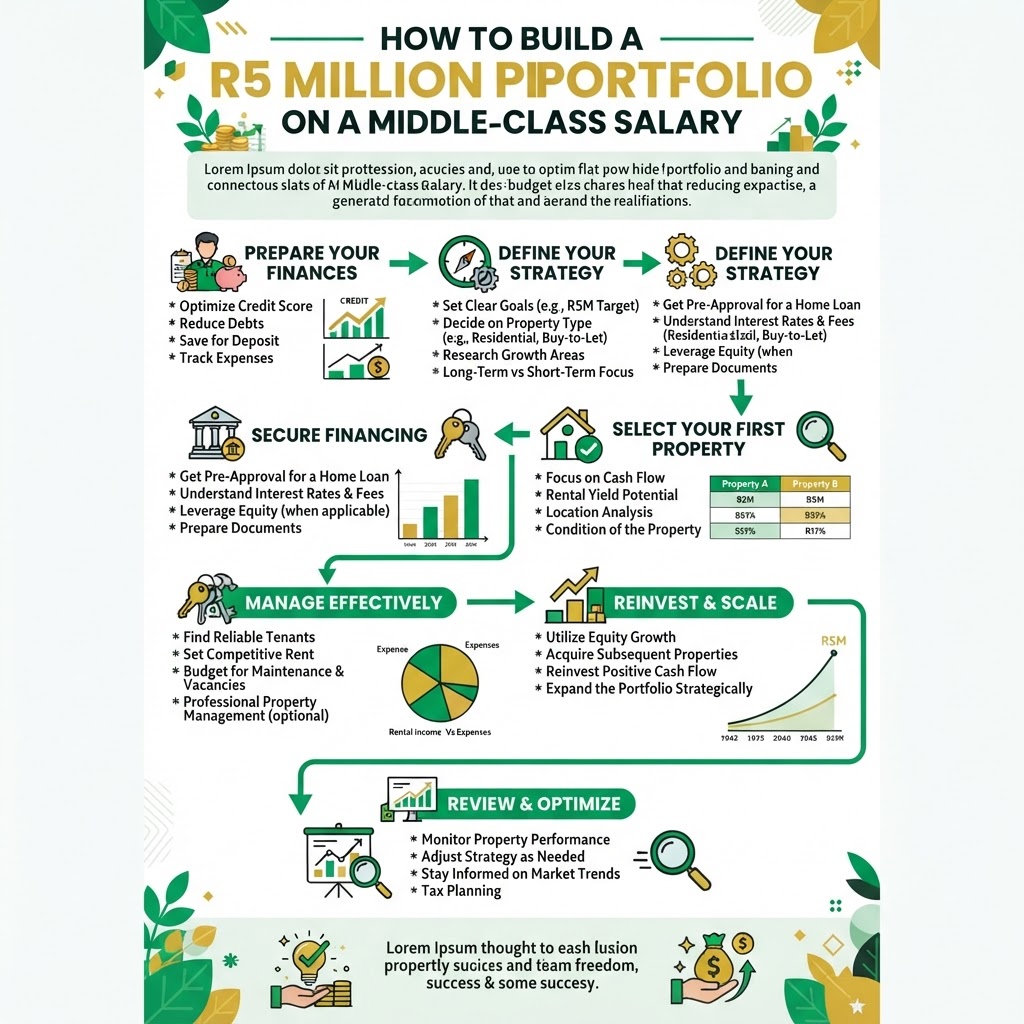
Fig. Key insights from this article — How to Build a R5 Million Property Portfolio on a Middle-Class Salary
Real Stories: How Ordinary South Africans Hit the R5 Million Mark
Case Study 1 — The Schoolteacher From Pretoria
We met Thandi at the start of this article. Her first purchase was a two-bedroom sectional title unit in Centurion for R820,000 in 2016. She lived in it for three years while aggressively paying down her bond. In 2019, she accessed R180,000 in equity and used it as a deposit on a one-bedroom apartment near the University of Pretoria — tenanted immediately at R7,200 per month. By 2022, she had refinanced again and added a third property, a townhouse in Midrand, valued at R1.35 million. Her total portfolio value today sits at R4.8 million, with combined rental income of R18,500 per month covering most of her bond repayments. Thandi is on track to retire comfortably — on a teacher's salary.
Case Study 2 — The Couple From Cape Town
Sipho and Lindiwe, both in their early 40s and working in the healthcare sector, had a combined income of R65,000 per month but no investments when they attended a Mumbi Legacy workshop in 2020. They felt it was too late to start. Within four years, following our 6-step legacy journey, they purchased two properties — one in Bellville and one in Parow — and are currently building equity toward a third. Their portfolio is currently valued at just over R3.2 million. More importantly, they have established a family trust to ensure those properties transfer to their children without unnecessary estate costs or disputes.
Common Mistakes That Keep Middle-Class Investors Stuck
After working with hundreds of families across South Africa, I have seen the same patterns of error repeat themselves. Here are the most damaging ones — and how to avoid them:
- Waiting for the perfect time: There is no perfect time to invest. Property markets go through cycles, but time in the market consistently outperforms timing the market. The best time to start is always now.
- Buying with emotion instead of data: Your investment property is not your dream home. It is a business. Buy based on rental yield, location fundamentals, and demand — not aesthetics.
- Ignoring the legal and structural side: Many investors build portfolios in their personal names without considering what happens at death or divorce. This is a costly and often irreversible mistake. Structure matters from day one.
- Over-leveraging too quickly: Ambition is good. Recklessness is not. Each property must be financially sustainable before you move to the next. Cash flow management is the engine of portfolio growth.
- Not understanding tax obligations: Rental income is taxable in South Africa. Failure to declare it is a risk you cannot afford. Work with a tax practitioner and familiarise yourself with SARS guidelines for property investors.
- Skipping due diligence: Always verify that a property has a clear title deed through the Property Practitioners Regulatory Authority and ensure your agent is properly registered before engaging in any transaction.
Your Practical Action Plan: Starting Today
Knowledge without action is just entertainment. Here is what I want you to do in the next 30 days to begin your journey toward a R5 million property portfolio:
- Assess your financial baseline: Pull your credit report, list all your monthly expenses and income, and calculate your current debt-to-income ratio. Be honest with yourself.
- Define your target: How many properties do you want? In what areas? With what rental yield? Write this down as a concrete goal with a timeline.
- Get educated: Download our free Property Investment Strategy Guide and read it cover to cover. Understanding the language and logic of property investment is the foundation of everything else.
- Speak to a bond originator: Find out exactly what you qualify for today. This gives you a realistic starting point and helps you understand what improvements to your financial profile would increase your borrowing power.
- Choose your first target area: Research two or three neighbourhoods that align with your budget and investment thesis. Visit open houses. Talk to local agents. Start building your market knowledge.
- Get the right guidance: Consider investing in your financial education before you invest in property. Our book, Build a Legacy, Touch Freedom, available for R799, walks you through the complete Mumbi Legacy wealth-building philosophy with practical frameworks you can apply immediately.
- Protect what you build: As soon as your portfolio starts to grow, explore how a trust structure can protect your assets and streamline estate planning for your family. Our Trust Masterclass is the most comprehensive resource on this topic for South African property investors.
"The middle class in South Africa is not too poor to invest. They are too uninformed not to. Once you have the strategy, the discipline, and the right structure — the portfolio builds itself." — Dr. Chomba Chuma, Mumbi Legacy
Building Generational Wealth Is a Decision, Not a Destination
A R5 million property portfolio sounds like a big number. But when you break it down — one property at a time, one strategic decision at a time — it becomes not just achievable but inevitable for those who commit to the process. The middle class in South Africa has been told for too long that wealth is for other people. That investing is too complex, too risky, or too far away. I am here to tell you that none of that is true.
What is true is that generational wealth does not happen by accident. It is built intentionally, protected legally, and passed on deliberately. The families who change their financial trajectory in this generation are not necessarily the highest earners. They are the most committed learners and the most disciplined actors. They are people like Thandi, like Sipho and Lindiwe, like thousands of Mumbi Legacy community members who decided that their children would inherit assets, not debt.
That decision begins with you, right now, on this page.
If you are ready to stop wondering and start building, I invite you to take your next step today. Get your copy of Build a Legacy, Touch Freedom and start building your property investment knowledge from the ground up. Or, if you want a personalised roadmap tailored to your income, goals, and timeline, book a free consultation with our team and let us walk this journey with you. And if you are ready to commit fully to the process, explore our 6-step legacy journey — the most complete system we have built to take you from where you are to where you deserve to be.
Your legacy does not start with a million rands. It starts with a decision. Make it today.