
Sectional Title vs Freehold: Which Property Type Builds More Wealth?
Sectional Title vs Freehold: Which Property Type Builds More Wealth in South Africa?
Let me tell you about Thandi. She is a 38-year-old nurse from Soweto who saved for six years to buy her first investment property. When she finally had her deposit ready, she sat across from a property agent who presented her with two options: a neat two-bedroom sectional title apartment in Midrand for R850,000, or a freehold townhouse on the outskirts of Pretoria East for R1.1 million. Thandi froze. She had no idea which one would actually grow her wealth — and she was terrified of making the wrong choice. If you have ever stood at that same crossroads, this article is written specifically for you. Understanding the difference between sectional title vs freehold is not just a technical exercise — it is one of the most important financial decisions a South African family can make on the road to generational wealth.
Why South African Families Struggle to Choose the Right Property Type
South Africa has one of the most dynamic property investment landscapes on the continent, yet many middle-class families approach property buying with incomplete information. The result? They either overpay, under-earn on rental yield, or get trapped in a structure that does not align with their long-term wealth goals.
The confusion is understandable. Estate agents are incentivised to sell, not to educate. Banks approve bonds without explaining the structural implications of ownership type. And family and friends — as well-meaning as they are — often give advice based on emotion rather than strategy.
Here at Mumbi Legacy, we see this every single day. Families who have worked incredibly hard to accumulate capital but who lack the roadmap to deploy it correctly. The sectional title vs freehold debate sits right at the heart of this challenge, and getting it wrong can cost you hundreds of thousands of rands in lost growth, unnecessary levies, or missed rental income over a decade.
"Property is not just an asset — it is a vehicle. The type of vehicle you choose determines how far and how fast your family travels toward financial freedom." — Dr. Chomba Chuma, Mumbi Legacy
Let us unpack both property types clearly, practically, and strategically — so you can make an informed decision for your family's future.
Understanding Sectional Title Properties in South Africa
A sectional title property is one where you own a specific section of a larger building or complex — typically a flat, apartment, or unit in a gated estate — along with a share of the common property. This type of ownership is governed by the Sectional Titles Schemes Management Act (STSMA), and it comes with both significant advantages and notable limitations.
What You Actually Own
When you buy a sectional title unit, you own the interior of your unit from wall to wall, floor to ceiling. The external walls, roof, garden areas, swimming pool, and other shared spaces are owned collectively by all unit owners through a Body Corporate. Every owner contributes to the maintenance and management of these shared areas through monthly sectional title levies.
The Role of Levies
Sectional title levies are the monthly contributions you pay to the Body Corporate for the upkeep of the scheme. These include administrative levies, reserve fund contributions, and sometimes special levies for unexpected large expenses like roof repairs or elevator maintenance. In South Africa, levies can range from as low as R500 per month in smaller complexes to over R4,000 per month in premium developments.
This is critical for your buy-to-let property calculations. If your rental income is R8,500 per month but your levy is R2,200, your bond repayment is R5,800, and you factor in rates and taxes, you could easily find yourself cash-flow negative — which defeats the purpose of investing.
- Advantages of Sectional Title:
- Lower entry price point compared to freehold
- Security features often included (guards, electric fencing, access control)
- Maintenance of external areas managed by Body Corporate
- Strong rental demand in urban areas from young professionals
- Easier to manage as a landlord — less maintenance responsibility
- Located in convenient, high-density areas near transport and amenities
- Disadvantages of Sectional Title:
- Monthly levies reduce net rental yield
- Limited control over Body Corporate decisions
- Special levies can arise unexpectedly
- Rules and conduct regulations restrict usage
- Capital appreciation can be slower in oversupplied complexes
- Pets, renovations, and Airbnb may be restricted
For more detailed information on sectional title regulations in South Africa, the Property Practitioners Regulatory Authority (PPRA) is an excellent and authoritative resource.
Understanding Freehold Property in South Africa
A freehold property — also called a full-title property — is one where you own both the structure and the land on which it stands, outright and without shared ownership obligations. This is the most traditional form of property ownership in South Africa, and it includes standalone houses, smallholdings, and full-title townhouses.
Complete Ownership, Complete Responsibility
With freehold, you are the sovereign of your property. You decide when to build a granny flat, when to paint the walls, whether to run a home business from the garage, or how to landscape the garden. This autonomy is extraordinarily powerful for wealth-building because it gives you development potential — the ability to add value and increase rental income through improvements.
Capital Appreciation Potential
Historically, well-located freehold properties in South Africa have shown stronger long-term capital appreciation than sectional title units, particularly when land scarcity increases. Land is a finite resource. As urban areas densify and development land becomes scarce, the value of freehold land tends to appreciate more aggressively. According to data from Property24, freehold properties in high-demand suburbs have consistently outperformed sectional title units over 10-year horizons in terms of price growth.
- Advantages of Freehold:
- Complete ownership including land
- No Body Corporate or monthly levies
- Greater development potential — add rooms, flats, outbuildings
- Stronger long-term capital appreciation in most markets
- Full autonomy over renovation, rental, and usage
- Can be held in a family trust for estate planning purposes
- Easier to subdivide in certain municipalities
- Disadvantages of Freehold:
- Higher purchase price and deposit requirement
- Owner responsible for all external maintenance costs
- Security typically self-funded
- May be located further from urban centres at entry-level price points
- Greater hands-on management as a landlord
A Practical Strategy for Choosing Between the Two
The honest answer is that neither sectional title nor freehold is universally superior. The right choice depends on your investment stage, budget, risk appetite, and long-term legacy goals. Here is a strategic framework that we use with our Mumbi Legacy clients:
- Clarify your investment goal first. Are you buying for monthly cash flow (rental income), long-term capital growth, or both? Sectional title units in high-demand urban areas often deliver stronger short-term rental yields. Freehold properties typically deliver stronger long-term capital appreciation.
- Calculate the true cost of ownership. For sectional title, add levies, rates, and insurance to your bond repayment before calculating yield. For freehold, budget for maintenance reserves — typically 1% of the property value per year.
- Assess your management capacity. If you are a first-time investor with limited time, a well-managed sectional title complex reduces your maintenance burden. If you are a seasoned investor with capital, a freehold property gives you more control and upside.
- Evaluate the location and demand. In densely populated urban nodes like Johannesburg's inner suburbs, Durban beachfront, or Cape Town's Atlantic Seaboard, sectional title apartments offer exceptional rental demand. In growing township areas, emerging suburbs, and peri-urban zones, freehold land offers transformational growth potential.
- Consider your legacy structure. If your goal is to pass wealth to your children, freehold properties held inside a family trust provide far more flexibility and protection than sectional title units. This is where legal structuring becomes critical.
- Think about your portfolio progression. Many successful South African property investors start with a sectional title buy-to-let to build a track record with the bank, then progress to freehold properties with development potential as their portfolio grows.
For a deeper dive into building a complete property investment strategy in South Africa, I encourage you to read our comprehensive Investment Strategy Guide on the Mumbi Legacy website.
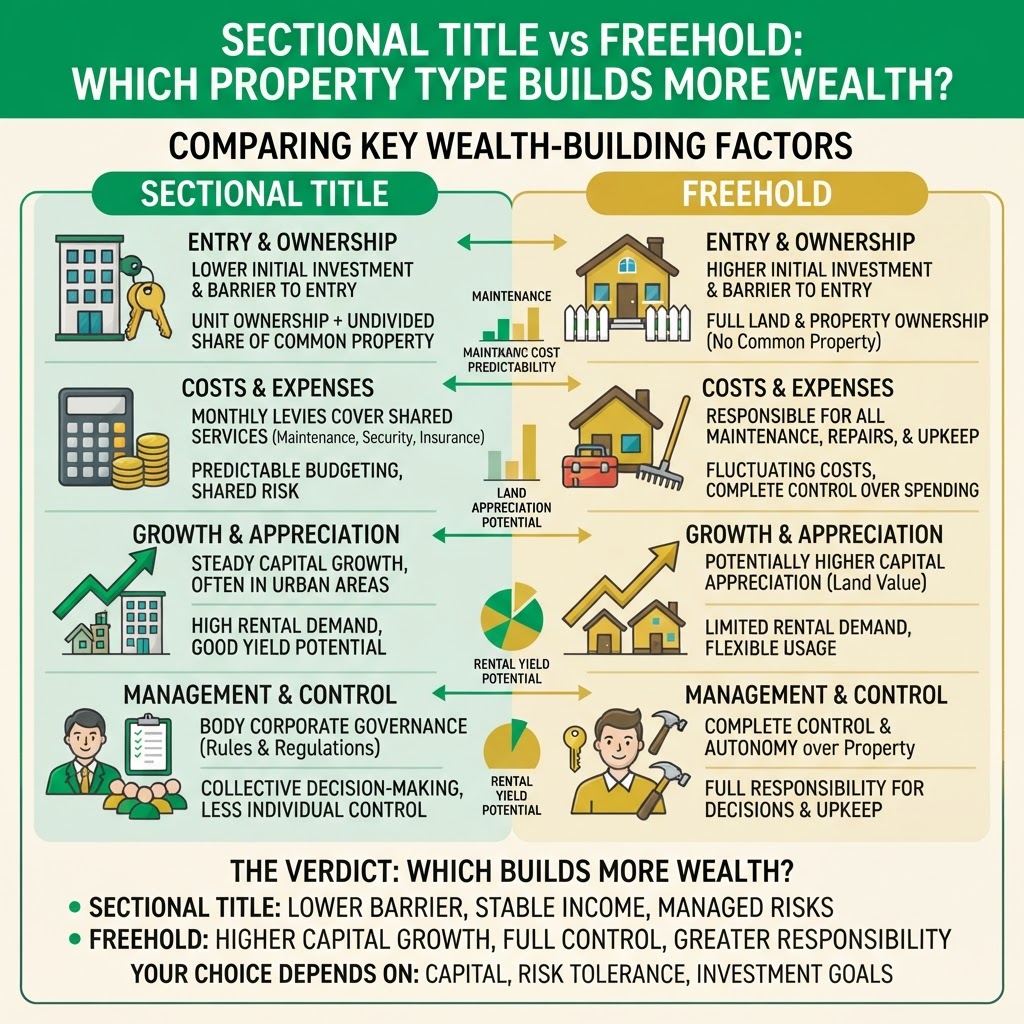
Fig. Key insights from this article — Sectional Title vs Freehold: Which Property Type Builds More Wealth?
Real-World Examples: What Works in Practice
Let me share two anonymised stories from clients who have walked through our Mumbi Legacy programme. Their experiences illustrate exactly how this decision plays out in the real world.
Case Study 1: The Sectional Title Success Story
Sipho, a 42-year-old civil engineer from Pretoria, purchased a one-bedroom sectional title apartment in Centurion for R620,000 in 2018. His monthly levy was R1,400, his bond repayment R4,850, and his rental income R6,800. His net cash flow was slightly negative at first — but here is what Sipho did right. He chose a complex close to the Gautrain station, ensuring perpetual rental demand from professionals and young couples who prioritised convenience. By 2023, the same unit was valued at R820,000 — a R200,000 gain — and his rental had increased to R8,200, making him cash-flow positive. The key was location discipline and tenant quality.
Case Study 2: The Freehold Wealth Multiplier
Nomsa, a 45-year-old teacher from Durban, purchased a three-bedroom freehold home in an emerging suburb north of Durban for R980,000 in 2019. The property had a spacious yard. Within 18 months, Nomsa had added a one-bedroom cottage at a cost of R180,000 — funded through a building loan. She now collects R7,500 from the main house and R4,800 from the cottage — a total of R12,300 per month in rental income. The property was recently valued at R1.6 million. Her total investment was approximately R1.16 million, and her asset is now worth R440,000 more — plus she generates positive cash flow every month. This is the power of freehold development potential.
"The wealthiest property investors I know did not simply buy and hold. They bought strategically, developed intentionally, and structured legally. That combination is unstoppable." — Dr. Chomba Chuma, Mumbi Legacy
Common Mistakes South African Investors Make
After working with hundreds of families across South Africa, I have seen the same costly mistakes repeat themselves. Here are the ones I urge you to avoid:
- Ignoring levies in the yield calculation. Many first-time buyers see the asking price and the rental estimate but forget to subtract levies, rates, insurance, and maintenance. Always calculate net yield — not gross yield.
- Buying in oversupplied complexes. Not all sectional title complexes are created equal. A complex with 200 units in an area with low demand will result in high vacancy, price competition, and stagnant capital growth. Research vacancy rates before you buy.
- Underestimating freehold maintenance costs. Freehold owners are responsible for everything — roof, plumbing, electrical, garden, perimeter walls. Without a maintenance reserve, one major repair can wipe out months of rental income.
- Buying in your personal name without a strategy. Whether you choose sectional title or freehold, buying investment property in your personal name exposes you to tax inefficiency and estate duty risk. Speak to a professional about trusts and company structures before you sign an offer to purchase.
- Neglecting the bond application strategy. South African banks like FNB Home Loans assess affordability differently for investment properties than for primary residences. Understanding how to position your application — including rental income projections — can be the difference between approval and rejection.
- Skipping due diligence on the Body Corporate. Before buying a sectional title unit, always request the last three years of Body Corporate financials, the levy structure, and any pending special levies. A poorly managed Body Corporate can be a financial nightmare.
- Thinking short-term. Property wealth is built over decades, not months. Investors who flip in and out of the market based on emotion consistently underperform those who buy strategically and hold with discipline.
Tax Implications You Must Understand
Whether you own a sectional title or freehold investment property, the South African Revenue Service (SARS) has clear rules on rental income, deductions, and capital gains tax. Your rental income is taxable, but you can deduct bond interest, levies, rates, insurance, agent fees, repairs, and depreciation on certain assets. Capital Gains Tax (CGT) applies when you sell at a profit. The SARS website provides detailed guidance on property-related tax obligations, and we strongly encourage every investor to consult a qualified tax practitioner before structuring their portfolio.
One of the most powerful legal strategies for managing property tax efficiently across generations is holding your assets inside a family trust. This is a topic we cover extensively in our Trust Masterclass — a resource I consider essential for any serious South African property investor.
Your Next Steps: Building a Property Legacy That Lasts
You now have a far clearer picture of the sectional title vs freehold landscape in South Africa. But knowledge without action is simply entertainment. Here is what I want you to do next:
- Define your wealth goal. Write down whether your priority is monthly income, long-term growth, or legacy creation. Your property type choice flows directly from this decision.
- Run your numbers honestly. Calculate net yield for any property you are considering — accounting for all costs including levies, rates, bond repayment, insurance, and a maintenance reserve.
- Get educated before you sign. My book, "Build a Legacy, Touch Freedom", walks South African families through a practical, proven framework for building property wealth across generations. At just R799, it is the single best investment you can make before your next property purchase. Get your copy here.
- Follow the Mumbi Legacy 6-step journey. We have designed a structured programme that takes you from financial awareness all the way through to a fully structured, multi-property portfolio. Start your Legacy Journey today.
- Book a free consultation. If you are ready to talk through your specific situation — your budget, your goals, your current assets — our team is here to help. Book your free consultation here.
Conclusion: The Property You Choose Shapes the Legacy You Leave
Thandi, the nurse from Soweto we met at the beginning of this article, eventually made her decision. After working through a clear framework, she purchased a freehold property with a separate flat already built on the plot. Today, both units are tenanted, her total rental income exceeds her bond repayment, and she is already planning her second purchase. She did not just buy a property — she started a legacy.
The sectional title vs freehold debate, at its core, is not really about bricks and mortar. It is about the future you are building — for yourself, for your children, and for the generations that will carry your name long after you are gone. Both property investment types in South Africa can build extraordinary wealth when chosen strategically, managed diligently, and structured legally.
The question is not which property type is better in the abstract. The question is: which property type is better for you, given your goals, your season of life, and the legacy you are called to build?
"Every great family legacy was built one intentional decision at a time. Your property choice today is a letter written to your grandchildren. Make it one they will be grateful for." — Dr. Chomba Chuma, MD & Founder, Mumbi Legacy
You have worked too hard and dreamed too long to leave this to chance. Let us help you get it right. Visit our bookshop, begin your Legacy Journey, or speak to our team today. The legacy you were meant to build is waiting — and it starts with the very next decision you make.