

Raising Financially Intelligent Children: Teaching the Next Generation About Wealth
Raising Financially Intelligent Children: Teaching the Next Generation About Wealth in South Africa
Imagine sitting at the dinner table with your twelve-year-old daughter, and she asks you, "Dad, why do we rent our house instead of owning it?" That question — simple, innocent, and yet devastatingly profound — stopped one of my clients, a senior engineer from Pretoria, completely in his tracks. He had a master's degree, a good salary, and twenty years of hard work behind him. But he had no answer. Not because he was unintelligent. But because nobody had ever taught him about money, property, or generational wealth either. This article is about breaking that cycle — for good. It is about financial education for children in South Africa, and why teaching kids about money is one of the most powerful investments you will ever make as a parent.
The Generational Wealth Gap: A South African Reality
South Africa sits in a uniquely challenging position when it comes to family wealth. Decades of economic exclusion have meant that millions of Black and Coloured families entered the democratic era without inherited assets, property portfolios, or the financial vocabulary needed to build wealth quickly. Even for families who have clawed their way into the middle class through education and employment, the generational wealth family structure that exists in wealthier communities — where parents pass down properties, trusts, and investments — remains largely absent.
According to data from Property24, property remains the single largest store of household wealth in South Africa. Yet far too many families treat property as a consumption asset — a roof over their heads — rather than a wealth-building tool that can be leveraged, grown, and transferred across generations.
The result? We produce generation after generation of highly educated, hardworking professionals who retire with little more than a pension fund and a prayer. The cycle does not break itself. We must break it deliberately. And the best place to start is with our children.
Why Financial Illiteracy Persists Across Generations
The reason financial illiteracy passes from parent to child is not laziness or lack of love. It is simply that we teach what we know. If your parents never discussed money openly, never explained the difference between an asset and a liability, and never involved you in financial decisions, you likely grew up financially silent — and that silence has a cost. Research from the South African government's financial sector reports consistently shows that financial literacy rates remain concerningly low across income brackets, not just among the poor.
The school curriculum does not adequately address personal finance. Children graduate knowing how to calculate the volume of a cylinder but not how to read a bank statement, understand compound interest, or assess a property deal. This is a systemic failure — but as parents, we cannot wait for the system to fix itself. We must act now.
Building a Legacy Mindset in Children: Where It All Begins
A legacy mindset in children does not begin with opening a savings account or buying your child their first share. It begins with language. With conversation. With the stories you tell and the values you model at home.
Children absorb everything. They watch how you react when the credit card bill arrives. They hear the anxiety in your voice when you talk about money. They notice whether you treat property as a dream deferred or an active goal being pursued. Before we give our children financial tools, we must give them a financial identity — a deep, unshakeable belief that wealth is not for other people, that property is within reach, and that their family is in the business of building something that lasts.
"The most valuable inheritance you can give your child is not a property — it is the mindset that knows how to acquire one." — Dr. Chomba Chuma, Founder of Mumbi Legacy
Age-Appropriate Financial Conversations
One of the most common questions I receive from parents is: "When is the right time to start talking to my children about money?" My answer is always the same — earlier than you think. Here is a general guide:
- Ages 4–7: Introduce the concept of money, saving, and waiting for things. Use a transparent piggy bank so they can see coins accumulating. Talk about needs versus wants.
- Ages 8–12: Introduce allowances tied to responsibilities. Teach them to divide money into three jars: spend, save, give. Begin talking about what a house is worth and why some families own their homes.
- Ages 13–17: Introduce basic investment concepts — interest, assets, liabilities. Show them your bond statement (if you have one) or explain what a mortgage is. Take them to show days for properties and explain what you are looking at.
- Ages 18+: Begin involving them in real financial decisions. Discuss family trusts, property structures, and the Mumbi Legacy 6-step legacy journey as a framework for building multigenerational wealth.
Teaching Kids About Money and Property: Practical Strategies That Work
Theory is beautiful, but South African families need practical tools they can implement this weekend — not after a five-year PhD in financial planning. Here are strategies I have personally seen transform families.
1. Make Money Visible and Real
Abstract conversations about "investing for the future" mean nothing to a ten-year-old. But showing your child a rental income transfer notification on your phone, and explaining "this is money our property earned while we slept," — that lands. Make wealth tangible. Print out a property listing. Drive through a neighbourhood you are considering investing in. Show them what R800,000 buys in one area versus another.
2. The Family Financial Meeting
Introduce a monthly family financial meeting. Keep it short — thirty minutes maximum. Review the family budget in age-appropriate terms. Celebrate wins. Discuss goals. Assign financial responsibilities to children based on their age. This practice builds financial confidence and removes the shame and secrecy that so many of us grew up with around money.
3. Involve Children in Property Research
When you are researching a potential investment property, involve your teenager. Ask them to look up comparable listings on Property24. Let them calculate a basic yield with you. Walk them through the logic of: "If we buy this flat for R650,000 and rent it for R6,500 a month, what return is that?" You are not just teaching maths — you are teaching a legacy mindset.
4. Open a Tax-Free Savings Account in Their Name
South Africa's tax-free savings accounts, regulated through SARS, allow individuals to invest up to R36,000 per year with all growth completely tax-free. Opening one in your child's name from an early age and contributing even small amounts consistently is a powerful way to demonstrate compound growth in action. Visit the SARS website for current regulations and limits.
5. Read and Learn Together
One of the most impactful things you can do is go on a financial learning journey alongside your child. Read books about wealth together. Discuss them at dinner. My book, Build a Legacy, Touch Freedom (available in our shop for R799), was written precisely for South African families who want a clear, culturally resonant roadmap for building property wealth and passing it to the next generation. It is not a dry textbook — it is a call to action, written for families just like yours.
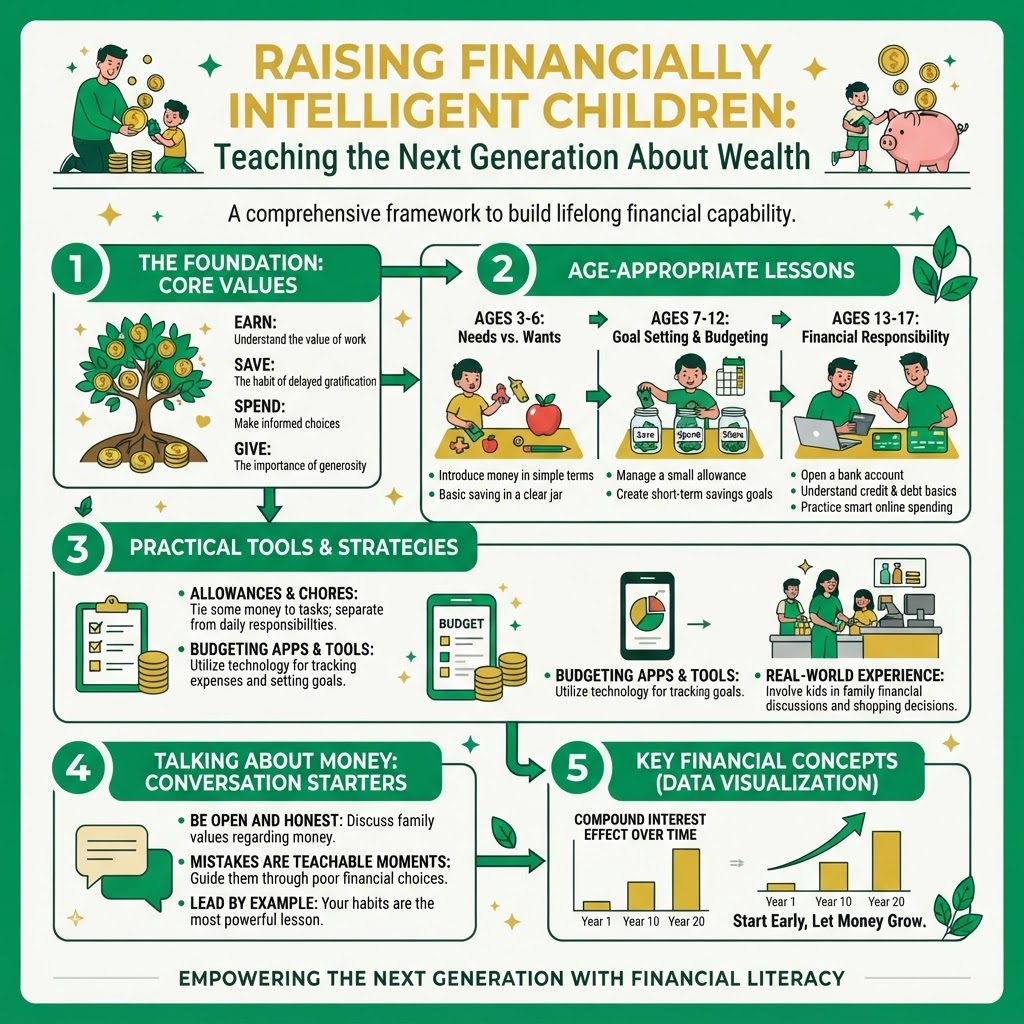
Fig. Key insights from this article — Raising Financially Intelligent Children: Teaching the Next Generation About Wealth
Real Families, Real Results: Case Studies in Legacy Building
Let me share a few anonymised stories from families I have had the privilege of working with through Mumbi Legacy. These are not extraordinary people with extraordinary incomes. They are ordinary South African families who made an extraordinary decision — to start.
The Dlamini Family — Durban
When Sipho and Nomvula came to me, they had one property — their family home in Durban North — and two teenagers they were desperate to set up for success. We worked together to restructure their finances, establish a family trust, and purchase a second buy-to-let unit in a developing suburb. But more importantly, we brought their children, aged fifteen and seventeen, into every conversation. Today, the elder child — now at university — is studying BCom and tells his parents he wants to buy his first investment property by twenty-five. The younger one manages a small trading account she started with her birthday money. The legacy mindset is alive in that household.
The Pietersen Family — Cape Town
Marcia is a single mother of three in Mitchells Plain. She came to a Mumbi Legacy workshop deeply sceptical that property investing was "not for people like her." Two years later, she owns a second property in Paarl that covers its own bond repayment through rental income. Every Sunday evening, she sits with her children and reviews the family's financial tracker together. Her eldest daughter, thirteen years old, recently told her teacher she wants to be a property investor when she grows up. That is legacy in motion.
The Mokoena Family — Johannesburg
Thabo is a high school teacher. His wife, Lerato, is a nurse. Combined income — solid, but not extravagant. They discovered Mumbi Legacy through a friend and enrolled in our Trust Masterclass, which taught them how to structure property ownership through a family trust for tax efficiency and generational transfer. They now have three properties held in trust, with their two young children named as beneficiaries. The wealth they are building will not die with them — it will grow beyond them.
Common Mistakes South African Parents Make When Teaching Kids About Wealth
Even the most well-intentioned parents make avoidable errors when it comes to financial education for children in South Africa. Here are the most common ones I encounter:
- Treating money as a taboo topic: Refusing to discuss financial struggles or decisions in front of children does not protect them — it leaves them unprepared. Appropriate transparency builds financial intelligence.
- Rewarding consumption over investment: Buying your child the latest smartphone as a reward for good grades sends a clear message: success equals spending. Consider instead opening an investment account in their name as a reward.
- Waiting until children are "old enough": There is no magic age. A five-year-old can understand that money is finite and that we choose how to use it wisely.
- Focusing only on income, not assets: Many parents encourage their children to "get a good job" without ever discussing asset ownership. A high income without assets is a treadmill, not a staircase.
- Failing to set up proper legal structures: Even if you have accumulated some property, failing to put it into a family trust or legal entity means that wealth is vulnerable to estate duty, creditors, and family disputes. Do not build a legacy on an unprotected foundation.
- Going it alone without expert guidance: Property investing, trust structures, and tax optimisation in South Africa have legal and financial complexities. Trying to navigate them without guidance can cost you far more than the advice would have.
Your Actionable Next Steps: Start the Legacy Journey Today
Reading this article is the first step. But knowledge without action is just inspiration that fades. Here is what I want you to do in the next seven days:
- Have the first money conversation. Tonight, at dinner, ask your children what they think money is for. Listen without correcting. You will be surprised what you hear — and what you learn about how they have absorbed your own financial beliefs.
- Download our free investment strategy guide. Our property investment strategy guide is a comprehensive resource tailored for South African families beginning their wealth-building journey. Read it with your partner and identify one action you can take this month.
- Get your copy of Build a Legacy, Touch Freedom. At R799, it is the most affordable investment you will make in your family's future this year. Order your copy from our shop today and start reading with your family.
- Explore the Trust Masterclass. If you already own property or are planning to purchase in the next twelve months, our Trust Masterclass will show you exactly how to structure your assets for maximum protection and generational transfer. This is the knowledge wealthy families have had for decades — now available to you.
- Start the 6-step legacy journey. Mumbi Legacy's 6-step legacy journey is a structured roadmap from financial clarity to multi-property ownership to a living legacy. It has been designed specifically for South African families, in the South African context, with the South African market in mind.
- Book a free consultation. If you are not sure where to start, or if your situation feels complex, do not guess. Book a free consultation with our team and let us help you map a personalised path forward. There is no obligation — only clarity.
"Legacy is not what you leave behind when you die. It is what you build while you are alive — and who you build it with." — Dr. Chomba Chuma
Conclusion: The Greatest Gift Is a Financial Education
There is a quiet revolution happening in South African households. Families who have been locked out of wealth for generations are beginning to ask different questions, make different decisions, and build different futures. They are buying properties instead of luxury cars. They are establishing trusts instead of just writing wills. They are sitting down with their children and having the conversations that their own parents never had with them.
This is what generational wealth for families actually looks like in practice. It is not glamorous at first. It is a dinner table conversation. It is a savings jar on the kitchen counter. It is a twelve-year-old girl asking her father why they rent — and her father, this time, having an answer.
The answer is not shame. The answer is: "We used to. But we are changing that. And one day, you will own property too — and so will your children."
That moment — that shift in belief, in identity, in possibility — is where legacy begins. You do not need to be wealthy to start. You need to be willing. South Africa needs families like yours to rise. Your children are watching. Your grandchildren are waiting. And the time to act is not someday. The time is now.
Start your journey today. Visit mumbi.africa/legacy-journey and take the first step toward a legacy that will outlive you — and bless every generation that comes after.