

Estate Planning for Property Investors: Leaving a Legacy, Not a Mess
Estate Planning for Property Investors: Leaving a Legacy, Not a Mess
I want to tell you about a family I'll call the Dlaminis. The father, a hardworking man from Soweto, spent thirty years building a property portfolio of three rental homes. He never got around to writing a will. When he passed away unexpectedly at sixty-two, his family — instead of inheriting freedom — inherited chaos. The properties were frozen in his estate for nearly four years. His children fought over what he would have wanted. The taxman took a significant portion. One property had to be sold just to cover the estate duty and legal fees. What should have been a powerful generational gift became a painful, expensive, and divisive process. I share this story not to frighten you, but because estate planning in South Africa is the single most neglected step among property investors — and it costs families dearly.
If you are building a property portfolio with the intention of passing something meaningful to your children and grandchildren, then this article is for you. We are going to walk through everything you need to know about property inheritance, wills and trusts, estate duty planning, and generational property transfer — in plain, practical language. This is how you leave a legacy, not a mess.
Why South African Families Struggle with Property Inheritance
South Africa has a deeply aspirational property-owning culture. For many middle-class families, buying a home — and eventually additional properties — represents the pinnacle of financial achievement. But the uncomfortable truth is that most property investors spend years acquiring assets and almost no time planning what happens to those assets when they are gone.
According to data from the South African Revenue Service (SARS), estate duty is levied at 20% on the dutiable amount of an estate up to R30 million, and 25% on amounts above that. Combined with executor's fees of up to 3.5% (plus VAT) of the gross estate value, the costs of dying without a proper plan can be staggering. On a property portfolio worth R5 million, you could be looking at hundreds of thousands of rands flowing away from your family and toward the state and legal professionals — money that could have stayed with your children.
Beyond the financial cost, there is the human cost. Intestate succession — dying without a valid will — means your estate is distributed according to the Intestate Succession Act, which may not reflect your wishes at all. Blended families, unmarried partners, and estranged relatives all create complications that a simple, well-drafted will could have resolved in advance.
"The greatest act of love a property investor can make is not buying the next property — it is making sure the properties they already own are protected and transferred with intention. Planning your estate is planning your legacy." — Dr. Chomba Chuma
Understanding the Legal Foundations of Estate Planning in South Africa
Before we get into strategy, let us make sure we understand the legal landscape. Estate planning in South Africa is governed by several key pieces of legislation, and understanding them empowers you to make smarter decisions.
The Will and the Wills Act
A valid will is your most fundamental estate planning tool. Under the Wills Act 7 of 1953, a will must be signed by the testator and witnessed by two competent witnesses who are present at the same time. Your will directs how your assets — including your properties — are distributed after your death. Without it, the state decides for you. Every property investor, regardless of the size of their portfolio, needs a current, properly drafted will.
Estate Duty and Capital Gains Tax
When you die, SARS treats your death as a deemed disposal of all your assets. This triggers Capital Gains Tax (CGT) on the appreciation of your properties, as well as estate duty on the net value of your estate above the R3.5 million abatement. For property investors with multiple assets that have appreciated significantly over time, this dual tax burden can be severe without proper planning structures in place.
Trusts and the Trust Property Control Act
An inter vivos trust (a trust formed during your lifetime) is one of the most powerful vehicles for property ownership and generational transfer. When property is owned by a trust rather than in your personal name, it falls outside your personal estate at death — potentially removing it from estate duty calculations entirely. The Trust Property Control Act 57 of 1988 governs how trusts are established and administered in South Africa.
For a deep dive into how trusts work specifically for property investors, our Trust Masterclass walks you through the full structure, benefits, and practical setup process in the South African context.
The Core Strategies for Generational Property Transfer
Now let us move from theory to strategy. There are several approaches available to South African property investors for effective estate planning. The right combination depends on your family structure, the size of your portfolio, your tax position, and your long-term vision.
1. Holding Property in a Family Trust
A family trust allows you to transfer the growth and ownership of property out of your personal estate while still maintaining control as a trustee. The trust owns the property; you manage it. When you die, the trust continues — your children, who are beneficiaries of the trust, continue to benefit from those properties without a lengthy and costly winding-up process. This is the gold standard structure for serious property investors building multi-generational wealth.
2. A Properly Drafted and Updated Will
For properties held in your personal name, a will is non-negotiable. Your will should specifically reference your properties, nominate a trusted executor, and include provisions for minor children if applicable. Review your will every two to three years or after any major life event — marriage, divorce, birth of a child, acquisition of a new property.
3. Section 4(q) Spousal Bequest
Under estate duty law, assets bequeathed to a surviving spouse are exempt from estate duty. This means you can defer the estate duty liability to the second death, giving your surviving spouse time to restructure and plan. This is a powerful tool, but it requires careful coordination with your will and trust structure to avoid simply pushing the problem forward without solving it.
4. Life Insurance as an Estate Liquidity Tool
One of the most practical problems in property estate planning is liquidity. Your estate may be asset-rich but cash-poor. Your heirs may face estate duty, CGT, and executor's fees that cannot be paid without selling a property. A well-structured life insurance policy — particularly one owned by a trust — can provide the cash needed to cover these costs without forcing a fire sale of your hard-earned properties.
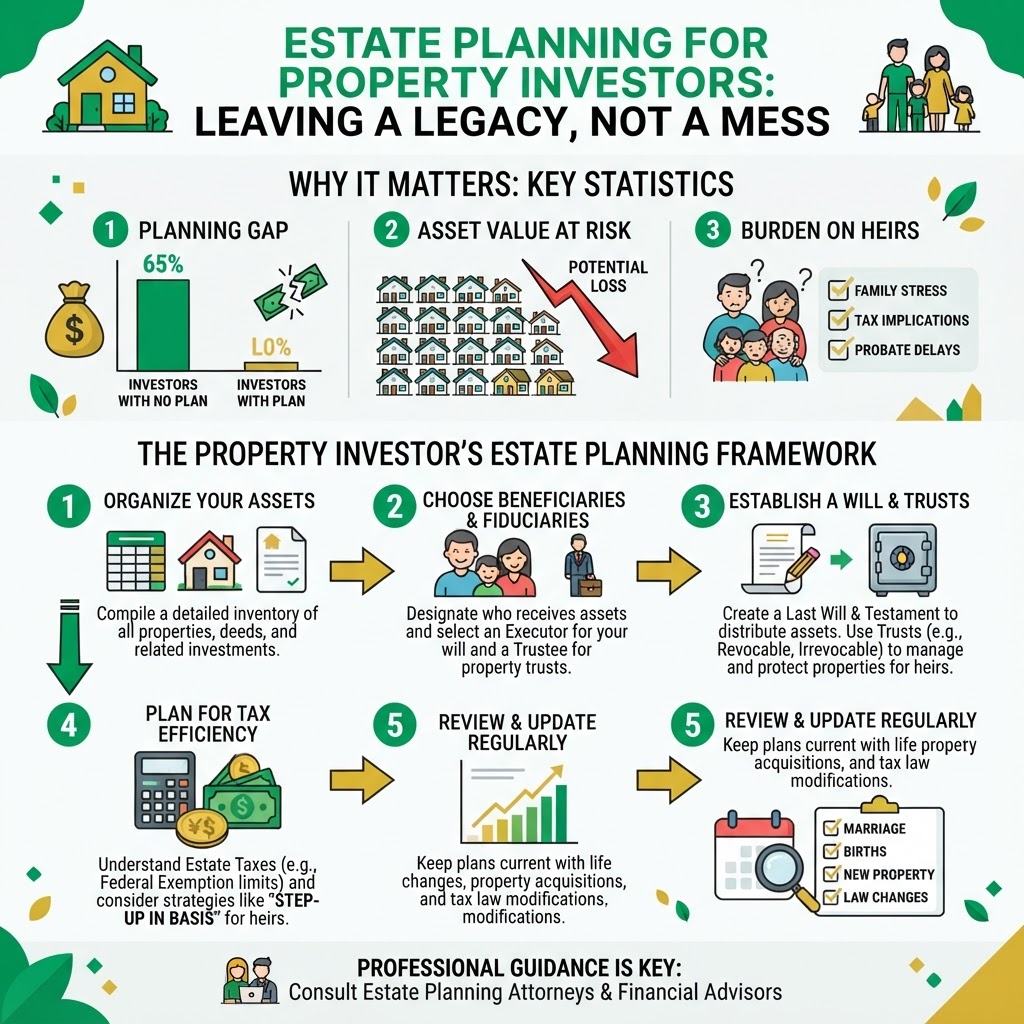
Fig. Key insights from this article — Estate Planning for Property Investors: Leaving a Legacy, Not a Mess
A Step-by-Step Guide to Building Your Property Estate Plan
Estate planning can feel overwhelming, but it does not have to be. Here is a practical, actionable roadmap tailored for South African property investors.
- Conduct a full asset audit. List every property you own, how it is titled (personal name, company, existing trust), its current market value, and any outstanding bonds or liabilities against it. You cannot plan what you have not mapped.
- Define your legacy intention. Who do you want to benefit? What do you want them to receive? Do you want properties sold and proceeds distributed, or do you want properties held and income generated for your family? Clarity of intention drives every subsequent decision.
- Assess your current tax exposure. Work with a qualified tax practitioner to calculate your current CGT exposure on each property and your estimated estate duty liability. This is your baseline — and often a sobering wake-up call that motivates action.
- Establish or review your trust structure. If you do not have a family trust, assess whether one is appropriate for your situation. If you already have one, review its deed, trustee composition, and whether your properties are correctly held within it. Visit our Trust Masterclass for guided support on this step.
- Draft or update your will. Engage a specialist wills attorney. Ensure your will is aligned with your trust structure and that there are no contradictions between the two documents.
- Arrange estate liquidity. Speak to a financial advisor about life cover or other liquidity mechanisms to cover anticipated estate costs without requiring property sales.
- Communicate with your heirs. This is the step most families skip — and it causes the most damage. Have honest conversations with your intended heirs about what you are building, how it is structured, and what you expect from them as stewards of the family legacy.
- Review annually. Property values change. Tax laws change. Family circumstances change. Your estate plan is a living document, not a once-off exercise.
Our 6-Step Legacy Journey at Mumbi Legacy walks you through this entire process with structured guidance, tools, and community support designed specifically for South African property investors.
Real-World Examples: What Good Estate Planning Looks Like
Let me share two anonymised case studies from families I have worked with. These illustrate the real difference that intentional planning makes.
Case Study 1: The Nkosi Family — From Chaos to Clarity
Mr. and Mrs. Nkosi owned four properties across Johannesburg and Pretoria, all in their personal names. After attending one of our workshops, they realised that their combined estate would face an estate duty bill of approximately R680,000 upon the first death, plus CGT on accrued gains of nearly R1.2 million across all properties — assuming the properties had to be transferred to heirs. They worked with a specialist attorney to establish a family trust, transferred three of the four properties into the trust over a structured two-year period (to manage the transfer duty and CGT implications), and took out a term life policy within the trust to cover anticipated estate costs. Their estate plan now means their three adult children will inherit the income-generating portfolio without a forced sale, a tax crisis, or family conflict.
Case Study 2: The Mokoena Estate — A Cautionary Tale Turned Right
Mrs. Mokoena came to us eighteen months after her husband passed away intestate. His estate included two rental properties and a primary residence. The intestate succession process meant the estate was divided equally between her and the couple's two children — but the children were minors, which meant their shares had to be administered by the Guardian's Fund at the Master of the High Court. Mrs. Mokoena could not sell or refinance any of the properties without Guardian's Fund approval, a process that took over a year for each transaction. She was asset-rich and cash-poor, unable to act on any opportunities. After finally resolving the estate, she immediately put in place a comprehensive will, a trust for the minor children's interests, and a clear property succession plan. The lesson: it is never too late to start, but starting earlier always costs less — financially and emotionally.
Common Mistakes South African Property Investors Make with Estate Planning
After years of working with families across South Africa, I have seen the same mistakes repeated. Here are the most costly ones — and how to avoid them.
- Not having a will at all. This remains the most common and most damaging mistake. If you own property, you need a will. Full stop.
- Having an outdated will. A will written before you acquired properties, got married, had children, or went through a divorce may be worse than useless — it may actively create conflict and unintended consequences.
- Assuming the trust does everything automatically. A trust is only as good as its deed, its administration, and the correct transfer of assets into it. Many investors establish trusts but never actually transfer properties into them, defeating the purpose entirely.
- Ignoring CGT on property transfers into trusts. Transferring property into a trust triggers a deemed disposal at market value, which can create a significant CGT liability. This must be planned and managed — ideally by structuring transfers over time and using available exemptions.
- Choosing the wrong executor. Your executor manages the administration of your entire estate. Choosing a family member without the time, knowledge, or emotional resilience to handle this during a period of grief is setting up for disaster. Consider a professional executor or co-executor arrangement.
- Not discussing the plan with heirs. Secrets in estate planning breed conflict. When beneficiaries do not understand why assets are structured the way they are, they challenge wills, contest trust arrangements, and destroy the very legacy they were meant to steward.
- Failing to account for debt. Outstanding bond balances, personal guarantees, and sureties can dramatically reduce the net value of your estate. Make sure your plan accounts for liabilities, not just assets.
"An estate plan without communication is just a document. A legacy is built through both the structure you create and the conversations you are willing to have." — Dr. Chomba Chuma
Resources and Legal Guidance: Where to Go for Help
Estate planning is a multidisciplinary exercise. It requires input from attorneys, tax practitioners, financial planners, and property specialists. Here are some authoritative resources to guide your research and professional engagement.
- The SARS website provides detailed guidance on estate duty, CGT, and the tax implications of trusts — essential reading for any serious property investor.
- The Private Property resource centre offers practical property market insights that can help you understand the current value landscape of your portfolio.
- The Master of the High Court administers deceased estates in South Africa. Information on the process is available through the South African Government website.
- For property investment strategy that underpins your legacy building, read our comprehensive property investment strategy guide on the Mumbi Legacy platform.
Your Next Steps: Start Building Your Legacy Today
You have read this far, which tells me you are serious about more than just accumulating property — you want to do something meaningful with it. That intention is everything. But intention without action is just a wish. Here is how to move from reading to doing.
Step 1: Get the Book
My book, "Build a Legacy, Touch Freedom", walks you through the complete philosophy and practical framework of generational property wealth in the South African context. It covers estate planning, trust structures, property selection, and the mindset shifts required to truly build something that outlasts you. Get your copy for R799 at our online shop. It is one of the best investments you will make this year.
Step 2: Begin Your Legacy Journey
The Mumbi Legacy 6-Step Legacy Journey is a structured programme designed to take you from where you are today — wherever that is — to having a fully documented, legally sound, and family-aligned property legacy plan. It includes workshops, templates, community support, and expert guidance. This is not theory; it is transformation.
Step 3: Book a Free Consultation
If you would prefer to start with a personal conversation about your specific situation, book a free consultation with our team. We will help you identify your most urgent estate planning gaps and point you toward the right next step — whether that is a will, a trust structure, a masterclass, or a full legacy review.
Conclusion: The Legacy You Leave Is the Life You Lived
There is a profound African concept embedded in the word ubuntu — the idea that we are who we are because of each other. The properties you are building are not just financial assets. They are expressions of sacrifice, discipline, vision, and love. They represent the late nights you spent researching, the difficult financial choices you made, the risk you took when others played it safe.
The question is not whether you will leave something behind. You will. The question is whether what you leave behind will bless your family for generations — or burden them with confusion, conflict, and cost. Estate planning in South Africa is not a luxury for the wealthy. It is a responsibility for anyone who owns property and loves their family.
The Dlamini family I told you about at the start of this article? They eventually resolved their estate — four years, two legal battles, and one sold property later. The father's intentions were good. His plan was non-existent. Do not let that be your story. You have the information. You have the resources. You have the platform. Now, make the decision to act.
Your legacy is not built the day you buy your first property. It is built the day you decide to protect it, structure it, and pass it on with intention. That day can be today.
Build a legacy. Touch freedom.