

The 6-Step Legacy System: Dr. Chomba Chuma's Blueprint to Generational Wealth
The 6-Step Legacy System: Dr. Chomba Chuma's Blueprint to Generational Wealth Through Property
Imagine sitting across from your grandchildren one day — not to hand them a small inheritance, but to hand them a portfolio of income-producing properties, a family trust that protects everything you built, and a mindset that multiplies wealth across generations. That is not a fantasy. That is what the Mumbi Legacy System was designed to make possible. My name is Dr. Chomba Chuma, and for over a decade I have worked with South African families — teachers, nurses, engineers, entrepreneurs — helping them transform modest incomes into lasting property wealth. This article is my most complete public explanation of the 6-step property system that sits at the heart of everything we do at Mumbi Legacy.
The Silent Wealth Crisis Facing South African Families
South Africa has a generational wealth problem that nobody talks about at the dinner table. We celebrate when someone buys their first home. We congratulate the family member who finally gets a bond approved. But very few of us ever ask the harder question: What happens to that property after you are gone?
According to data from the Property Practitioners Regulatory Authority (PPRA), property remains one of the most reliable long-term wealth vehicles available to ordinary South Africans. Yet most families never move beyond owning a single home — and even that home is often lost to estate disputes, unpaid debt, or family conflict when the owner passes away.
The statistics are sobering:
- Most South African families own zero investment properties by retirement.
- The majority of deceased estates result in property being sold rather than transferred to the next generation.
- Without a formal legal structure, wealth built over a lifetime can dissolve within one or two generations.
- Many first-time investors make early mistakes that cost them years of progress and thousands of rands.
The problem is not that South Africans lack ambition. The problem is that nobody taught us the system. Our parents worked hard. Our grandparents survived. But very few of them had access to a structured blueprint for building, protecting, and passing on property wealth. That ends with your generation — if you choose to act.
"Wealth is not built in a single transaction. It is built in a system — a repeatable, teachable, transferable system that your children can continue long after you are gone." — Dr. Chomba Chuma
Introducing the Mumbi Legacy System: A Generational Wealth Blueprint Built for South Africa
The Mumbi Legacy System is a 6-step generational wealth blueprint that I developed after years of working in property investment, financial education, and family wealth planning. It is not a get-rich-quick scheme. It is not a secret known only to the wealthy elite. It is a practical, step-by-step framework that any South African family with a stable income and a serious mindset can follow.
This system is the foundation of my book, Build a Legacy, Touch Freedom — available now for R799 — and it is the framework we teach in detail inside the Mumbi Legacy Journey. Whether you are a first-time buyer still saving for a deposit or a seasoned investor looking to structure your portfolio correctly, this system meets you where you are.
Let us walk through all six steps together.
The 6-Step Legacy System: Dr. Chomba Chuma's Complete Framework
Step 1 — Legacy Mindset: The Foundation Everything Else Is Built On
Before you look at a single property listing on Property24 or speak to a bond originator, you must do the inner work. Most people approach property investment as a personal financial goal — something they want for themselves. The legacy investor approaches it differently. Every decision is made with the next generation in mind.
This shift changes everything. It changes how long you hold a property. It changes how you structure ownership. It changes how you respond when the market dips or when a tenant defaults. A legacy mindset gives you the emotional resilience and strategic patience that short-term investors never develop.
- Define your family's wealth vision — not just your personal goals.
- Have honest conversations with your spouse or partner about money, debt, and property.
- Educate your children about property from an early age — make wealth a family conversation.
- Commit to learning continuously, because the rules of property investment evolve.
Step 2 — Financial Foundation: Clean Up, Build Up, Show Up
You cannot build on a cracked foundation. Before acquiring investment property, your personal financial house must be in order. This means understanding your credit profile, debt-to-income ratio, and monthly cash flow with ruthless clarity.
Many aspiring investors are surprised to discover that small adjustments — paying down a store account, correcting an error on their credit report, or restructuring a vehicle finance agreement — can dramatically improve their bond approval prospects and the interest rate they qualify for. Even a 0.5% difference in your home loan interest rate translates into tens of thousands of rands over a 20-year bond.
Key actions at this stage include:
- Pull your credit report and dispute any inaccuracies with the relevant credit bureaus.
- Build an emergency fund of at least three to six months of expenses before investing.
- Understand what Standard Bank and other lenders look for in a bond application.
- Work with a qualified bond originator who understands investment property — not just primary residence purchases.
Step 3 — Strategic Acquisition: Buying the Right Property, in the Right Area, at the Right Price
This is the step most people think is the whole strategy. It is not. Buying well is critical, but it is only one-sixth of the system. That said, a poor acquisition decision can set you back years — so we take this step very seriously.
The 6-step property system teaches investors to evaluate opportunities using a multi-layered criteria framework, not just gut feel or what a real estate agent tells you. You need to assess:
- Location fundamentals — infrastructure development, school proximity, employment nodes, and municipal service quality.
- Rental yield vs. capital growth — depending on your wealth-building phase, you may prioritise one over the other.
- Entry price vs. intrinsic value — the goal is to acquire below or at market value wherever possible.
- Tenant demand — understanding who will rent in that area and what they can afford.
- Future development plans — check municipal spatial development frameworks for planned infrastructure that lifts property values.
For a deeper dive into evaluating specific investment strategies, visit our Property Investment Strategy Guide.
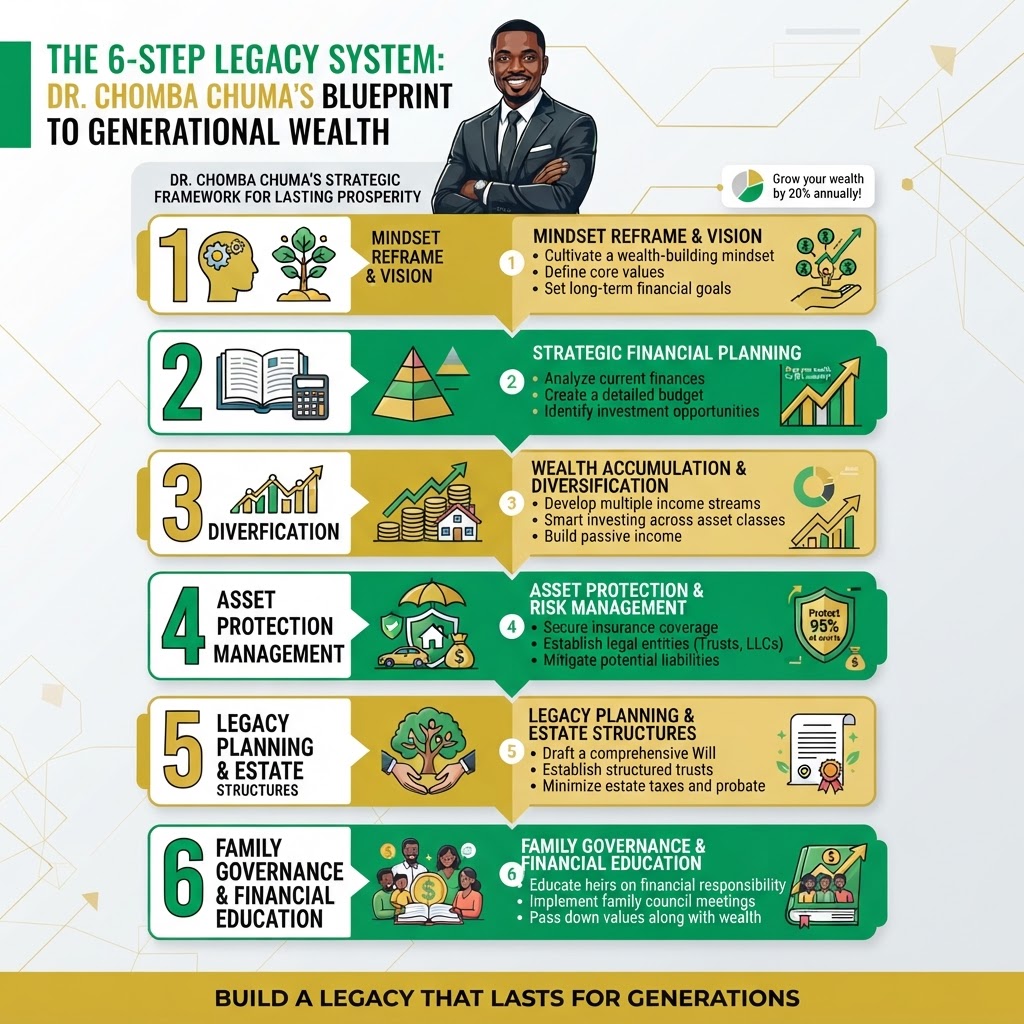
Fig. Key insights from this article — The 6-Step Legacy System: Dr. Chomba Chuma's Blueprint to Generational Wealth
Step 4 — Portfolio Structuring: Owning Property the Smart Way
This is the step that separates educated investors from those who learn hard lessons later. How you own your property matters as much as what you own. In South Africa, there are several ownership structures available to investors — each with different implications for tax, liability, estate planning, and generational transfer.
The most common structures include:
- Personal ownership — simple, but exposes you to personal liability and complicates estate planning.
- Private company (Pty Ltd) — offers liability protection but comes with specific tax and SARS compliance requirements. Learn more at SARS.
- Family trust — the most powerful structure for generational wealth, offering asset protection, estate duty planning, and long-term control over how wealth is distributed to beneficiaries.
At Mumbi Legacy, we believe that every serious property investor should understand trusts — and ideally have one established before their portfolio grows beyond two or three properties. This is exactly what we cover in our Trust Masterclass, which walks you through how to set up, fund, and manage a family trust for property wealth.
"The property is the asset. The trust is the armour. Without both, you are building wealth that the system can take away." — Dr. Chomba Chuma
Step 5 — Wealth Acceleration: Scaling Without Losing Control
Once you have your first investment property performing well and your structure in place, the question becomes: how do I grow faster without taking on reckless risk? The Mumbi Legacy System answers this through a concept we call Controlled Acceleration — using the equity in existing properties, rental income reinvestment, and strategic refinancing to acquire additional assets without overextending your financial position.
This stage also involves building your professional network — because your ability to scale depends heavily on the quality of the people around you. You need a reliable property attorney, a tax-savvy accountant, a property manager who protects your asset, and a mentor or community that holds you accountable.
Key principles at this stage:
- Never acquire property number two until property number one is cash-flow neutral or positive.
- Understand how refinancing works and the true cost of accessing equity.
- Build a 6-month rental income reserve for each property to absorb vacancy periods.
- Review your portfolio performance annually and adjust your strategy as your life circumstances change.
Step 6 — Legacy Transfer: Passing It On Intentionally
This final step is what makes the Mumbi Legacy System different from every other property investment course or book you will find in South Africa. Most systems stop at building wealth. We are obsessed with keeping it and transferring it.
Legacy transfer is not just about having a will — though that is essential. It is about creating a deliberate, legally sound, and emotionally intelligent plan for how your wealth passes from you to the next generation, and how that generation is equipped to manage it responsibly.
- Draft a comprehensive will with a qualified attorney familiar with property and trust law.
- Ensure your trust deed clearly outlines succession and distribution terms.
- Have regular family meetings to educate your heirs about the portfolio and their responsibilities.
- Establish a Family Wealth Charter — a documented set of values, rules, and intentions that guide how the family manages its wealth together.
- Work with a financial planner to minimise estate duty and tax exposure at the point of transfer.
Real-World Lessons: What Legacy Building Looks Like in Practice
Allow me to share two anonymised examples from families I have worked with through the Mumbi Legacy Journey.
The Dlamini Family — From One Bond to Four Properties in Seven Years
When Mr. and Mrs. Dlamini first came to me, they owned their primary home in Midrand with a bond they had been paying for four years. They had a combined income of R65,000 per month and had never considered themselves "property investors." Within seven years of applying the 6-step system, they owned four properties — two in their family trust and two in a private company — generating a combined monthly rental income of over R28,000. Their eldest daughter, who is now 19, has already attended two of our youth wealth workshops and understands how to read a sectional title scheme register.
The Mokoena Estate — A Cautionary Tale with a Redemption Arc
Mr. Mokoena passed away unexpectedly at 54, leaving behind three investment properties worth a combined R4.2 million. Because none of these were in a trust or company, they fell into his personal estate. After legal fees, estate duty, and an 18-month winding-up process, his family received just over R2.1 million — less than half the value he had worked his entire life to build. His widow later joined our Legacy Journey programme, restructured ownership of the one remaining property she retained, and has since rebuilt a small but properly structured portfolio. The lesson cost her dearly. It does not have to cost you anything.
Common Mistakes That Destroy Generational Wealth — Before It Even Begins
In my years of working with South African families, I have seen the same mistakes repeated across income levels, professions, and provinces. Here are the most damaging ones:
- Buying emotionally, not strategically — falling in love with a property instead of evaluating it as a business.
- Neglecting legal structure — owning everything personally until it is too late to restructure efficiently.
- Ignoring tax obligations — rental income is taxable and must be declared to SARS. Undeclared rental income is a growing area of audit focus.
- Not having a will or trust deed — dying intestate with property in your name is one of the most expensive gifts you can leave your family — in legal fees and heartache.
- Scaling too quickly — acquiring more properties than your cash flow can support, then being forced to sell at the worst moment.
- Keeping wealth a secret — your heirs cannot protect what they do not know exists. Financial transparency with family is a form of love.
Your Next Step: Start Building Your Legacy Today
You have read this far because something in you knows it is time to move. Not to think about it more. Not to wait until the market is "better" or until you earn a certain salary. The best time to start building a legacy was twenty years ago. The second best time is today.
Here is exactly what I recommend you do next, depending on where you are in your journey:
- If you are just starting out: Get your copy of Build a Legacy, Touch Freedom for R799. It is the most complete introduction to the entire Mumbi Legacy System and will give you a clear picture of where you are going and how to get there.
- If you are ready to follow a structured path: Enrol in the 6-Step Legacy Journey — our full programme that takes you through every step with community support, templates, and expert guidance.
- If you already own property and need to get your structure right: Join the Trust Masterclass and learn how to set up and fund a family trust for long-term wealth protection.
- If you want personalised guidance: Book a free consultation with our team. We will assess where you are, identify the gaps, and map out the most direct path forward for your family's specific situation.
"Freedom is not a destination you arrive at alone. It is a table you set — wide enough for the children who will come after you." — Dr. Chomba Chuma
Conclusion: Your Family Deserves a Blueprint, Not Just a Bond
The Dr. Chomba Chuma generational wealth blueprint is not theoretical. It has been tested in the real world, with real South African families, in real economic conditions — through load shedding, interest rate hikes, political uncertainty, and all the complexity that comes with building wealth on this continent. It works because it is built on timeless principles: structure before scale, protection before profit, and legacy before luxury.
You do not need to be rich to start. You need to be intentional. You need to be consistent. And you need a system — a 6-step property system that has already helped hundreds of families move from financial anxiety to generational confidence.
The Mumbi Legacy System is that blueprint. Build a Legacy. Touch Freedom. Your family is counting on the decision you make today — even if they do not know it yet. Take the first step, and let us walk this journey together.