

How to Finance Multiple Properties: Advanced Bond Strategy for Portfolio Growth
How to Finance Multiple Properties: Advanced Bond Strategy for Portfolio Growth
Let me ask you something. What if the biggest thing standing between your family and generational wealth is not your income, not your credit score, and not even the property market — but simply not knowing how the financing game is played at the next level? Multiple property finance is one of the most powerful and least understood tools available to South African families who want to build lasting wealth. And today, I want to walk you through exactly how it works — practically, strategically, and with the kind of clarity that changes lives.
At Mumbi Legacy, we work with hundreds of South African families every year — teachers, nurses, engineers, small business owners — people just like you who started with one property and dreamed of more. The ones who break through are not necessarily the richest. They are the ones who understand how to use portfolio bond strategy and leverage wisely. This article is your roadmap to doing exactly that.
The Wealth Gap Nobody Talks About: Why One Property Is Never Enough
South Africa has one of the most striking wealth inequality gaps in the world. A large part of that gap is not just about income — it is about assets. Specifically, it is about who owns property and how much of it they own. The wealthy in this country do not just buy one home and stop. They build portfolios. They use debt strategically. They understand that bank finance for investment property is not something to fear — it is a tool to master.
But here is the painful reality for most middle-class South African families. They buy their first home, they breathe a sigh of relief, and then they stop. They tell themselves: "One day I will buy another property." That day rarely comes — not because the opportunity disappears, but because nobody taught them how to structure their finances to make the next purchase possible.
Banks do not teach you this. Financial advisors often do not know property well enough to guide you. And the internet is full of generic advice that does not speak to the South African lending environment — the National Credit Act, the SARB repo rate cycles, the specific requirements of local lenders. This is the gap Mumbi Legacy exists to close.
"The first property gives you confidence. The second property gives you momentum. But it is the strategy behind the third, fourth, and fifth that builds a legacy your grandchildren will thank you for." — Dr. Chomba Chuma
Understanding the Foundation: How Banks Actually View Property Investors
Before we talk about portfolio bond strategy, you need to understand something critically important: when you walk into a bank as a property investor — not just as a homeowner — the rules change. Banks assess you differently. They weigh risk differently. And if you do not know this going in, you will make costly mistakes.
The Loan-to-Value Ratio: Your Most Important Number
The loan to value property ratio — commonly called LTV — is the percentage of the property value that the bank is willing to lend you. For a primary residence, South African banks will sometimes lend up to 100% LTV, especially for first-time buyers. But for investment properties — your second, third, and fourth bond — expect the bank to require a deposit. Typically, lenders want to see between 10% and 30% deposit on investment properties, depending on your overall portfolio and income profile.
Why does this matter for portfolio growth? Because if you do not plan for LTV requirements from the beginning, you will find yourself asset-rich but cash-poor, unable to raise the deposits needed for your next acquisition. Smart investors plan their deposit strategy two or three properties ahead.
How Banks Calculate Rental Income
Here is something most people do not know until it is too late. When you apply for your second or third bond, many South African banks will not count 100% of your rental income toward your qualifying income. FNB Home Loans, for example, and most major lenders will typically discount rental income by 20% to 25% to account for vacancy risk, maintenance, and management fees. This means your income qualification is lower than you think — unless you structure things correctly from the start.
Understanding this nuance is the difference between getting your third bond approved or rejected. It is also why working with a specialist bond originator who understands investment portfolios is essential — not just your local bank branch manager.
The Advanced Portfolio Bond Strategy: Financing Multiple Properties Without Hitting a Wall
Now we get to the heart of it. How do you actually structure your finances to grow a property portfolio beyond the first or second property? Here is the framework we teach at Mumbi Legacy, refined through years of working with South African investors at every income level.
Strategy One: Access Equity Through an Access Bond
If you have owned your first property for a few years and made regular payments — or if property values in your area have increased — you may have built up significant equity. An access bond (offered by most South African banks) allows you to redraw that equity and use it as a deposit on your next property. This is how many investors fund their second and third acquisitions without needing to save from scratch.
The key is to have your property professionally valued and to work with your bank proactively. Do not wait for the bank to offer this — ask for it. Banks reward proactive, well-prepared clients. Visit Property24 to track valuations in your area and understand what your current property might be worth on the open market before you walk into that bank conversation.
Strategy Two: Structure Through a Legal Entity
This is where the strategy gets truly powerful — and where most investors leave enormous value on the table. Holding your investment properties through a properly structured legal entity, such as a private company or a trust, can dramatically change how banks view your portfolio risk and how SARS treats your rental income.
A trust structure, for example, allows you to separate your personal liability from your investment portfolio, provides continuity for generational transfer, and in certain configurations, can optimize your tax position on rental income. Our Trust Masterclass goes deep into exactly how to set this up correctly — because doing it wrong can cost you more than doing nothing at all.
Strategy Three: The Multi-Bank Portfolio Approach
Sophisticated property investors do not keep all their bonds with one bank. Why? Because each bank has its own internal credit limits. Once you reach a certain level of exposure with one lender, they become reluctant to extend further credit — regardless of your income or asset quality. By spreading your portfolio across two or three banks, you effectively multiply your borrowing capacity.
This requires careful management and a clear financial picture with each lender. It also requires that each bond application be presented strategically — with proper documentation, clean bank statements, and a portfolio narrative that demonstrates you are a serious, competent investor rather than someone who stumbled into owning a few properties.
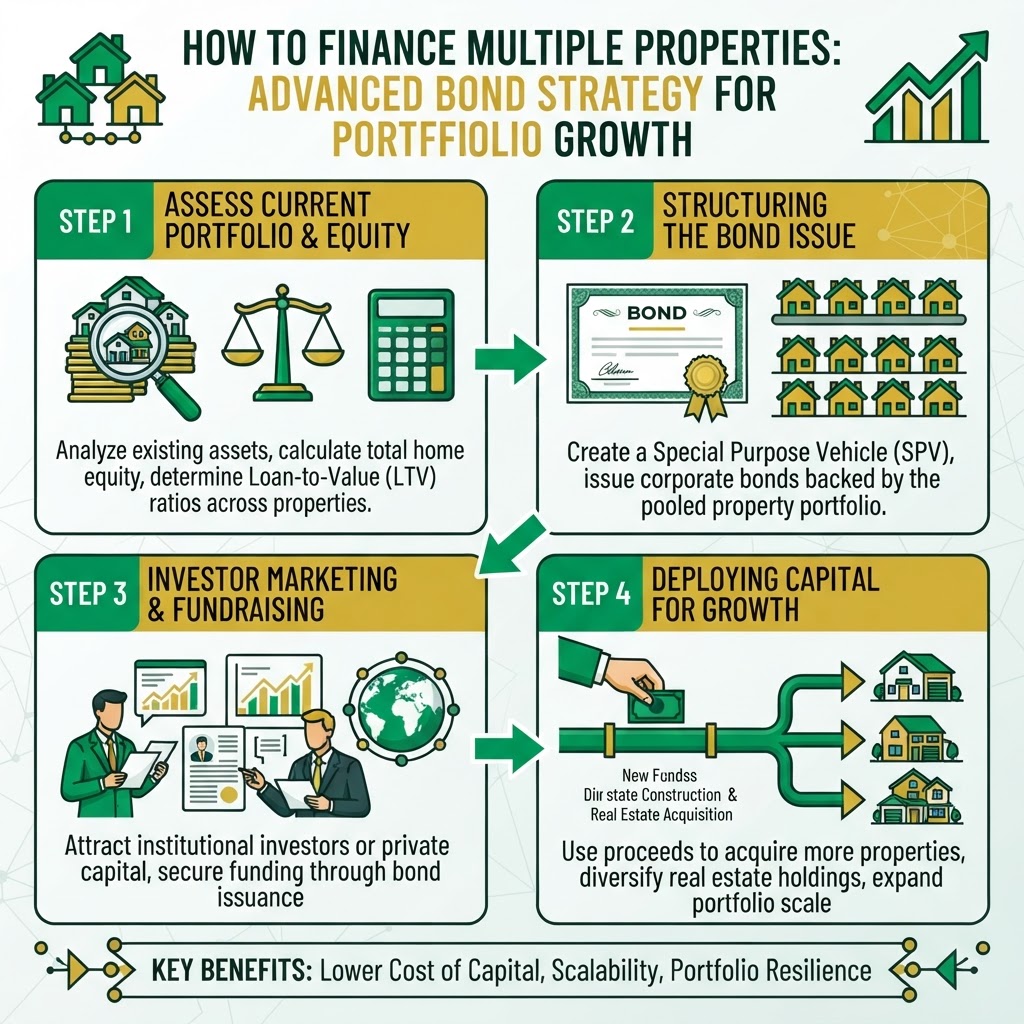
Fig. Key insights from this article — How to Finance Multiple Properties: Advanced Bond Strategy for Portfolio Growth
Step-by-Step: Building Your Multi-Property Finance Plan
Let us make this concrete. Here is the practical sequence we walk clients through at Mumbi Legacy when they are ready to move from one property to a genuine portfolio.
- Audit your current financial position: Pull your credit report (you are entitled to one free report per year from registered credit bureaus under the National Credit Act), calculate your net monthly surplus after all obligations, and list all current assets and liabilities. This is your baseline.
- Have your existing property valued: Get a professional valuation — not just a bank valuation — to understand your true equity position and potential access bond capacity.
- Consult a specialist bond originator: A bond originator works with multiple banks simultaneously and can identify which lender will offer you the best terms for an investment property bond. This costs you nothing — they are paid by the banks — but the difference in terms can save you hundreds of thousands of rands over a loan period.
- Structure your legal entity before you buy: If you plan to hold more than two investment properties, set up your company or trust structure before the next purchase, not after. Restructuring ownership later triggers transfer duty and CGT implications.
- Define your acquisition criteria: Know your target yield (rental income as a percentage of property value), your target areas, and your price band before you start shopping. Emotion is the enemy of portfolio strategy.
- Manage your debt serviceability proactively: As your portfolio grows, keep detailed records of all rental income, expenses, and bond statements. Banks will ask for these when you apply for your next bond. Looking organised and professional dramatically improves your approval odds.
- Review and refinance regularly: Every two to three years, review all your bonds. Are you on the best available rate? Can you access built-up equity? Has your portfolio grown to the point where you qualify for better commercial lending terms?
Real-World Examples: South African Families Who Did This Right
Let me share two anonymised examples from families we have worked with at Mumbi Legacy. These are real journeys, with names changed to protect privacy.
The Dlamini Family: From One Apartment to Five Properties in Eight Years
Thabo and Naledi Dlamini were both teachers in Gauteng. They bought their first flat in 2015 for R680,000 in Kempton Park. For the first three years, they just paid their bond and thought nothing of portfolio building. In 2018, they attended one of our workshops and realized they had built up over R180,000 in equity.
We helped them access that equity through an access bond and use it as a 15% deposit on a second property — a two-bedroom unit in Boksburg that rented immediately for R7,500 per month. That rental income, combined with Thabo's salary, qualified them for a third bond two years later. By 2023, they held five properties, with a combined portfolio value exceeding R5.2 million and monthly rental income of R38,000. Their combined teaching salaries total R62,000 per month. Their properties are on track to match and eventually exceed their earned income within seven years.
The Mokoena Sisters: Using a Family Trust to Build Cross-Generational Wealth
Three sisters — professionals in their 30s and 40s — pooled their resources to purchase investment properties under a family trust. Individually, none of them could qualify for the size of portfolio they wanted. Together, with the trust structure holding the assets and their combined incomes servicing the bonds, they built a portfolio of eight residential units in Pretoria over six years.
The trust structure means the portfolio will pass seamlessly to their children without triggering estate duty complications. It also means the rental income is distributed in a tax-efficient manner across the beneficiaries. This is exactly the kind of strategy detailed in our book — Build a Legacy, Touch Freedom — available now for R799.
Common Mistakes That Kill Portfolio Growth
Building a multi-property portfolio is not just about knowing what to do — it is equally about knowing what to avoid. Here are the mistakes we see most often, and they are expensive ones.
- Buying the wrong properties: Many investors buy what they like rather than what the market wants. Focus on yield and rentability, not personal taste. A property you love but cannot rent is a liability, not an asset.
- Neglecting bond structure: Choosing a shorter term to pay less interest sounds smart — until it kills your cash flow and disqualifies you from the next bond. In a portfolio context, maximizing loan term often makes more strategic sense.
- Mixing personal and business finances: If you are holding investment properties in your personal name while building a portfolio, your personal credit risk grows with every acquisition. Separate structures protect you and optimize your borrowing profile.
- Ignoring the total cost of ownership: Rates, levies, insurance, maintenance, vacancy periods, agent fees — these can easily add 2% to 3% of property value per year in costs. If your rental yield does not account for this, you are losing money and calling it investment.
- Failing to review and optimise: South African prime lending rate has moved significantly in recent years. Investors who do not periodically review their bond terms are often paying 0.5% to 1% more than they need to. On a R2 million portfolio, that is R10,000 to R20,000 per year in unnecessary interest.
- Buying without a legal framework in place: The Property Practitioners Regulatory Authority (PPRA) regulates the sale of property in South Africa. Make sure you work with registered practitioners and understand your rights and obligations before signing any agreement of sale.
Tax Considerations You Cannot Afford to Ignore
No article on financing multiple properties would be complete without addressing tax. South Africa's tax treatment of rental income and property investment is nuanced — and getting it wrong can wipe out years of gains.
Rental income is taxable in South Africa and must be declared to SARS. However, as a property investor, you are entitled to deduct a range of expenses against that income — bond interest, repairs and maintenance, rates and taxes, insurance, and agent fees, among others. Depreciation on certain assets within the property can also be claimed. The net effect is that your taxable rental income is often significantly lower than your gross rental income.
When you sell an investment property, Capital Gains Tax (CGT) applies on the profit. For individuals, 40% of the capital gain is included in your taxable income. For a trust, that inclusion rate rises to 80%. For a company, it is a flat effective CGT rate. Understanding these differences is essential when deciding what entity structure to use for your portfolio — and is one of the most important conversations to have with a specialist before you buy.
Your Next Steps: Turn Strategy Into Action
Knowledge without action is just entertainment. Here is exactly what I want you to do after reading this article.
- Start with education: Get your copy of Build a Legacy, Touch Freedom — our flagship book that walks you through the entire property wealth journey, from your first purchase to multi-property portfolio management. At R799, it is the best investment you will make this month.
- Map your legacy journey: Visit our 6-Step Legacy Journey and identify exactly where you are right now in the process. Are you at step one, thinking about your first property? Or are you at step three or four, ready to accelerate? Knowing your position clarifies your path.
- Download our investment strategy guide: Our Property Investment Strategy Guide gives you the frameworks, worksheets, and checklists you need to evaluate deals, calculate yields, and present yourself professionally to lenders.
- Consider the Trust Masterclass: If you are serious about protecting and growing your portfolio across generations, our Trust Masterclass will show you exactly how to structure your assets for longevity, tax efficiency, and seamless inheritance.
- Book a free consultation: If you want personalised guidance — if you want to sit down and talk through your specific situation, your numbers, and your goals — book your free consultation with our team. We will help you build a clear, actionable plan that fits your life.
Building a Legacy That Outlasts You
I want to close with something that goes beyond spreadsheets and LTV ratios — though all of that matters enormously. I want to remind you why we do this.
The families who built wealth in this country — who moved from surviving to thriving — did not do it by accident. They made deliberate, strategic decisions about how to use the resources available to them. They educated themselves. They found mentors and communities who understood the path. They made sacrifices in the short term to secure abundance in the long term.
That is what a property portfolio growth strategy is really about. It is not just about owning more properties. It is about creating a foundation — a portfolio of assets — that generates income whether you work or not. It is about giving your children a head start that took you thirty years to build. It is about your family name meaning something. That is the Mumbi Legacy vision, and it is why I built this platform.
"You do not build a legacy in a day. But every property, every smart financial decision, every structured move you make today is a brick in a wall your grandchildren will one day lean against with pride." — Dr. Chomba Chuma
The strategy is clear. The tools are available. The market, despite its cycles and challenges, still rewards those who move with knowledge and intention. South Africa's property sector remains one of the most compelling wealth-building environments on the continent — for those who know how to navigate it.
You have read this far because you are serious. Now take the next step. Pick up the book. Start the journey. Book the call. Your legacy does not build itself — but with the right strategy, the right structure, and the right support, it absolutely will be built. And it will last.