

Capital Gains Tax on Property: What Every South African Investor Must Know
Capital Gains Tax on Property: What Every South African Investor Must Know
Every year, thousands of South African families sell a property — sometimes after years of hard work, sacrifice, and careful saving — only to be blindsided by a tax bill they never saw coming. Capital gains tax in South Africa is one of the most misunderstood aspects of property investment, and that misunderstanding costs ordinary families hundreds of thousands of rands that could have stayed in their pockets — or better yet, been passed down to the next generation. If you are serious about building generational wealth through property, understanding CGT on property sales is not optional. It is foundational.
My name is Dr. Chomba Chuma, and over the years I have sat across the table from hundreds of South African investors — teachers, nurses, engineers, entrepreneurs — who came to me after the damage was already done. My mission with Mumbi Legacy has always been simple: to make sure your family never has to learn these lessons the hard way. Today, we are going to break down capital gains tax in a way that is clear, practical, and immediately useful — because knowledge without action is just information.
What Is Capital Gains Tax and Why Does It Matter for Property Investors?
Let us start at the beginning. Capital Gains Tax (CGT) is not a separate tax in South Africa. It is actually a component of your normal income tax, triggered when you dispose of a capital asset — and property is one of the most common capital assets South Africans hold. When you sell a property for more than you paid for it, the profit you make is called a capital gain, and a portion of that gain is included in your taxable income for that year.
The South African Revenue Service, commonly known as SARS, introduced CGT in October 2001. Since then, the rules have evolved, the inclusion rates have increased, and the consequences of ignorance have grown steeper. Understanding how this tax works — and how to legally minimise it — can mean the difference between a wealth-building strategy that thrives across generations and one that gets quietly eroded every time you make a move.
Key CGT Terminology You Must Understand
- Base Cost: What you originally paid for the property, plus qualifying improvements and acquisition costs.
- Proceeds: What you received when you sold the property.
- Capital Gain: Proceeds minus Base Cost.
- Inclusion Rate: The percentage of your capital gain that gets added to your taxable income.
- Effective CGT Rate: The actual percentage of tax you pay on the gain, after applying the inclusion rate to your marginal income tax rate.
- Annual Exclusion: A portion of your gain that is excluded from tax automatically each year.
For the 2024/2025 tax year, the annual exclusion for individuals is R40,000. This means the first R40,000 of any capital gain you make in a tax year is tax-free. For the year in which you die, this exclusion increases to R300,000 — a detail that matters enormously in estate and legacy planning.
How CGT Is Calculated on Property Sales in South Africa
Here is where many investors get confused, so let us walk through this carefully. The calculation of CGT on a property sale in South Africa follows a clear process, but the devil is absolutely in the details.
Step 1 — Determine Your Base Cost
Your base cost is not simply what you paid for the property. It includes the purchase price plus all qualifying costs associated with acquiring and improving the property. These include transfer costs, bond registration fees, legal fees, estate agent commissions paid at acquisition, and the cost of capital improvements (note: not maintenance or repairs, but structural improvements that added value).
Step 2 — Calculate the Capital Gain
Subtract your base cost from your net proceeds (sale price less selling costs like agent commissions and legal fees). The result is your gross capital gain. If this number is negative, you have a capital loss, which can be carried forward to offset future gains.
Step 3 — Apply the Annual Exclusion
Subtract the R40,000 annual exclusion (for individuals) from your gross capital gain to arrive at your net capital gain.
Step 4 — Apply the Inclusion Rate
Only a portion of your net capital gain is added to your taxable income. The inclusion rates are as follows:
- Individuals: 40% inclusion rate
- Companies: 80% inclusion rate
- Trusts: 80% inclusion rate (with some exceptions for special trusts)
Step 5 — Apply Your Marginal Income Tax Rate
The included portion of your gain is added to your other income for the year and taxed at your marginal income tax rate. For the highest earning individuals in South Africa, the marginal rate is 45%, which means the effective CGT rate for an individual is 40% × 45% = 18%. For companies, at a corporate tax rate of 27%, the effective CGT rate is 80% × 27% = 21.6%. For trusts, the effective rate can reach as high as 36%.
"The most expensive mistake a property investor can make is not understanding how their ownership structure affects the tax they pay. The difference between holding a property in your personal name versus a trust can mean tens of thousands of rands on a single transaction — and millions across a portfolio." — Dr. Chomba Chuma, Founder, Mumbi Legacy
The Primary Residence Exclusion — Your Most Powerful CGT Shield
Here is the good news that too few South Africans take full advantage of: the primary residence exclusion. If you sell a property that qualifies as your primary residence, you can exclude up to R2 million of the capital gain from CGT. This is one of the most generous tax reliefs available to ordinary South African families, and it is completely legal.
To qualify as a primary residence under SARS guidelines, the property must be a residence in which you or your spouse ordinarily reside as your main home, and you must have an ownership interest in the property. The exclusion applies to the land on which the house stands, up to a maximum of two hectares.
What Happens When the Property Was Partly Used for Business?
This is where many homeowners inadvertently forfeit part of their exclusion. If you have been running a business from home — even a home office — SARS may apportion the exclusion. Only the portion of the property used as a residence qualifies. This is a nuance that catches many professionals and entrepreneurs off guard, particularly in the era of remote work. Document everything carefully and consult a tax professional before you sell.
What If You Lived There for Only Part of the Time?
If the property was your primary residence for part of the ownership period but was rented out or used for another purpose for the rest, the exclusion is calculated proportionally based on the years of primary residence occupation versus total ownership years. The formula matters — and getting it right matters even more.
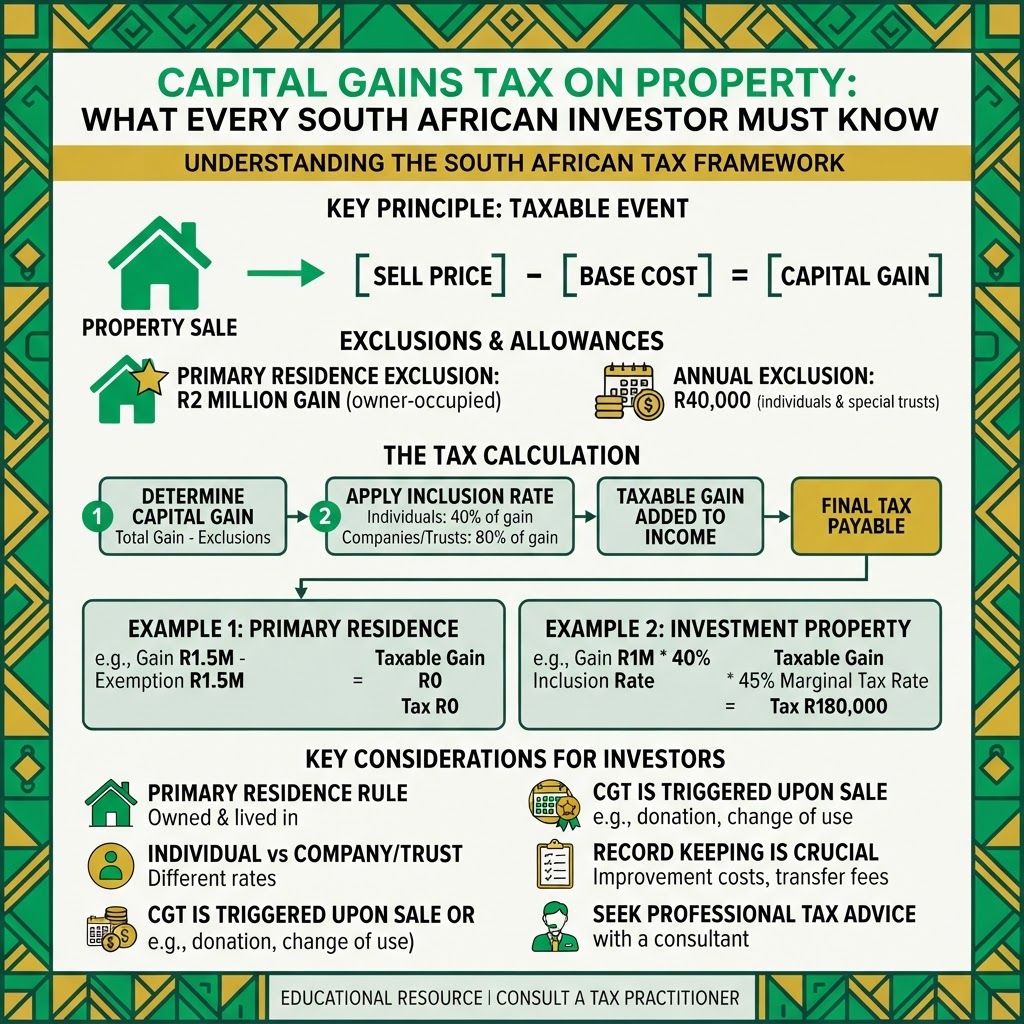
Fig. Key insights from this article — Capital Gains Tax on Property: What Every South African Investor Must Know
CGT and the Trust Structure — What You Need to Know Before You Build Your Portfolio
One of the most common strategies in South African property tax planning is holding property inside a trust — particularly an inter vivos (living) trust. And while trusts offer powerful benefits for asset protection, estate planning, and generational wealth transfer, the trust CGT rate is a critical consideration that many investors overlook until it is too late.
As mentioned earlier, trusts face an 80% inclusion rate on capital gains, compared to 40% for individuals. When you apply the maximum trust tax rate of 45%, the effective CGT rate for a trust reaches 36% — double the effective rate for an individual. This means that a R1 million capital gain inside a trust could cost you up to R360,000 in tax, whereas the same gain in your personal name might cost R180,000 — or even nothing if the primary residence exclusion applies.
Does this mean trusts are bad for property? Absolutely not. It means that trusts must be used strategically, with full awareness of the tax implications at every stage. The right property in the right structure for the right purpose — that is the Mumbi Legacy philosophy. If you want to understand how to structure your portfolio intelligently across different entities, our Trust Masterclass walks you through exactly this, step by step.
When Does It Still Make Sense to Hold Property in a Trust?
- When long-term capital appreciation is the goal and you do not plan to sell frequently
- When asset protection from creditors is a priority
- When estate duty savings outweigh the CGT cost over time
- When the property is income-generating and the trust has multiple beneficiaries across different tax brackets
- When you are building a portfolio to pass on to children or grandchildren without triggering estate duty
The key is always to run the numbers with qualified professionals. According to Property24, South African property investors increasingly require holistic financial and tax advice — not just conveyancing — to protect their returns in a high-tax environment.
Real-World Examples — Learning from Others Without Paying Their Price
Case Study 1 — The Family That Got It Right
Consider a fictional but representative family: Thabo and Naledi, both teachers in Johannesburg. They bought their home in Soweto in 2010 for R650,000. By 2023, they sold it for R1.85 million — a gain of R1.2 million. Because this was their primary residence throughout the ownership period, they applied the R2 million exclusion. Their entire capital gain of R1.2 million fell below the exclusion threshold. They paid zero CGT. They used the proceeds to purchase two income-generating properties and formally began their legacy journey.
Case Study 2 — The Investor Who Didn't Plan
Now consider a different scenario: Sipho, an engineer in Cape Town, bought a second property as an investment in 2015 for R800,000. He held it in his personal name and rented it out. In 2024, he sold it for R2.1 million — a gross gain of R1.3 million. After applying the R40,000 annual exclusion, his net gain was R1.26 million. At a 40% inclusion rate, R504,000 was added to his income. At his marginal rate of 45%, he paid approximately R226,800 in CGT. Had he planned better — tracked improvements more carefully, timed the sale in a year with lower income, or structured his portfolio differently — this number could have been significantly reduced.
Case Study 3 — The Trust Trap
A third investor, let us call her Zanele, was advised years ago to buy all her properties inside a trust without a full explanation of the tax implications. When she sold her first property — a rental flat — the trust's 36% effective CGT rate cost her R180,000 more than if she had held the property personally. The silver lining? She learned early, restructured her portfolio with professional guidance, and now uses trusts only where they offer a net advantage. Her story is far too common — and entirely preventable.
Common CGT Mistakes South African Property Investors Must Avoid
- Not tracking your base cost from day one. Keep every invoice, receipt, and contract related to improvements, renovations, and acquisition costs. These reduce your taxable gain directly.
- Confusing primary residence rules. Not every home qualifies for the full R2 million exclusion. Partial business use, short periods of occupation, and multiple properties all affect eligibility.
- Ignoring the timing of your sale. Selling a property in a year when your other income is high pushes your marginal rate — and your CGT — up significantly. Strategic timing can save you tens of thousands.
- Assuming trusts are always better. As we have seen, the trust CGT rate in South Africa can be punishing. Always model the numbers across different structures before deciding where to hold a property.
- Overlooking spousal transfers and Section 9HB elections. Transfers between spouses can be done at base cost (no CGT triggered), but this requires proper documentation and intent.
- Not declaring capital gains on your tax return. SARS matches deeds office data with tax returns. Non-disclosure is not a strategy — it is a liability. Always declare accurately and on time.
- Failing to get professional advice before selling. CGT planning must happen before the sale, not after. Once transfer is registered, your options narrow dramatically.
"Wealth is not built by earning more. It is built by losing less. Every rand you legally protect from unnecessary tax is a rand that compounds, grows, and one day sits in the hands of your children." — Dr. Chomba Chuma
Practical Property Tax Planning — Your Action Framework
Understanding CGT is one thing. Doing something about it is another. Here is a practical framework for South African property investors who want to take control of their tax position and protect their wealth across generations.
1. Audit Your Current Portfolio Structure
Determine which properties you hold personally, which are in a trust, and which are in a company. Understand the CGT implications if you were to sell each one today. This single exercise often reveals opportunities and risks you were not aware of. Our investment strategy guide can help you begin this audit systematically.
2. Document Everything Meticulously
From the day you acquire a property, keep a dedicated file — physical or digital — with all purchase documents, bond costs, transfer costs, renovation invoices, and improvement receipts. Your base cost is only as strong as the documentation that supports it.
3. Plan Your Disposals Strategically
Work with a tax practitioner to model the CGT impact of any sale before you list the property. Consider the timing relative to your other income, whether the primary residence exclusion applies, and whether a spousal or trust-related transfer makes sense.
4. Understand How CGT Fits Into Your Legacy Plan
CGT does not exist in isolation. It connects to estate duty, income tax, transfer duty, and dividends tax. Your Mumbi Legacy journey is designed to show you how all these pieces fit together into a coherent, long-term wealth strategy for your family.
5. Educate Yourself Continuously
Tax law changes. Inclusion rates have risen over the years, and they may rise again. The investor who stays informed is the investor who stays ahead. Read, attend workshops, engage with professionals, and invest in your financial education the same way you invest in property.
Conclusion — Build a Legacy That Outlives the Tax Man
Capital gains tax is real, it is significant, and for unprepared investors, it can feel like a punch to the stomach after years of hard work. But here is what I want you to walk away with today: CGT is manageable. With the right knowledge, the right structure, and the right timing, you can legally minimise your tax burden, protect your family's wealth, and build a property portfolio that thrives for generations.
The families who build true generational wealth in South Africa are not the ones who earn the most — they are the ones who keep the most, plan the most, and share that knowledge with their children. That is what Mumbi Legacy exists to do. We are not just teaching you how to buy property. We are teaching you how to build a lasting financial foundation that carries your family's name forward with dignity and power.
Your next step is simple. If you are just beginning your journey, start with our flagship book, Build a Legacy, Touch Freedom — available now at the Mumbi Legacy shop for just R799. It is the most direct path from where you are now to where you need to be. If you are ready to go deeper on trust structures and tax-efficient property ownership, join our Trust Masterclass and let us walk you through the strategy step by step. And if you want personalised guidance on your specific situation — your portfolio, your family, your goals — book a free consultation with our team today. There is no obligation, only opportunity.
The legacy you build today is the freedom your children will inherit tomorrow. Let us build it wisely, legally, and together.