

Understanding ISA Loans: The Strategy Banks Don't Tell You About
Understanding ISA Loans: The Property Leverage Strategy Banks Don't Tell You About
Most South African families work their entire lives to pay off one home — and they do it the hard way. They take a standard 20-year bond, pay it off faithfully, and consider themselves successful. But here is the truth that banks rarely volunteer: there is a smarter way to use debt, build equity faster, and turn a single property into a portfolio. It is called an ISA loan — an Investment Secured Advance — and once you understand how it works, you will never look at your bond the same way again. This article unpacks the ISA loan South Africa strategy that our most successful Mumbi Legacy clients use to accelerate their path to generational wealth.
The Wealth Gap Nobody Talks About at the Dinner Table
Let me tell you about a family I will call the Dlaminis. Both parents are professionals. They earn a combined household income of R85,000 per month. They own their home in Midrand, they have a retirement annuity, and their children go to good schools. By almost every measure, they are doing well. But when I sat with them for a financial review, the picture was sobering.
They had been paying their bond for eleven years. Their property had appreciated from R1.2 million to R2.1 million. That is R900,000 in equity sitting in the walls of their home — completely dormant, earning nothing, and inaccessible to them. Meanwhile, their neighbour — let us call him Mr. Sithole — had purchased the same property at roughly the same time. But Mr. Sithole had used an investment secured advance against his equity to purchase a second property five years ago. That second property is now tenanted, generating R9,500 per month in rental income, and has itself appreciated by over R400,000.
Same neighbourhood. Same starting point. Vastly different outcomes.
This is the wealth gap that nobody talks about at the dinner table. And it is not about income — it is about financial literacy and the strategic use of property leverage.
What Is an ISA Loan and Why Does It Matter for South African Families?
An ISA loan — formally known as an Investment Secured Advance — is a credit facility offered by South African banks and financial institutions that allows you to borrow against the equity you have already built up in a registered property. Unlike a personal loan or a credit card, an ISA loan is secured against your existing asset, which means the interest rates are far more favourable — typically ranging between prime minus 0.5% and prime plus 1%, depending on your credit profile and the institution.
In the South African context, most major banks — including FNB and Standard Bank — offer variations of this product, sometimes branded under different names such as a home equity loan, further advance, or access bond facility. The underlying principle, however, remains the same: you are using the value locked inside your property as collateral to generate fresh capital for investment.
Here is the key distinction that most families miss: an ISA loan is not the same as re-financing your home to pay off consumer debt. That would be a dangerous and costly mistake. An ISA loan, used correctly, is a property leverage strategy — a calculated move to deploy equity into income-generating assets that will grow your net worth over time.
How an ISA Loan Differs from a Standard Bond
- A standard bond is used to purchase a primary residence. You repay capital and interest monthly over 20 to 30 years. The goal is ownership.
- An interest-only bond or ISA facility allows you to draw against accumulated equity. Repayments can sometimes be structured as interest-only in the short term, preserving cash flow.
- With an ISA loan, the purpose is investment, not consumption. The borrowed capital is deployed into a second or third property that generates rental income, ideally enough to service the advance itself.
"Equity is not wealth until it moves. A home that has appreciated is not working for you — it is simply storing value. The ISA loan is the key that unlocks that value and puts it to work." — Dr. Chomba Chuma, Mumbi Legacy
The ISA Loan South Africa Strategy: A Step-by-Step Guide
Before you approach a bank, you need a strategy. Too many families rush to access their equity without a clear investment thesis, and they end up worse off. Here is the framework our clients follow at Mumbi Legacy before executing an ISA loan strategy.
-
Calculate your available equity.
Start with the current market value of your property. You can use a qualified estate agent valuation or request a bank valuation. Subtract your outstanding bond balance. In South Africa, most lenders will advance up to 80% of the property's current value, less your outstanding bond. So if your home is worth R2 million and your bond balance is R800,000, you may be able to access up to R800,000 in equity (R2m × 80% = R1.6m − R800k outstanding = R800k available).
-
Assess your serviceability.
Banks will still apply the National Credit Act affordability criteria. Your monthly income must comfortably service the new advance. If you are using the ISA loan to purchase a rental property, many lenders will factor in a percentage of the projected rental income — typically 70 to 80% — to strengthen your application.
-
Identify the right investment property.
Not all properties are suitable investment vehicles. You are looking for properties with strong rental demand, low vacancy rates, and capital growth potential. Sectional title units in well-managed complexes, or freehold properties in emerging corridors, often represent the best risk-adjusted returns. Resources like Property24 and Private Property are useful starting points for market research.
-
Run the numbers with discipline.
Calculate the gross rental yield (annual rental income divided by purchase price). A healthy investment property in South Africa should yield between 6% and 10% gross. After deducting rates, levies, insurance, management fees, and vacancy provision, your net yield should still comfortably cover your ISA loan repayment — with something left over.
-
Structure the transaction correctly.
Consider whether to purchase the investment property in your personal name, a company, or a family trust. Each structure has different tax implications, asset protection benefits, and estate planning consequences. This is where professional guidance is not optional — it is essential. You can explore this in detail through our Trust Masterclass at Mumbi Legacy.
-
Apply for the ISA facility.
Approach your existing bond financier first, as they already hold your property as security and the process may be faster. Submit a formal application with your income documentation, a property valuation, and your investment proposal. Ensure your credit record is clean — check it via the South African credit bureaus before applying.
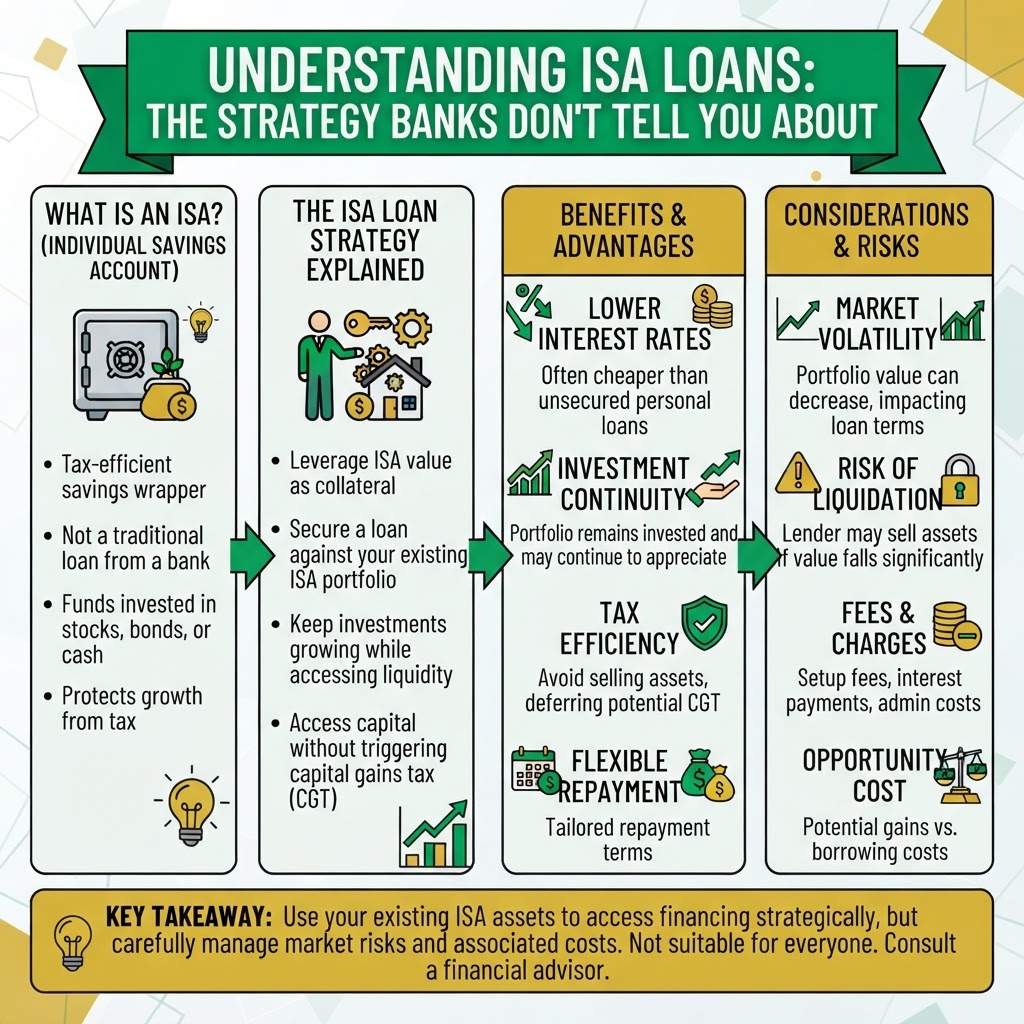
Fig. Key insights from this article — Understanding ISA Loans: The Strategy Banks Don't Tell You About
Real-World Examples: How South African Families Are Using This Strategy
Case Study 1: The Mokoena Family — Johannesburg South
A couple in their early forties came to Mumbi Legacy after attending one of our webinars. They had a property in Johannesburg South worth approximately R1.8 million with a bond balance of R620,000. Using the ISA loan framework, they accessed R820,000 in equity and used it as a deposit to purchase a two-bedroom sectional title unit in Roodepoort for R950,000.
The new property was tenanted within three weeks at R7,200 per month. Their ISA advance repayment (interest-only for the first 24 months) was R6,100 per month. Net monthly surplus: R1,100 — plus the capital growth on the new property. Within eighteen months, the Roodepoort unit had appreciated to R1.05 million, and they had simultaneously reduced their ISA balance using a portion of the rental income. They are now exploring a third property using the same model. For a full walkthrough of how to replicate this approach, read our investment strategy guide.
Case Study 2: Ms. Zinhle Ndlovu — Durban North
A single mother and nurse practitioner earning R42,000 per month — a profile that many banks would consider a lower priority for investment finance. But Zinhle had been disciplined. She had paid an extra R3,000 per month into her bond for six years, building R480,000 in accessible equity.
She used an ISA advance of R380,000 as a full cash purchase of a one-bedroom apartment in a well-run Durban North complex listed at R370,000. Because she paid cash, she negotiated a R15,000 reduction on the purchase price. The unit now rents for R5,800 per month. Her ISA repayment is R3,750. She clears R2,050 monthly — and owns an asset with zero bond against it. In five years, that property is projected to be worth R550,000 based on current area growth trends, according to market data tracked on platforms like Property24.
Case Study 3: The Petersen Family — Cape Town
A family in Bellville used their ISA loan not to purchase a second property immediately, but to renovate an existing outbuilding on their stand and convert it into a legally compliant flatlet. The renovation cost R210,000. The flatlet now generates R6,500 per month in rental income. Their ISA repayment is R2,100 per month, leaving them with R4,400 monthly in net passive income — generated from an asset they already owned. This is what we call value extraction without speculation.
Common Mistakes Families Make with ISA Loans
The ISA loan strategy is powerful — but misused, it can accelerate financial distress rather than wealth. Here are the most common errors I see, and how to avoid them.
- Using equity to fund lifestyle expenses. Accessing equity to pay for a vehicle, holiday, or school fees might feel like smart borrowing in the short term, but it is consuming your wealth base. Equity accessed for non-income-generating purposes is wealth destruction, not wealth building.
- Ignoring cash flow analysis. Many investors focus entirely on capital growth and neglect monthly cash flow. If your rental income does not at minimum cover your ISA repayment plus property running costs, you are subsidising the investment from your salary every month — which is unsustainable.
- Purchasing in the wrong area. Sentimental attachment to certain suburbs or following trends without data leads to poor investment decisions. Focus on vacancy rates, infrastructure development pipelines, and rental demand — not just where you would personally like to live.
- Skipping legal due diligence. All property transactions in South Africa must be registered through the Deeds Office. Ensure your conveyancer confirms the title deed, checks for any encumbrances, and that the seller has the legal right to transfer. Do not shortcut this process.
- Holding all investment properties in personal name. For portfolio builders, holding all properties in your personal name can create unnecessary tax exposure and estate planning complications. Structuring through a family trust or private company — done correctly — can offer meaningful protection and generational transfer advantages. This is a nuanced area that requires expert guidance, which is why we developed the Mumbi Legacy Trust Masterclass.
- Not having a contingency reserve. Every investment property needs a maintenance and vacancy reserve — ideally one to two months of rental income held in a separate account. Investors who skip this are one burst geyser away from financial crisis.
"The ISA loan does not create wealth on its own. It is a tool — and like any tool, its value depends entirely on the skill and intention of the person wielding it. Educate yourself before you execute." — Dr. Chomba Chuma, Mumbi Legacy
Bond Finance, Tax, and the South African Regulatory Context
It is important to understand the regulatory landscape in which this strategy operates. South Africa has a robust property finance and consumer credit framework. The National Credit Act 34 of 2005 governs how banks assess affordability, and no lender can advance credit that a borrower cannot demonstrably service. This is a protection for consumers, not a barrier — it ensures that ISA loan approvals are grounded in financial reality.
From a tax perspective, SARS treats rental income as taxable in the hands of the property owner. However, legitimate deductions are available against rental income — including interest on the bond used to finance the investment property, maintenance costs, property management fees, insurance, and municipal rates. This means the tax burden on a well-structured rental property is often lower than many investors expect. Consult a registered tax practitioner to ensure your deductions are correctly applied and your returns are compliant.
Estate agents involved in any property transaction must be registered with the Property Practitioners Regulatory Authority (PPRA). Always verify your agent's registration before proceeding with any transaction.
Your Next Steps: From Knowledge to Action
Understanding the ISA loan concept intellectually is the beginning — not the destination. Generational wealth is not built by those who read and reflect. It is built by those who read, plan, and act with intention. Here is how to move forward.
- Get the foundation right. If you are new to property investment and wealth building, start with the fundamentals. Our book, Build a Legacy, Touch Freedom, is available for R799 and gives you a complete framework for building wealth through property — written specifically for South African families navigating the real economic landscape we all live in.
- Follow a structured path. Wealth building without a roadmap is guesswork. Our 6-Step Legacy Journey walks you through each stage of the process — from financial foundations and property acquisition to portfolio growth, trust structuring, and generational transfer. It is the most comprehensive property wealth pathway designed for South African families.
- Master the structure. If you are ready to move beyond a single property and start building a protected, tax-efficient portfolio, our Trust Masterclass will teach you how to use legal structures — including family trusts and private companies — to hold, grow, and protect your wealth across generations.
- Get personalised advice. Every family's situation is different. Before executing an ISA loan strategy, we encourage you to speak with a qualified advisor who understands the South African property landscape. Book a free consultation with our team at Mumbi Legacy, and let us help you map out a strategy that is realistic, legal, and aligned with your family's specific goals.
Building a Legacy That Outlives You
There is a generation of South African families who are one property decision away from changing everything. Not just for themselves — but for their children, and their children's children. The ISA loan strategy is not a get-rich-quick scheme. It is a patient, disciplined approach to deploying what you have already built, in service of something bigger than a single home.
The banks will process your application. They will advance your equity. But they will not sit down with you and explain the full picture — the compounding power of a well-structured portfolio, the tax advantages of informed structuring, or the legacy implications of building generational wealth through property. That is not their job. It is ours.
The Dlamini family I mentioned at the start of this article? They came back to Mumbi Legacy six months after that first financial review. They had done the work, cleaned up their cash flow, and submitted their ISA loan application. Their second property is now tenanted. Their equity has begun to move. Their legacy has begun to take shape.
Yours can too. The strategy exists. The knowledge is available. The next step is yours to take.
Start today. Get the book. Begin your legacy journey. Or speak to us directly — because your family's future is too important to leave to chance.