

Good Debt vs Bad Debt: How South African Investors Use Leverage to Build Wealth
Good Debt vs Bad Debt: How South African Investors Use Property Leverage to Build Generational Wealth
Let me ask you something honest: when you hear the word "debt", what feeling rises in your chest? For most South African families — especially those who watched their parents struggle with store accounts, personal loans, and credit card balances — that word carries a heavy emotional weight. But here is what the wealthy know that most of us were never taught in school: not all debt is created equal. In fact, the right kind of debt — what sophisticated investors call good debt in South Africa — is one of the most powerful tools available to build lasting, generational property wealth. Today, I want to change how you see debt forever.
The Debt Trap Facing South African Middle-Class Families
South Africa has one of the highest household debt-to-income ratios in the developing world. According to the South African government's economic data, millions of families are caught in a cycle of borrowing to consume rather than borrowing to create. We take out loans for televisions, furniture, holidays, and vehicles — things that lose value the moment we sign the agreement. This is bad debt, and it quietly destroys the financial future of hardworking families every single day.
The middle-class trap is particularly painful. You earn enough to qualify for credit, but the credit you qualify for is largely designed to keep you spending, not investing. Retail accounts, personal loans, and vehicle finance drain your monthly cash flow while delivering zero long-term financial return. Many families I counsel at Mumbi Legacy are not poor — they are income-rich and asset-poor, with little to no property wealth to show for decades of hard work.
The real tragedy? The knowledge gap. Most of us were never taught the difference between debt that costs you money and debt that makes you money. That distinction is the foundation of everything we teach at the Mumbi Legacy 6-step legacy journey.
Understanding Good Debt vs Bad Debt: The Core Principle
Let me give you the simplest possible definition:
"Bad debt pays for things that depreciate or disappear. Good debt finances assets that appreciate and generate income. The moment you understand this difference, your entire financial life can change." — Dr. Chomba Chuma, MD, Founder of Mumbi Legacy
What Is Bad Debt?
- Personal loans used for lifestyle expenses like holidays or events
- Vehicle finance on a car you cannot afford without a loan
- Retail credit accounts for clothing, electronics, and furniture
- Credit card balances carried month to month at high interest rates
- Payday loans or micro-lending at predatory rates
These forms of debt have one thing in common: they finance consumption. The moment you drive that car off the lot or unbox that television, the asset begins losing value. Meanwhile, the debt remains — and grows with interest.
What Is Good Debt?
- A home loan (bond) used to purchase a property that appreciates over time
- Bond finance strategy applied to buy income-generating rental properties
- Business financing that funds productive, revenue-generating operations
- Education loans that demonstrably increase earning capacity
- Leveraged property investment where rental income services the bond
Good debt works for you while you sleep. A bond on a well-chosen rental property in Gauteng or the Western Cape can be largely serviced by your tenant, while the underlying asset grows in value year after year. That is the power of property leverage — and it is exactly how South Africa's wealthiest families have built their portfolios for generations.
The Property Leverage Strategy Explained in Depth
Property leverage is the practice of using borrowed money — typically a mortgage bond — to control an asset far larger than you could purchase with cash alone. It is the single most accessible wealth-building tool available to the South African middle class, and yet it remains one of the least understood.
Consider this simple example: You have R200,000 in savings. You could buy a small car for cash — an asset that will be worth perhaps R80,000 in five years. Or you could use that R200,000 as a deposit on a R1,000,000 investment property, taking a bond for R800,000. If that property appreciates at a conservative 7% per year — well within South African property norms tracked by Property24's annual market reports — it will be worth approximately R1,400,000 in five years. Your R200,000 deposit has generated R400,000 in equity growth. That is a 200% return on your initial capital, powered entirely by leverage.
The Bond Finance Strategy in Practice
A disciplined bond finance strategy is not about reckless borrowing. It is about strategic, calculated use of bank finance to acquire appreciating assets where the numbers work in your favour. The key metrics every investor must understand are:
- Loan-to-Value (LTV) ratio: The lower your LTV, the lower your risk exposure
- Debt Service Coverage Ratio (DSCR): Can the rental income cover the bond repayment?
- Net rental yield: What percentage return does the property generate after costs?
- Capital appreciation rate: What is the historical and projected growth rate in that area?
- Interest rate environment: Is the current prime rate favourable for fixed or variable rate bonds?
South African banks like FNB Home Loans offer a range of mortgage products designed for both owner-occupiers and investors. Understanding which product suits your strategy — and how to structure your application to maximise approval odds — is a skill every serious property investor must develop.
ISA Loans and Leveraged Structures
An increasingly popular approach among sophisticated South African investors is the use of ISA loans — loans advanced against existing property equity or structured through an investment structure agreement — to fund further acquisitions without depleting liquid savings. This strategy allows investors to recycle capital efficiently, using the equity built in one property to fund the deposit on the next. When applied correctly within a trust or company structure, an ISA loan can significantly accelerate portfolio growth while managing personal liability exposure. We cover this in detail in our Trust and Structure Masterclass.
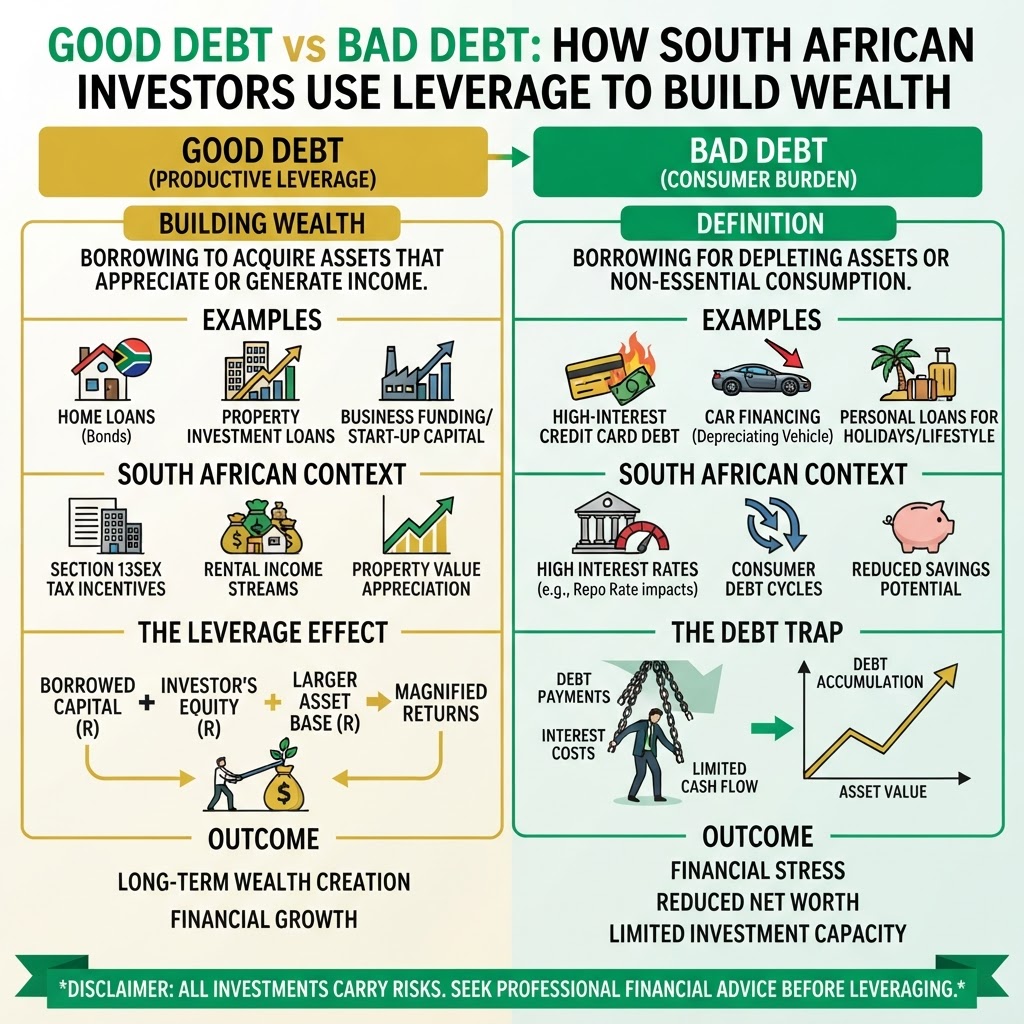
Fig. Key insights from this article — Good Debt vs Bad Debt: How South African Investors Use Leverage to Build Wealth
Step-by-Step: How to Use Good Debt to Start Building Property Wealth
Theory without action is just entertainment. Here is a practical, sequential framework for South African families ready to begin using good debt strategically:
- Clean up your bad debt first. Before applying for investment finance, systematically eliminate high-interest consumer debt. Banks assess your total debt obligations when evaluating bond applications. A clean credit profile with manageable existing commitments dramatically improves your borrowing capacity.
- Build your deposit through disciplined saving. Most South African banks require a minimum 10% deposit for investment properties, though 20–30% gives you significantly better terms and reduces monthly bond repayments. Automate a monthly transfer to a dedicated savings account the day your salary arrives.
- Educate yourself on investment debt management. Understand the difference between personal and investment debt. Learn how to read a cash flow statement for a rental property. Study the areas where you intend to invest. Enrol in structured learning — our property investment strategy guide is an excellent starting point.
- Identify a cash-flow positive property. Not every property makes a good investment. You want a property where the gross rental yield — annual rent divided by purchase price — exceeds your bond interest rate plus operating costs. In many South African markets, this is achievable with careful research.
- Structure your ownership correctly from day one. Buying in your personal name may seem simpler, but it exposes your personal assets to liability and can create significant estate duty complications. Consider a trust or private company structure from the outset. This is the kind of guidance we provide in our flagship resource — Build a Legacy, Touch Freedom (available now for R799).
- Apply for bond finance strategically. Approach multiple lenders. Use a bond originator to access the best rates. Understand what documentation you need and present your financial picture in the most favourable, honest light. Approval is rarely about luck — it is about preparation.
- Manage your investment debt proactively. Once you own the property, treat it like a business. Monitor your expenses, maintain your property, review your rental income annually, and reinvest surplus cash flow to reduce bond principal faster. Every extra rand paid into your bond builds equity you can leverage again.
Real-World Examples: South African Families Using Leverage Wisely
Let me share some anonymised stories from the Mumbi Legacy community — real families who made the decision to stop fearing debt and start using it intelligently.
The Dlamini Family: From One Bond to a Portfolio
Sipho and Naledi Dlamini were a dual-income couple in their mid-thirties with a combined monthly income of R65,000. They owned their primary residence in Midrand with roughly R400,000 in equity. For years, they assumed that because they had a bond, they were already "in debt" and should avoid borrowing more.
After attending a Mumbi Legacy workshop, they restructured their thinking entirely. They used an access bond facility on their primary residence to release R200,000 in equity — funds that had been sitting idle. They used this as a deposit on a two-bedroom sectional title unit in Centurion, which they rented out for R8,500 per month. Their bond repayment on the investment property was R7,200 per month, leaving a positive monthly cash flow of R1,300 — before accounting for capital appreciation.
Within three years, they had refinanced and used the same strategy to acquire a second investment property. Their investment debt management was disciplined, their yields were healthy, and their net worth had grown by over R900,000 — almost entirely funded by strategic good debt.
The Mokoena Sisters: Starting with Less
Not every success story starts with equity. Two sisters in their late twenties pooled their savings — R120,000 between them — and purchased a modest two-bedroom home in a developing area of Limpopo for R480,000. They lived in one room and rented out the second. The rental income offset a significant portion of their bond. In four years, the property had appreciated to R680,000, and they refinanced to fund a second purchase, this time as a pure investment property.
Their story is not extraordinary — it is entirely replicable. What made the difference was knowledge, discipline, and the courage to use good debt intentionally.
Common Mistakes South African Investors Must Avoid
Leverage is a powerful tool — but like any powerful tool, it can cause serious damage when misused. Here are the most common pitfalls I see among new investors:
- Over-leveraging too quickly: Acquiring multiple properties before any one of them is stabilised and generating consistent income is a recipe for cash flow crisis. Build slowly and solidly.
- Ignoring vacancy risk: Your investment property projections must account for periods when the property is untenanted. Budget for at least one month of vacancy per year in your cash flow models.
- Buying in the wrong area: Property leverage only works if the underlying asset appreciates and remains lettable. Location research is non-negotiable. Study rental demand, infrastructure development, and economic activity in any area you consider.
- Mixing personal and investment finances: Keep your investment property finances entirely separate from your household finances. Use a dedicated account for rental income and bond repayments. This protects you legally and makes your accounting far simpler.
- Neglecting legal structure: Many investors buy their first few properties in their personal names and only later realise the estate duty, liability, and tax inefficiencies this creates. Structure correctly from the beginning — it is far easier and cheaper than restructuring later.
- Failing to account for all costs: Bond repayment is not your only expense. Rates, levies, insurance, maintenance, property management fees, and income tax on rental income all reduce your net yield. Model your numbers conservatively and completely.
Your Next Steps: From Knowledge to Legacy
Reading this article is a meaningful first step — but knowledge without action produces nothing. Here is how Mumbi Legacy can support you on your property wealth journey:
- Start with the book: Build a Legacy, Touch Freedom (R799) is your comprehensive guide to building property wealth in South Africa — covering everything from mindset and debt strategy to legal structures and portfolio management. It is the starting point for every serious investor in our community.
- Follow the proven path: Our 6-step Legacy Journey provides a structured, sequential framework for building generational wealth — from financial foundation through to multi-property portfolio and trust structures.
- Go deeper on structures: If you are ready to understand how trusts and company structures can protect and accelerate your property portfolio, our Trust and Structure Masterclass is exactly what you need.
- Get personalised guidance: Every family's situation is different. Book a free consultation with our team and let us help you map out a strategy that fits your specific income, goals, and risk profile.
"Generational wealth is not built by accident. It is built by families who decided — one generation — to stop consuming their income and start investing it. That decision changes everything that comes after it." — Dr. Chomba Chuma
Conclusion: The Legacy You Leave Begins With the Decisions You Make Today
South Africa is a country of extraordinary possibility — and extraordinary inequality. The gap between those who build wealth and those who struggle is not always a gap in income. It is very often a gap in financial education, in structure, and in the courage to think differently about debt and leverage. The families who will define the next generation of South African prosperity are not necessarily those who earn the most. They are those who learn to use what they earn most wisely.
Good debt is not a compromise of your values or a risk to your family's security — when used with knowledge and discipline, it is the very mechanism by which ordinary families build extraordinary legacies. A well-structured bond finance strategy, applied to the right properties in the right locations, managed within the right legal structures, compounds wealth over time in a way that no savings account or salary increase can match alone.
The families I have had the privilege of walking through this journey — from confusion and debt anxiety to clarity and growing property portfolios — all share one defining moment: the moment they decided that their family's financial future was worth the investment of education, strategy, and action. That moment can be today for you.
You do not need to be wealthy to start. You need to start to become wealthy. And Mumbi Legacy is here to walk every step of that journey with you. Get the book, begin the legacy journey, or speak with our team today — because the best time to plant the tree of generational wealth was twenty years ago, and the second best time is right now.