

Rental Income Management: How to Maximize Returns on Your Investment Property
Rental Income South Africa: How to Maximize Returns on Your Investment Property
Let me tell you about a couple I'll call Thabo and Nomsa. They saved for seven years, bought a second property in Midrand, found a tenant within two weeks, and felt like they had finally cracked the code to financial freedom. Twelve months later, they were stressed, cash-negative, and seriously considering selling. Their tenant had stopped paying. The property needed unexpected repairs. They had no lease agreement worth enforcing. And nobody had ever taught them how to actually manage rental income once they had it. This story is more common than most people admit — and it is exactly why I founded Mumbi Legacy. Owning a property is just the beginning. Managing it like a business is where the real wealth is built.
If you are a South African family working hard to create passive income through property, this guide is written specifically for you. We are going to walk through everything — from screening tenants correctly to calculating your true rental yield, protecting your asset, and turning a single investment property into the foundation of a generational legacy.
The Real Challenge Facing South African Property Investors
South Africa's property market offers extraordinary opportunity. According to Property24, rental demand in key urban areas like Johannesburg, Cape Town, and Durban remains consistently strong, particularly in the R6,000 to R15,000 per month price band where middle-income families seek quality accommodation. Yet despite this demand, thousands of landlords are quietly bleeding money every single month.
Why? Because most people were taught how to buy property, not how to run it. They focus entirely on the acquisition — the deposit, the bond, the transfer costs — and give almost no thought to the operational systems that determine whether that property will enrich them or drain them. The result is what I call accidental landlord syndrome: you own the asset, but the asset owns you.
Here are the most painful realities many South African landlords face:
- Tenants who stop paying rent and take months to evict legally
- Properties sitting vacant for two to four months between tenants
- Maintenance costs that were never budgeted for, destroying monthly cash flow
- No formal lease agreements, making legal recourse nearly impossible
- Tax obligations they never knew existed, creating SARS liability
- Rental income that barely covers the bond, with nothing left as true return
The good news is that every single one of these problems is solvable. And solving them begins with a mindset shift: your rental property is a business, and you are the CEO.
Building a Solid Rental Income Strategy From the Ground Up
Before we talk about maximising returns, we need to talk about building the right foundation. A maximised return on a broken foundation is still a loss. The strategy I teach at Mumbi Legacy is built around four pillars: the right property, the right tenant, the right systems, and the right numbers. When all four are aligned, your investment property begins to work for you — not the other way around.
Pillar One: Choosing the Right Property for Rental
Not every property makes a good rental property. Many investors buy what they personally love rather than what the rental market demands. A good rental property is not necessarily beautiful — it is functional, well-located, low-maintenance, and in demand. Look for properties close to public transport, schools, hospitals, and economic activity. A two-bedroom apartment in a secure complex near a major employment hub will almost always outperform a large house in a quiet suburb when it comes to rental yield in South Africa.
Rental yield is the annual rental income divided by the purchase price of the property, expressed as a percentage. A property that costs R800,000 and earns R8,000 per month generates R96,000 per year — a gross rental yield of 12%. In today's market, a gross yield of 8% to 12% is considered healthy. Anything below 6% should raise serious questions about whether the numbers truly work. You can find detailed market data and suburb-level rental trends on Private Property to help you make informed decisions before you buy.
Pillar Two: Understanding Your True Numbers
Gross yield is only part of the picture. Your net rental yield — after all expenses — is what actually determines your wealth-building progress. Too many landlords look at their rent and feel successful without accounting for the full cost of ownership. Your true monthly expenses on a rental property typically include:
- Bond repayment (principal and interest)
- Property rates and taxes
- Levies (for sectional title properties)
- Insurance (building and landlord insurance)
- Property management fees if you use an agent (typically 8% to 12% of monthly rent)
- Maintenance and repairs reserve (budget at least 1% of property value annually)
- Vacancy allowance (budget for one month vacant per year at minimum)
- Tax on rental income (discussed below)
When you subtract all of these from your gross rental income, what remains is your actual return. Run these numbers honestly before you buy, and revisit them every year. Our property investment strategy guide includes a full rental yield calculator to help you do this accurately.
"The investor who knows their numbers sleeps well at night. The investor who ignores them is always one bad month away from a crisis." — Dr. Chomba Chuma
Tenant Screening: The Most Important Decision You Will Make
I cannot overstate this enough: tenant screening is the single highest-leverage activity in property management. A great tenant in your property means predictable income, low maintenance headaches, and a preserved asset. A poor tenant means sleepless nights, legal costs, and potential property damage that can wipe out years of profit in a matter of months.
South Africa's Rental Housing Act and the Prevention of Illegal Eviction Act (PIE Act) strongly protect tenants' rights once they are in occupation. This is not a bad thing — but it does mean that removing a non-paying tenant is a legal process that can take three to six months or longer. This is precisely why getting the right person in from the beginning is non-negotiable.
What a Proper Tenant Screening Process Looks Like
- Application form: Collect full personal details, employment history, current and previous landlord references, and identity documentation.
- Credit check: Run a formal credit check through a reputable bureau. Many property management platforms and agencies offer this service. A poor credit history is a significant red flag.
- Income verification: The widely accepted standard is that a tenant's gross monthly income should be at least three times the monthly rental. Request three months of payslips and recent bank statements.
- Employment verification: Contact the employer directly. Do not rely solely on documents, which can be falsified.
- Reference checks: Call previous landlords. Ask specific questions: Did they pay on time? Did they maintain the property? Would you rent to them again?
- In-person interview: Meet prospective tenants face-to-face. Trust your instincts alongside the data.
The Property Practitioners Regulatory Authority (PPRA) regulates estate agents and property managers in South Africa. If you choose to work with a professional managing agent, ensure they are registered with the PPRA — this protects both you and your tenants.
The Lease Agreement: Your Legal Shield
A verbal agreement is not worth the air it was spoken into. Every tenancy must be governed by a written lease agreement that complies with the Rental Housing Act. Your lease should clearly specify the monthly rental amount, payment date, deposit amount, lease duration, notice periods, maintenance responsibilities, and the consequences of breach. Consider having a property attorney review your standard lease template — it is a once-off cost that can save you enormous expense down the line.
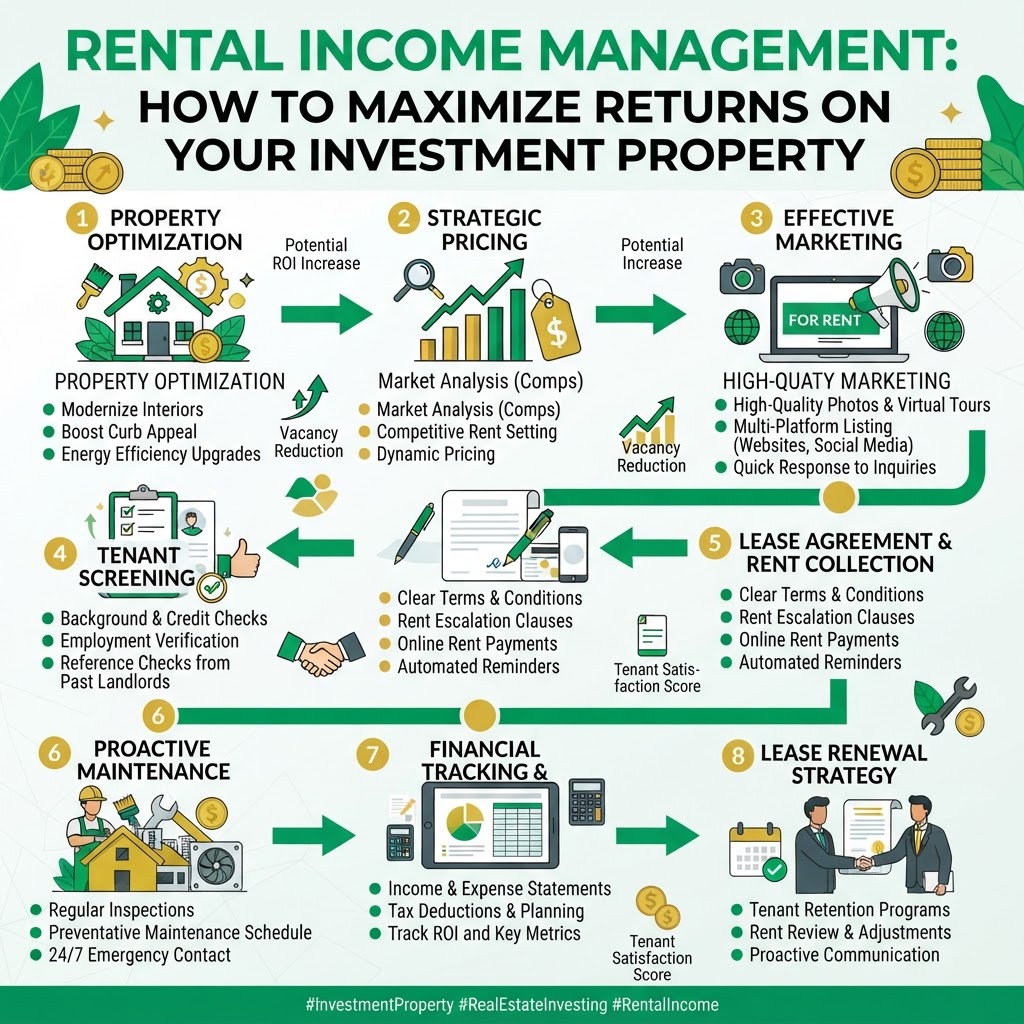
Fig. Key insights from this article — Rental Income Management: How to Maximize Returns on Your Investment Property
Property Management Tips That Protect Your Returns
Once you have the right tenant in place with a solid lease, your focus shifts to ongoing management. Here are the property management tips that make the biggest difference to long-term returns:
Proactive Maintenance Over Reactive Repairs
Reactive maintenance is expensive. A geyser that bursts because it was never serviced costs four to six times more than one that was replaced proactively at the end of its lifespan. Build a maintenance calendar for your property: annual electrical inspections, bi-annual plumbing checks, roof inspections before the rainy season, and regular gutter cleaning. A well-maintained property also retains better tenants — people who pay well tend to want to live in quality spaces.
Rental Escalations: Never Leave Money on the Table
Your lease should include an annual rental escalation clause, typically between 8% and 10% in line with inflation. Many landlords, afraid of losing a good tenant, skip this. This is a costly mistake. Over five years, a landlord who consistently escalates rent at 8% per year will be earning nearly 47% more than they started with. A landlord who kept the rent flat is actually earning less in real terms due to inflation. Have the conversation. A good tenant will understand. And if they leave over a reasonable escalation, they were not the tenant you wanted for the long term anyway.
Tax Compliance on Rental Income
This is an area where many South African landlords are unknowingly non-compliant. Rental income is taxable and must be declared to SARS as part of your personal income tax return. However, the tax code is also generous with deductions: bond interest, rates, insurance, repairs, agent fees, and even depreciation on certain assets can be deducted against your rental income. The key is keeping meticulous records. Visit SARS for the latest guidance on rental income taxation, or speak to a qualified tax practitioner who specialises in property.
Should You Self-Manage or Use an Agent?
This is one of the most common questions I receive. The honest answer is: it depends on your time, proximity, and capacity. A professional managing agent typically charges 8% to 12% of monthly rental income. In exchange, they handle tenant screening, lease administration, maintenance coordination, rent collection, and often legal processes. For a landlord who lives far from their property, works demanding hours, or owns multiple units, this fee is absolutely worth it. For someone hands-on with a single nearby property, self-management can work — provided you invest in the right systems and knowledge.
Real-World Case Studies: What Success Actually Looks Like
Let me share two anonymised examples from families in our Mumbi Legacy community.
Case Study One: The Systematic Landlord
A 38-year-old nurse from Pretoria purchased a two-bedroom apartment in Centurion for R750,000 in 2019. She followed our framework: thorough tenant screening, a professional lease, an 8% annual escalation clause, and a maintenance reserve of R500 per month. By 2024, she was earning R9,200 per month in rent — up from R6,500 at the start. Her bond repayment had not changed. Her monthly cash flow after all expenses was over R2,800. She used that surplus to save a deposit on a second property. Her first investment had effectively paid for her second.
Case Study Two: The Costly Shortcut
A 44-year-old businessman from Durban bought a three-bedroom house as a rental in 2020. He was in a hurry to get a tenant in and skipped the formal screening process. He rented to the first applicant who seemed presentable and paid the deposit in cash. By month four, the tenant had stopped paying. The eviction process — handled without a proper lease — took eight months and cost him over R40,000 in legal fees and lost rental income. He eventually sold the property at a loss, exhausted and disillusioned. The lesson is not that property investment is bad. The lesson is that shortcuts in tenant screening and legal documentation have a price, and that price is always higher than the shortcut seemed to save.
"Generational wealth is not built by accident. It is built by ordinary families making consistently wise decisions over time." — Dr. Chomba Chuma
Common Mistakes South African Landlords Must Avoid
- Emotional pricing: Setting rent based on what you need to cover your costs rather than what the market will bear. Price to the market, then manage your costs.
- Ignoring vacancies: Every vacant month is an emergency. Have a re-letting strategy before your current tenant's lease expires.
- No written lease: This is inexcusable in today's environment. There is no good reason to rent without a compliant written agreement.
- Delaying maintenance: Small problems become large ones. A R500 repair today can prevent a R15,000 emergency next month.
- Mixing rental income with personal finances: Open a dedicated account for your rental income and expenses. This protects your cash flow clarity and makes tax season dramatically simpler.
- Not holding a deposit correctly: Under the Rental Housing Act, deposits must be held in an interest-bearing account. Failure to do so is a legal violation.
- Underinsuring the property: Make sure your building insurance reflects current replacement value, not original purchase price. These are very different numbers in today's construction cost environment.
Your Next Steps: Turning Knowledge Into Wealth
Knowledge without action is just entertainment. If this article has opened your eyes to what is possible — and what is at risk — the next step is to move from awareness to implementation. Here is how Mumbi Legacy can support you on that journey:
- Get the foundational knowledge: Our book Build a Legacy, Touch Freedom — available in our online shop for R799 — gives you the complete framework for building property wealth in South Africa. It covers everything from your first purchase to structuring your portfolio for generational transfer.
- Follow the 6-step system: Our Legacy Journey walks you through the exact six steps we use to help South African families go from single property owners to multi-property wealth builders — step by practical step.
- Protect your wealth structurally: Once your rental portfolio starts generating meaningful income, you need to think about how it is held and how it will pass to the next generation. Our Trust Masterclass teaches you exactly how to use trusts and legal structures to protect and transfer your property wealth.
- Get personalised guidance: Every family's situation is different. Book a free consultation with our team and let us help you map out a strategy specific to your income, goals, and current portfolio.
Conclusion: Your Rental Property Is a Legacy, Not Just an Asset
When Thabo and Nomsa first told me their story, they were ready to give up on property investment entirely. Two years later — with a proper tenant screening process, a compliant lease, a maintenance reserve, and a clear understanding of their numbers — that same property in Midrand is cash flow positive every single month. More importantly, they now think about it differently. It is not just a house with a tenant. It is the first chapter of their family's financial story. It is the asset that will help educate their children. It is the proof that ordinary South African families can build extraordinary wealth — not by luck, not by speculation, but by doing the fundamentals consistently and correctly.
The South African property market, for all its challenges, remains one of the most accessible pathways to passive income and generational wealth available to the middle class. You do not need to be wealthy to start. You need to be willing to learn, to be disciplined, and to build systems that outlast your daily involvement. That is what Mumbi Legacy exists to help you do.
Your legacy does not begin when you die. It begins with the decision you make today. Start with the right knowledge, surround yourself with the right guidance, and take the next step — however small — toward the financial future your family deserves.