

How to Build Passive Income Through Residential Rental Properties
How to Build Passive Income Through Residential Rental Properties in South Africa
Imagine waking up on a Tuesday morning, making yourself a cup of rooibos tea, and checking your phone to see that R8,500 has just landed in your account — while you slept. No alarm clock. No traffic. No boss. Just passive income from residential rental properties quietly working for you in the background. For many South African families, this feels like a distant dream. But I want to tell you today, as someone who has walked this road and helped hundreds of families do the same — it is not a dream. It is a strategy. And it starts with a decision.
Welcome. I'm Dr. Chomba Chuma, founder of Mumbi Legacy, and in this article I'm going to walk you through exactly how to build sustainable passive income in South Africa through residential rental properties. Whether you own one property or none yet, this guide is written for you — the hardworking South African family that is ready to stop trading time for money and start building something that outlives you.
The Promise and the Reality of Passive Income in South Africa
The phrase "passive income" gets thrown around a lot. Cryptocurrency schemes. Network marketing. Online businesses. But there is one vehicle that has quietly built more generational wealth for ordinary families across the world — and right here in South Africa — than almost anything else. That vehicle is residential rental property.
Property is tangible. You can touch it, insure it, leverage it, and pass it on to your children. Unlike stocks or digital assets, a well-located rental home in Gauteng, the Western Cape, or KwaZulu-Natal will almost always find a tenant. South Africa has a massive housing demand gap, with millions of people needing affordable, quality accommodation. That gap is your opportunity.
"Property is not just an investment. It is a declaration that your family's future matters. Every rental unit you own is a chapter in your legacy story." — Dr. Chomba Chuma
According to data from Property24, the South African rental market remains one of the most resilient asset classes, with consistent demand in urban and peri-urban areas even during economic downturns. This resilience is precisely why property cash flow strategies work so well for families seeking long-term financial security.
The Real Challenge South African Families Face
Let me be honest with you. Most South African middle-class families are one retrenchment away from financial crisis. We earn decent salaries, drive decent cars, live in decent homes — but very little of what we earn is working for us after hours. Our money goes to sleep when we do.
Here are the real barriers I hear from families every single week:
- Lack of capital: "I don't have a deposit." Most people believe you need a large lump sum to get started. You don't always.
- Fear of bad tenants: "What if they don't pay?" This is a valid concern — and a manageable one.
- Complexity overwhelm: "I don't understand bonds, rates, and taxes." Neither did I when I started. Education changes everything.
- Time constraints: "I'm too busy to manage a property." Property management can be structured to be largely hands-off.
- Mindset barriers: "Property is for rich people." This is the most dangerous lie of all.
The good news? Every single one of these barriers has a solution. And that solution begins with a clear, structured strategy — which is exactly what we teach through the Mumbi Legacy 6-Step Legacy Journey.
The Foundation: Understanding Residential Rental Income as a Wealth Strategy
Before we dive into the how, let's ground ourselves in the why. Residential rental income builds wealth through multiple streams simultaneously:
1. Monthly Cash Flow
This is the rent you collect every month after paying your bond, rates, levies, insurance, and management fees. Even a modest positive cash flow of R500 to R2,000 per month per property adds up significantly across a portfolio of three to five units over time.
2. Capital Appreciation
South African residential property, despite economic volatility, has historically appreciated in value over the long term. A property bought for R800,000 today in a growth area like Midrand, Bellville, or Umhlanga could be worth R1.4 million in ten years — creating substantial equity without you doing a single thing.
3. Bond Repayment by Your Tenant
Here is one of the most powerful — and most overlooked — concepts in property wealth: your tenant is paying off your bond. Every month their rent covers your mortgage repayment, they are effectively buying you an asset. You own it. They paid for it.
4. Tax Efficiency
The South African Revenue Service (SARS) allows landlords to deduct legitimate rental expenses — including bond interest, maintenance, rates, insurance, and management fees — against rental income. This means your tax liability can be significantly reduced when structured correctly. Always work with a property-savvy accountant to maximise these benefits legally.
5. Leverage
With as little as a 10% deposit, a bank will finance the remaining 90% of a property purchase. No other investment vehicle offers this kind of leverage to ordinary South Africans. You control a R1 million asset with R100,000. That is the power of financial freedom through property.
Step-by-Step: How to Start Generating Rental Property Cash Flow
Now let's get practical. Here is a proven roadmap that I have used personally and guided hundreds of families through:
- Get financially fit first. Before you buy, clean up your credit profile. Check your credit score through bureaus like TransUnion or Experian. Pay down high-interest debt. Banks like FNB and Standard Bank offer competitive home loan products, but they want to see a healthy financial profile. Aim for a credit score above 650.
- Define your investment criteria. Not all properties make good rentals. Focus on location, rental yield, and tenant demand. A simple formula: Annual Rental Income ÷ Purchase Price × 100 = Gross Rental Yield. Aim for a gross yield of at least 8% in South Africa to ensure positive cash flow after costs.
- Choose the right area. Look for areas near employment hubs, schools, transport routes, and amenities. Affordable suburbs in Johannesburg South, East London, Pretoria East, and Cape Town's northern suburbs consistently show strong rental demand. Research vacancy rates through platforms like Private Property.
- Structure the purchase correctly. How you buy matters as much as what you buy. Buying in your personal name, a company, or a trust each has different tax, liability, and estate planning implications. Our Trust Masterclass covers this in depth and has helped many families protect their property portfolios from unnecessary risk and taxation.
- Secure your financing. Apply for pre-approval before you start viewing properties. This gives you clarity on your budget and makes you a credible buyer. Consider using a bond originator — they shop your application across multiple banks at no cost to you.
- Conduct rigorous due diligence. Before signing any offer to purchase, verify the title deed through the Deeds Office, check for outstanding municipal accounts, assess the condition of the property, and review sectional title rules if applicable. Ensure the estate agent is registered with the PPRA.
- Screen tenants properly. A bad tenant will cost you more than a vacant property. Always run a credit check, verify employment and income (look for a gross income of at least 3x the monthly rent), check references, and use a legally compliant lease agreement aligned with the Rental Housing Act.
- Decide on self-management vs. professional management. A reputable managing agent typically charges 8–10% of rental income and handles tenant communication, maintenance, and collections. For busy professionals, this is often worth every cent. True passive income requires systems — and a good property manager is one of your most important systems.
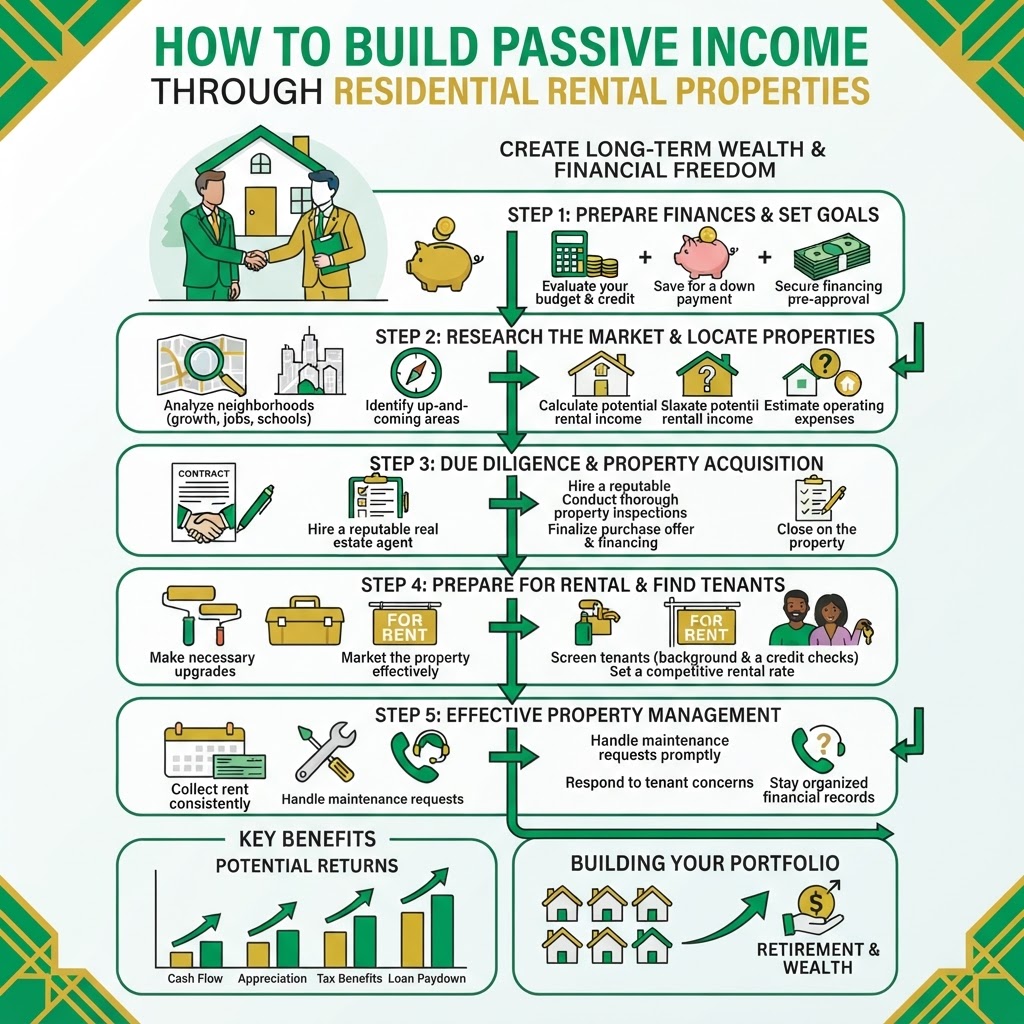
Fig. Key insights from this article — How to Build Passive Income Through Residential Rental Properties
Real-World Stories: Families Who Made It Work
Theory is powerful. But stories change lives. Here are two anonymised case studies from families in the Mumbi Legacy community.
The Dlamini Family — From One Property to Five in Seven Years
Sipho and Zanele Dlamini were a dual-income household in Ekurhuleni earning a combined R85,000 per month. They owned their primary home but had no investment property. In 2017, after attending a Mumbi Legacy workshop, they purchased a two-bedroom townhouse in Germiston for R620,000. The rental income was R6,800 per month; their bond repayment was R5,900. After rates and levies, the property was nearly cash flow neutral — but the tenant was paying down their bond.
By 2020, the property had appreciated to R780,000, giving them R160,000 in equity. They refinanced, used the equity as a deposit, and bought a second property. Then a third. Today, the Dlamini family owns five residential units generating a combined net rental income of R18,400 per month. Sipho recently took early retirement at 52. Their eldest child's university fees are funded entirely by rental income.
Nomvula — A Single Mother Who Started With R40,000
Nomvula is a schoolteacher in Limpopo who saved R40,000 over three years. Most people told her it wasn't enough to invest in property. But she attended our Legacy Journey programme, learned about 100% bond financing through certain bank products, and found a R380,000 property in Polokwane that qualified. Her tenant pays R4,200 per month. Her bond repayment is R3,850. She nets approximately R350 after management fees — not a fortune. But she owns the asset. In five years, she plans to own three more.
"You don't need to start big. You need to start. The first property teaches you more than any book ever will — and it builds equity while you learn." — Dr. Chomba Chuma
Common Mistakes That Kill Your Property Cash Flow
I have seen many families make avoidable mistakes that turn promising investments into financial burdens. Here are the most common ones — and how to avoid them:
- Buying with emotion, not numbers. Falling in love with a property because it's beautiful is the enemy of good investment decisions. Always run the numbers first. If the yield doesn't work, walk away.
- Underestimating costs. Bond repayment is only one expense. Factor in rates and taxes, levies, insurance, maintenance (budget 1% of property value per year), vacancy periods, and management fees. Many new landlords forget these and find themselves cash flow negative.
- Skipping tenant screening. One bad tenant can cost you six to twelve months of lost rent, legal fees, and property damage. The few hours spent on proper screening are always worth it.
- No written lease agreement. A verbal agreement protects no one. Use a comprehensive, legally compliant lease that covers all eventualities including deposit terms, maintenance responsibilities, and termination clauses.
- Buying in the wrong structure. Purchasing property purely in your personal name exposes your entire personal estate to liability and can create devastating estate duty on death. Understanding trusts, companies, and holding structures is not optional — it is essential. Our Trust Masterclass gives you exactly this knowledge.
- Not building a cash reserve. Maintain a reserve fund of at least two to three months' rental income per property for unexpected maintenance, vacancy periods, or tenant disputes. This reserve is what separates resilient investors from stressed ones.
- Ignoring the Rental Housing Act. South Africa's rental legislation is clear. Failing to comply with deposit rules, maintenance obligations, and eviction procedures can land you in the Rental Housing Tribunal — costing you time, money, and stress.
Your Action Plan: The Next 90 Days
Reading this article is valuable. But action is transformational. Here is a clear, focused plan for the next 90 days to move from intention to implementation:
- Days 1–10: Educate yourself. Read our comprehensive Property Investment Strategy Guide and get a copy of Build a Legacy, Touch Freedom — available from our Mumbi Legacy shop for just R799. This book has been the starting point for hundreds of South African families and will give you a complete framework for property wealth building.
- Days 11–20: Assess your financial position. Check your credit score, list all your debts, calculate your disposable income, and determine how much deposit you can realistically accumulate or access through equity in an existing property.
- Days 21–40: Research your target market. Identify two or three areas that meet your investment criteria. Spend time on Property24 and Private Property. Attend show houses. Talk to local managing agents about vacancy rates and rental demand.
- Days 41–60: Get pre-approved. Approach at least two banks or a reputable bond originator. Getting pre-approval costs nothing and gives you enormous clarity and confidence.
- Days 61–80: Build your team. Start identifying a property-savvy attorney, accountant, managing agent, and financial planner. The right team is worth more than any single piece of information.
- Days 81–90: Take decisive action. Make an offer on a property that meets your criteria. Or, if you're not yet ready to buy, enrol in the Mumbi Legacy 6-Step Journey and let us guide you systematically to your first purchase.
And if you would like personalised guidance tailored to your specific family situation, income, and goals — I invite you to book a free consultation with our team. We will sit with you, understand your position, and map out a realistic path forward. No pressure. No sales pitch. Just honest, expert guidance.
Building a Legacy That Outlives You
There is a conversation I want every South African family to have around the dinner table. Not about the economy. Not about load shedding. Not about politics. I want families to ask each other: "What are we building that will still be standing when we are gone?"
Passive income through residential rental properties is not just about financial freedom in your lifetime — though it absolutely delivers that. It is about creating an asset base that your children inherit, that funds their education, that gives them a head start in life that you perhaps never had. It is about breaking cycles of financial scarcity that have held too many South African families back for too long.
Every single property you purchase is a brick in the foundation of your family's legacy. Every tenant that pays rent is contributing, unknowingly, to your children's future. Every year you hold a well-chosen property, the equity grows, the bond reduces, and the wealth compounds.
"The best time to buy your first rental property was ten years ago. The second best time is today. Your legacy cannot wait for perfect conditions — it can only be built by courageous decisions made in imperfect ones." — Dr. Chomba Chuma
South Africa needs more families who think beyond the next salary. More parents who invest in assets, not just experiences. More children who inherit property portfolios, not debt. That future is possible. It is being built right now by ordinary families in our Mumbi Legacy community — teachers, nurses, engineers, entrepreneurs — who decided that enough was enough and took their first step.
You are reading this article for a reason. That reason is bigger than curiosity. It is the beginning of your legacy.
Start today. Get the book at our Mumbi Legacy shop. Begin the 6-Step Legacy Journey. Or simply reach out to us and let's have a conversation. The future of your family is worth one brave decision — and that decision starts right here, right now.
To your legacy,
Dr. Chomba Chuma, MD
Founder, Mumbi Legacy | mumbi.africa