

Mindset Shifts That Separate Wealthy Investors From Middle-Class Earners
Mindset Shifts That Separate Wealthy Investors From Middle-Class Earners in South Africa
Every week, I sit across from South African families who are doing everything "right" — working hard, saving diligently, paying their bond on time — and yet, somehow, the financial freedom mindset they desperately want feels just out of reach. They earn decent salaries. They drive reasonable cars. They send their children to good schools. But when I ask them, "What assets will you leave behind when you're gone?" — the room goes quiet. This article is for every family sitting in that silence. Because the gap between where you are and where you want to be is not primarily a money problem. It is a mindset problem. And mindset, unlike income, can change today.
The Real Reason Most Middle-Class South African Families Never Build Wealth
South Africa has one of the most unequal economies in the world. According to data referenced by the South African government, the wealth gap between the top and bottom earners remains staggering — and the middle class, rather than bridging that gap, often finds itself trapped in what I call the "comfort trap."
The comfort trap looks like this: you earn enough to live comfortably, but not enough to build generational wealth. You spend on lifestyle rather than assets. You see property as a home, not as an investment vehicle. You think of the stock market as gambling. And when someone mentions a trust structure or a holding company, your eyes glaze over because no one ever taught you that this is how wealthy families protect and multiply what they build.
The tragedy is not poverty — it is proximity to wealth without the investor psychology needed to grasp it. Most middle-class earners are one or two mindset shifts away from a completely different financial trajectory. But those shifts require unlearning some very deep-seated beliefs about money, risk, and identity.
"The wealthy don't just have more money. They have a fundamentally different relationship with money — they see it as a tool, not a destination." — Dr. Chomba Chuma, Founder of Mumbi Legacy
Understanding the Wealthy Mindset in South Africa: It Starts With Identity
Before we talk about property portfolios, tax structuring, or passive income streams, we need to talk about identity. Because here is the hard truth: you will never consistently act in ways that contradict who you believe yourself to be.
The middle-class earner identifies as someone who works for money. The wealthy investor in South Africa identifies as someone who makes money work for them. That single identity shift changes everything — the questions you ask, the risks you're willing to take, the advisors you seek out, and the legacy you ultimately leave behind.
From Employee to Owner: The Most Powerful Identity Shift
Many South Africans have been conditioned — through education, culture, and circumstance — to see themselves as employees. The school system rewards compliance. The corporate world rewards loyalty. And for decades, a stable job was the pinnacle of success in many communities. There is honour in honest work, absolutely. But financial freedom requires ownership — of assets, of businesses, of property, of intellectual capital.
When you begin to see yourself as an owner, you start asking different questions. Instead of "How do I get a raise?" you ask, "How do I build a recurring revenue stream?" Instead of "Can I afford this?" you ask, "What return will this generate?" This is the beginning of the abundance mindset that every wealthy investor I've worked with embodies at their core.
From Scarcity to Abundance: Rewiring How You See Opportunity
A scarcity mindset says: "There is not enough for everyone, so I must protect what I have." An abundance mindset says: "There is more than enough, and the right moves will bring more to me." In practical terms, scarcity makes you hoard cash in a low-interest savings account while inflation quietly erodes your purchasing power. Abundance makes you deploy that capital strategically — into a buy-to-let property, a fractional investment, or a business that generates income while you sleep.
According to data from Property24, property values in key South African metros have consistently outperformed inflation over the long term. The families who understood this ten years ago — who pushed past the fear of debt and embraced strategic leverage — are today sitting on portfolios worth multiple times their initial investment. They didn't have more money. They had a different mindset.
The Six Core Mindset Shifts Every Aspiring Investor Must Make
Over years of working with South African families through the Mumbi Legacy 6-Step Legacy Journey, I have identified six recurring mindset shifts that separate those who build wealth from those who merely earn it. Let me walk you through each one with honesty and clarity.
Shift 1: From "Saving Money" to "Deploying Capital"
Saving is virtuous. Saving is necessary. But saving alone will never make you wealthy in an environment where inflation consistently outpaces bank interest rates. Wealthy investors think about capital deployment — where every rand is positioned to generate the maximum possible return over the longest possible time horizon. Your emergency fund is sacred. But everything beyond that should be working for you.
Shift 2: From "Good Debt Is Bad" to "Debt Is a Tool"
Many middle-class South African families were raised to fear all debt equally. The reality is that there is a profound difference between consumer debt (credit cards, vehicle finance on depreciating assets) and investment debt (a bond on a property that generates rental income and appreciates in value). Wealthy investors use the bank's money — strategically and responsibly — to build their portfolios. Understanding how to access home loan financing intelligently is one of the most powerful tools available to aspiring property investors.
Shift 3: From Short-Term Thinking to Legacy Thinking
The middle-class earner asks: "What can I afford this month?" The wealth builder asks: "What am I building for the next generation?" Legacy thinking extends your time horizon dramatically. When you think in decades rather than months, you make dramatically different decisions — about the assets you acquire, the structures you use to protect them, and the values you instil in your children about money.
Shift 4: From Avoiding Risk to Managing Risk
Risk avoidance is not safety — it is a different kind of risk. The risk of inaction. The risk of inflation. The risk of arriving at retirement with insufficient assets. Wealthy investors don't avoid risk — they study it, understand it, and manage it through diversification, legal structures, insurance, and expert guidance. If you'd like a deeper understanding of how to structure your investments strategically, our property investment strategy guide is a powerful place to start.
Shift 5: From Solo to Team
One of the most damaging myths of self-reliance is the idea that you should figure it all out alone. Wealthy families invest in advisors — tax practitioners, conveyancers, property managers, financial planners, and mentors. They understand that the cost of good advice is a fraction of the cost of a bad decision. Building a trusted team is not a luxury — it is a strategy.
Shift 6: From Consumption to Creation
Every rand spent on a luxury today is a rand not compounding in your future. This is not about deprivation — it is about sequence. Wealthy investors delay lifestyle inflation. They build first. They create assets that fund their lifestyle, rather than funding their lifestyle from their salary. The moment your assets pay for your living expenses, you have achieved what most people never do: true financial freedom.
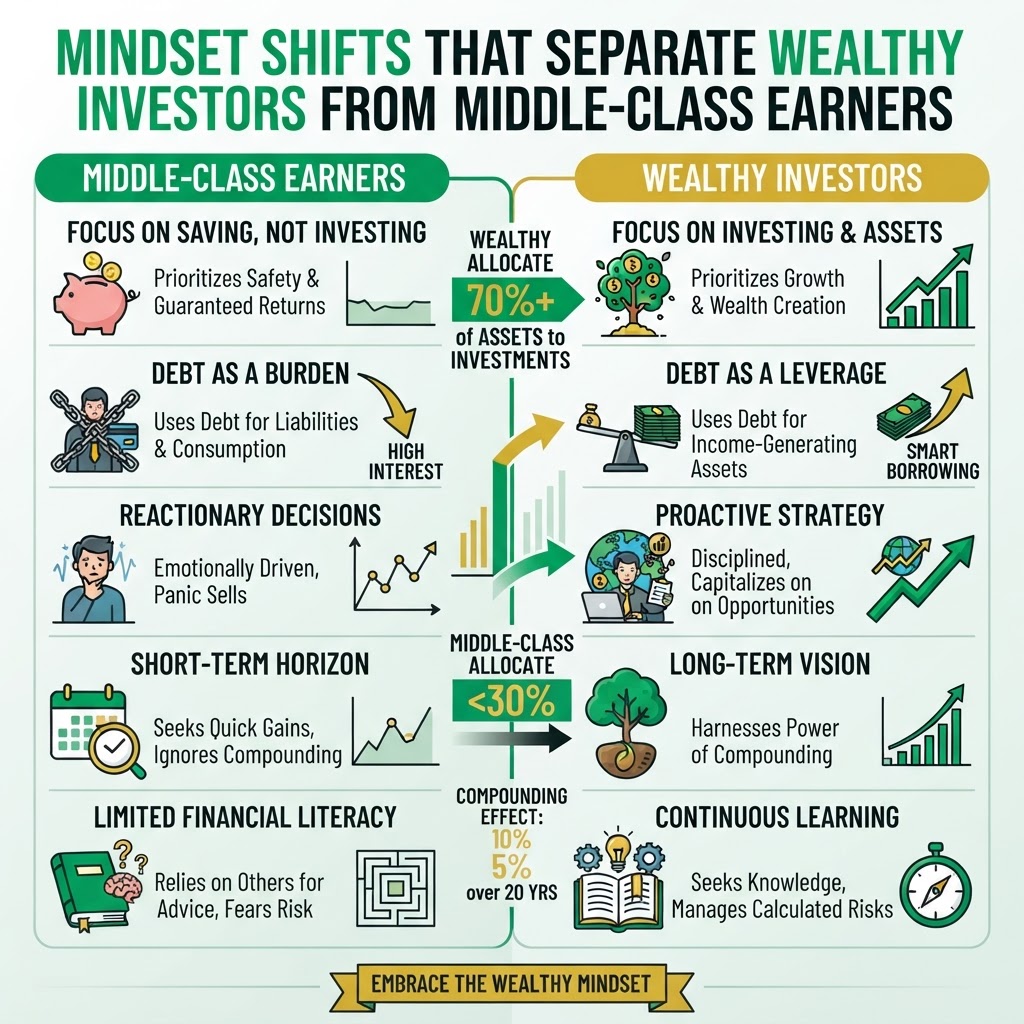
Fig. Key insights from this article — Mindset Shifts That Separate Wealthy Investors From Middle-Class Earners
Real Families, Real Transformations: What Mindset Shifts Look Like in Practice
Let me share some anonymised case studies from families I have worked with through the Mumbi Legacy platform. These are real stories of wealth building habits in action.
The Dlamini Family: From Renting Forever to Building a Portfolio
When Thabo and Nomsa first came to me, they had been renting for eleven years and believed they would "never qualify for a bond." Thabo was a government employee earning a stable income. Nomsa ran a small catering business. Together, they had more than enough qualifying income — they simply didn't know how the system worked. After working through our legacy journey together, they purchased their first buy-to-let in Johannesburg South at R780,000. Within 18 months, they had refinanced based on equity and used that capital as a deposit on a second property. Today, they own three income-producing properties and are on track to leave a portfolio worth over R4 million to their two children. The only thing that changed first was their mindset.
The Mokoena Family: Using a Trust to Protect What They Built
Sipho Mokoena spent fifteen years building a successful business. When he came to us, he was wealthy on paper but completely exposed — all his assets were in his personal name, and a single lawsuit could have wiped everything out. Through our Trust Masterclass, Sipho learned how to restructure his assets into a family trust. He immediately reduced his estate duty exposure significantly and created a framework that will allow his wealth to transfer to his children and grandchildren with minimal tax leakage. The mindset shift? Moving from "I built this" to "We are protecting this — together, across generations."
The Nkosi Sisters: Starting Small, Thinking Big
Lerato and Dineo Nkosi were both teachers in their early thirties when they decided to pool their resources and purchase a sectional title property in Pretoria. They had been told by a family member that property investment was "for rich people." They chose to question that belief. Their first property was modest — but it was theirs. It generated rental income from day one. Two years later, they upgraded their own living situation and kept the original property as a full rental. Their wealth building habits are now deeply ingrained — they track their net worth monthly, they read about property law, and they attend every Mumbi Legacy workshop they can. What began as a small purchase is becoming a lasting legacy.
Common Mistakes That Keep Middle-Class Earners Stuck
Understanding what to do is only half the battle. Knowing what to avoid is equally important. Here are the most common mistakes I see aspirational investors make:
- Waiting for the "perfect time" to invest: The property market will always have risks. Waiting for certainty means waiting forever. The best time to invest was ten years ago. The second best time is now.
- Buying property in their personal name without considering structure: South Africa's SARS tax regulations and estate duty laws make it critical to consider whether a trust or company structure is more appropriate for your situation. Failing to do this can cost your estate enormously.
- Underestimating due diligence: Purchasing a property without understanding the title deed, the levy structure, the rental demand, and the area's growth trajectory is a recipe for loss. Always investigate before you invest.
- Neglecting cash flow: A property that doesn't cover its costs from day one puts pressure on your entire financial life. Cash flow is king — always model your numbers conservatively before committing.
- Going it alone: As I mentioned earlier, the cost of not having the right guidance far exceeds the cost of professional advice. Surround yourself with people who have done what you want to do.
- Confusing net worth with cash flow: You can be asset-rich and cash-flow poor. True financial freedom requires both. Always ask: "Does this asset generate income today?"
- Allowing fear of complexity to paralyse action: Trusts, holding companies, and tax structures sound intimidating. But complexity is manageable when you have the right education and the right team. Don't let unfamiliarity stop you from protecting your family's future.
Your Practical Roadmap: How to Begin Shifting Your Mindset and Your Wealth Today
Knowledge without action is just entertainment. So let me give you a clear, practical starting point for implementing these wealth building habits in your own life.
- Conduct a financial audit: Write down every asset you own, every liability you carry, and every monthly cash flow stream. This is your current financial reality. You cannot change what you cannot clearly see.
- Define your legacy statement: What do you want to leave behind? For whom? By when? A clear legacy statement transforms abstract wealth goals into concrete, emotionally-driven action plans.
- Educate yourself systematically: Start with our book, "Build a Legacy, Touch Freedom" (available for R799) — it is the foundational text for every Mumbi Legacy client, and it will fundamentally shift how you see money, property, and generational wealth.
- Review your legal and tax exposure: If your assets are all in your personal name, speak to a qualified professional about whether a trust or company structure makes sense for your situation. The Property Practitioners Regulatory Authority and SARS resources can help you understand your obligations as a property owner.
- Identify your first — or next — investment property: Research your target area. Understand the rental demand, the vacancy rates, the average yields. Use platforms like Property24 to benchmark current prices. Then make a plan — not a wish.
- Commit to a structured legacy journey: You don't have to figure this out alone. Our 6-Step Legacy Journey walks you through everything — from mindset, to acquisition, to structuring, to generational transfer — with expert guidance at every stage.
The Legacy You Leave Begins With the Mindset You Choose Today
I want to close with something personal. I built Mumbi Legacy because I watched too many brilliant, hardworking South African families arrive at retirement with very little to show for decades of dedication. Not because they were lazy. Not because they lacked intelligence. But because no one had ever sat down with them and said: "You are capable of building something that outlasts you. And here is how."
The wealthy mindset South Africa needs is not an imported one. It is not reserved for those who grew up privileged or who graduated from elite institutions. It is available to every person willing to question their inherited beliefs about money — and replace them with something more powerful, more intentional, and more aligned with the future they actually want to build.
The families in my case studies are not exceptional people. They are people who made an exceptional decision: to stop being passive about their financial future and start being architects of their legacy. That decision is available to you today. This moment. Right now.
"Generational wealth is not built in a single transaction. It is built in a thousand small decisions — each one shaped by the belief that what you do today will matter long after you are gone." — Dr. Chomba Chuma
The middle class in South Africa has the income, the intelligence, and the ambition to build extraordinary legacies. What has been missing — until now — is the roadmap and the mindset to make it real. That is exactly what Mumbi Legacy exists to provide. And it begins with you deciding that your family's story deserves a different ending.
Ready to Start Building Your Legacy? Here Are Your Next Steps
You don't have to have everything figured out before you begin. You just have to begin. Here is how we can walk this journey together:
- Get the book: Order "Build a Legacy, Touch Freedom" for R799 — your foundational guide to property wealth, mindset, and generational impact.
- Start the journey: Explore the 6-Step Legacy Journey and discover exactly where you are on the path to financial freedom — and what your next step should be.
- Master the structures: Enrol in the Trust Masterclass and learn how South Africa's wealthiest families protect and transfer their assets across generations.
- Talk to us: Book your free consultation with the Mumbi Legacy team — because sometimes the most powerful thing you can do is have an honest conversation about where you are and where you want to go.
Your legacy is not a distant dream. It is a decision. Make it today.